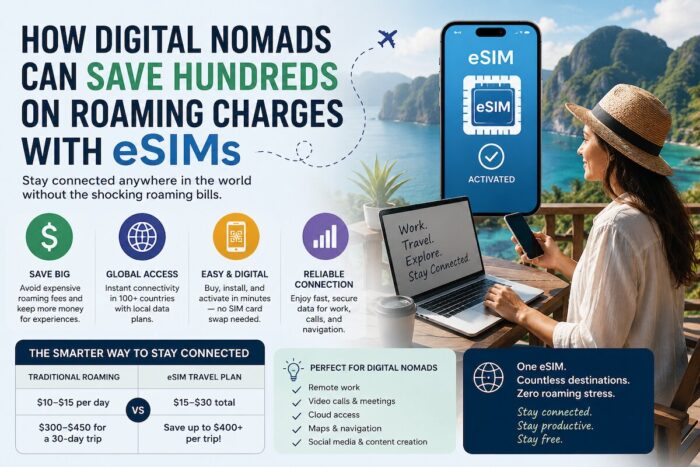

For digital nomads, reliable internet is as important as a passport. Whether you’re attending virtual meetings from a coworking space in Bangkok, managing an online business while exploring Lisbon, uploading travel content from Tokyo, or answering client emails from a beachfront café in Bali, staying connected is essential to maintaining productivity. Unfortunately, international roaming charges remain one of the biggest hidden expenses for remote workers who travel frequently. Many travelers don’t realize how quickly these fees accumulate until they receive a surprisingly expensive phone bill at the end of the month.
How Digital Nomads Can Save Hundreds on Roaming Charges with eSIMs
Fortunately, eSIM technology has revolutionized international connectivity. Instead of paying expensive roaming fees or purchasing a new physical SIM card in each country, digital nomads can activate affordable mobile data plans on their smartphones within minutes. This simple innovation not only saves money but also provides greater flexibility, convenience, and peace of mind throughout every journey. For frequent travelers, switching from traditional roaming to eSIMs can result in annual savings of hundreds—or even thousands—of dollars.
Why International Roaming Can Be a Major Travel Expense
Traditional mobile carriers rely on international roaming agreements with foreign network providers. Whenever your phone connects to one of these partner networks abroad, your home carrier charges premium rates for using another company’s infrastructure. While many providers now offer international roaming packages, these plans often include limited data allowances, daily usage fees, or reduced internet speeds once usage exceeds a certain threshold.
For occasional vacations, these packages may seem acceptable. However, they become extremely costly for digital nomads who spend months traveling across multiple countries each year. A daily roaming pass that costs around USD 10 may not seem expensive at first, but over a month, it can add up to approximately USD 300. Extend that over several months of travel, and the total can easily exceed USD 2,000, or even USD 3,000, annually—money that could instead be spent on accommodations, flights, travel insurance, or experiences.
Beyond the financial cost, traditional roaming often leaves travelers worrying about exceeding their data limits. Many nomads avoid using navigation apps, uploading large files, or joining video conferences because they’re concerned about unexpected charges, ultimately affecting both their productivity and travel experience.
What Is an eSIM and How Does It Work?
An eSIM, or embedded SIM, is a digital version of the traditional SIM card permanently built into many modern smartphones, tablets, and laptops. Rather than inserting a physical SIM card into your device, you simply purchase a mobile data plan online, download a digital SIM profile, and activate it by scanning a QR code or using the provider’s mobile application.
The entire setup process usually takes only a few minutes and can be completed before leaving home. Once activated, the eSIM functions just like a traditional SIM card, allowing your device to connect to local mobile networks in your destination without requiring any physical hardware. This means you can arrive in a new country with internet access already configured and ready to use.
As more smartphone manufacturers adopt eSIM technology, it has become one of the most valuable tools for international travelers, especially those who frequently cross borders.
Why eSIMs Are Ideal for Digital Nomads
Unlike leisure travelers who visit one destination before returning home, digital nomads often move between countries every few weeks or months. Purchasing a local SIM card in every destination can become time-consuming and inconvenient. It usually involves finding a mobile store, presenting identification documents, navigating language barriers, comparing various prepaid plans, and physically replacing your existing SIM card.
An eSIM eliminates nearly all of these inconveniences. Instead of visiting a store after every flight, you can purchase and activate a new mobile data plan entirely online, often before your plane even lands. Many smartphones also allow users to store multiple eSIM profiles simultaneously, making it incredibly easy to switch between different countries or regions without constantly swapping physical SIM cards.
This flexibility allows digital nomads to spend more time exploring their destinations or focusing on work instead of dealing with mobile network logistics.

How Much Money Can Digital Nomads Actually Save?
One of the biggest advantages of using an eSIM is the substantial reduction in communication expenses over time. Imagine a digital nomad who spends three months exploring Southeast Asia, another two months traveling around Europe, two months working remotely from Japan, and several additional months in North America.
Using a traditional roaming plan that costs approximately USD 10 per day would result in nearly USD 3,000 in mobile charges over the course of a year.
By comparison, regional eSIM data plans are significantly more affordable. Depending on the destination and data allowance, travelers may spend only USD 15-40 per month for reliable high-speed mobile internet. Over the course of a year, total connectivity costs could range from USD 300 to USD 500.
That difference represents savings of well over USD 2,000 annually. For freelancers, entrepreneurs, travel bloggers, and remote employees, those savings can help fund future trips, improve work equipment, or simply reduce overall travel expenses.
Enjoy Internet Access the Moment You Land
One of the most stressful moments during international travel is arriving at an unfamiliar airport without internet access. Travelers often need to contact their accommodation, book airport transportation, access digital boarding passes, or simply use navigation apps to reach their destination.
With an eSIM, internet connectivity is available almost immediately after landing. If the mobile data plan is activated before departure or while in transit, your smartphone automatically connects to a supported local network upon arrival. There’s no need to search for airport SIM kiosks, wait in long queues, or rely on unsecured public Wi-Fi networks.
For digital nomads with scheduled meetings shortly after arrival, this instant connectivity can be invaluable.
Keep Your Personal Number Active While Using Affordable Data
Most modern smartphones support Dual SIM functionality, allowing users to operate both a physical SIM card and an eSIM simultaneously.
This feature provides significant advantages for remote workers. Your home SIM card can remain active to receive important verification codes from banks, authentication apps, or financial institutions, while the eSIM handles all mobile data usage abroad. Business contacts, family members, and existing WhatsApp conversations continue using your original number without interruption.
As a result, travelers enjoy affordable internet access without sacrificing communication with clients or access to essential online accounts.
Regional eSIM Plans Make Multi-Country Travel Simple
One of the greatest strengths of eSIM technology is the availability of regional data plans. Rather than purchasing a separate SIM card every time you cross an international border, many providers offer plans that work seamlessly across multiple countries.
For example, a single regional eSIM can provide uninterrupted data service while traveling throughout much of Europe, allowing users to move between France, Germany, Italy, Spain, Portugal, and numerous other destinations without changing mobile plans. Similar regional packages are available for Southeast Asia, North America, Latin America, the Middle East, and other regions.
This seamless connectivity is particularly valuable for digital nomads whose itineraries frequently involve multiple countries over a relatively short period.
Better Control Over Your Travel Budget
One of the most frustrating aspects of international roaming is the uncertainty surrounding your final bill. Unexpected charges often appear weeks after returning home, making it difficult to accurately manage travel expenses.
eSIMs largely eliminate this problem because most providers operate on prepaid pricing. You purchase exactly the amount of data you need, monitor usage through an app, and top up only when necessary. There are no surprise invoices, hidden roaming fees, or excessive overage charges.
For freelancers and entrepreneurs who carefully manage monthly cash flow, this predictability makes budgeting considerably easier.
Easily Switch Networks Whenever Necessary
Mobile network quality varies across countries and even within cities in the same destination. Some providers offer stronger coverage in urban areas, while others perform better in rural regions or islands.
With traditional SIM cards, switching carriers usually requires purchasing a new SIM and replacing the existing one. With eSIM technology, switching providers is far simpler. Travelers can install another eSIM profile in just a few minutes, allowing them to choose the network that best suits their current location.
This flexibility ensures more reliable internet connectivity throughout long-term international travel.
Improved Security for Remote Work
Digital nomads frequently handle confidential business information while traveling. Uploading work files, accessing cloud storage, conducting financial transactions, and participating in video conferences all require stable and secure internet access.
Although public Wi-Fi remains convenient in airports, cafés, hotels, and coworking spaces, these networks are often less secure than mobile data connections. Using an eSIM provides a dedicated cellular connection through established local carriers, reducing reliance on unsecured public networks. When combined with a trusted VPN and two-factor authentication, eSIM connectivity creates a safer environment for remote work wherever your travels take you.
Practical Tips for Maximizing eSIM Savings
To get the greatest value from an eSIM, digital nomads should compare available providers before traveling, paying close attention to coverage, data allowances, and pricing in their destinations. Installing the eSIM before departure ensures immediate connectivity upon arrival, while downloading offline maps and travel documents in advance can further reduce data usage. It’s also wise to monitor consumption through the provider’s mobile app, especially when uploading videos or participating in lengthy video calls.
Keeping your primary SIM active solely for calls and verification messages while assigning all mobile data to the eSIM is another effective strategy for minimizing roaming charges without losing access to important communications.
Final Thoughts
For today’s digital nomads, dependable internet access is no longer optional—it is the foundation of a productive and flexible lifestyle. While traditional international roaming may appear convenient, the long-term costs can quietly consume a significant portion of any travel budget. eSIM technology offers a smarter alternative by providing affordable mobile data, instant activation, seamless connectivity across multiple countries, and the ability to keep your primary phone number active throughout your journey.
Whether you’re working remotely from the vibrant streets of Seoul, a mountain café in Switzerland, a tropical island in the Philippines, or a coworking space in Mexico City, an eSIM lets you stay connected without worrying about roaming fees. Over months or years of international travel, the savings can easily reach hundreds or even thousands of dollars, making an eSIM one of the most valuable investments any digital nomad can make.
Follow and subscribe to OutofTownBlog.com on Facebook , Twitter, Instagram, Pinterest, and YouTube for more Travel-related updates.
Read:

Stacie Harris is a local resident and reporter of the Maple Grove area. Stacie reports on medicine and science for the Maple Grove Report.