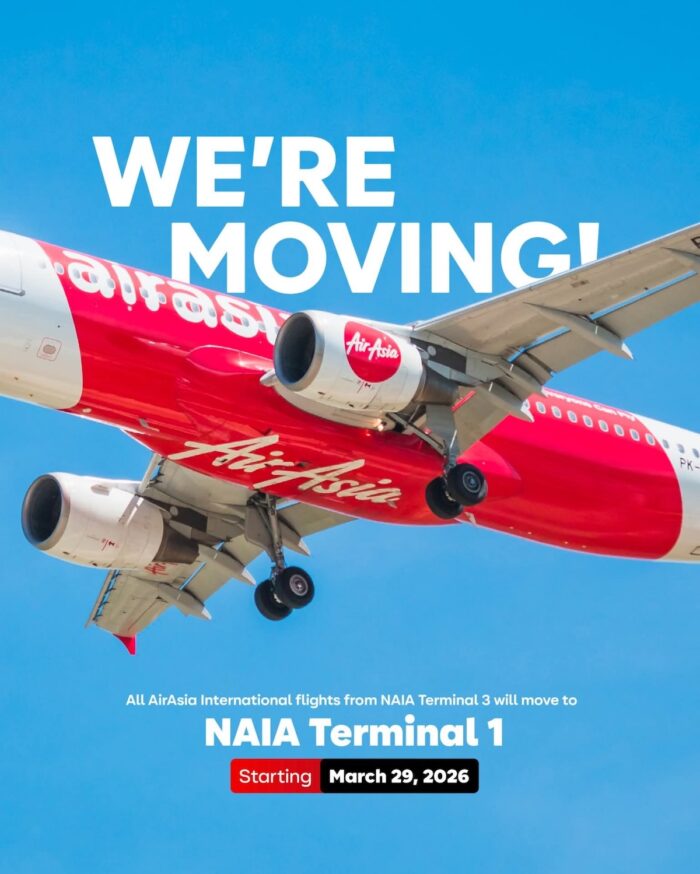

Manila, Philippines — Everything is set for the “Big Switch!” AirAsia Philippines (Z2) and Malaysia AirAsia (AK) are making an exciting move by transferring all their international flights from Ninoy Aquino International Airport (NAIA) Terminal 3 to Terminal 1 starting March 29, 2026. Both airlines are fully prepared to handle the expected increase in travel during the holy week.
AirAsia Philippines Moves International Flights to NAIA Terminal 1 Ahead of Holy Week Travel Rush
The terminal reassignment is part of New NAIA Infrastructure Corporation’s (NNIC) ongoing effort to optimize terminal operations, enhance efficiency, and improve the overall passenger experience at NAIA.
Starting from March 29, all AirAsia Philippines international flights, including check-in, boarding, and baggage claim, will be managed at NAIA Terminal 1.
Guests can proceed to AirAsia Philippines’ designated check-in counters at Terminal 1, located in the Departure area
“We are excited about this transition as it is designed with our guests’ convenience in mind. With our international flights moving to Terminal 1 and our domestic operations currently at Terminal 2, both terminals will now be in closer proximity to each other. This allows guests with connecting flights to enjoy a seamless and efficient transfer experience, with shorter distances and easier access between connections. This also comes at an important time for the Holy Week, ensuring we are ready to support the travel surge during this time.” AirAsia Philippines CEO and President Capt. Suresh Bangah shares.
To guide travelers during the transition, AirAsia Philippines clarifies:
- International flights scheduled before March 29, 2026, will continue to depart from NAIA Terminal 3
- International flights departing on or after March 29, 2026, will check in and depart from NAIA Terminal 1
- International flights arriving in Manila on or after March 29, 2026, will land at NAIA Terminal 1
- Domestic flights to continue operations at NAIA Terminal 2.
For guests with connecting flights or those requiring inter-terminal transfers, NNIC offers a 24-hour free Inter-Terminal Shuttle Bus service connecting Terminals 1, 2, and 3. Shuttle buses operate at approximately 15- to 30-minute intervals, depending on the time of day. Guests are required to present a valid boarding pass or flight itinerary to avail of the service.
NNIC will also provide a special shuttle bus service for misrouted passengers every 15 minutes starting 9pm on 28 March 2026
NNIC Special Shuttle Bus
- Start Date and Time: 2100H, 28 MARCH 2026\Pick-up Points: Terminal 3 (Departure Area)| Bays 7 & 8
- Terminal 1: Bays A12 AND A14
The terminal reassignment applies only to guests with AirAsia Philippines international flights from March 29, 2026, onwards. Affected guests have been informed via registered email and SMS and are advised to regularly verify their contact information and flight details.
Meanwhile, AirAsia Philippines will maintain its domestic flights from NAIA Terminal 2, with no alterations to current operations.
To ensure guests receive uninterrupted service, the airline has increased staff and established 24/7 check-in counters.
The airline recommends that guests arrive at the airport early and review their travel details, including terminal information, to ensure a smooth journey.
AirAsia Philippines continues to collaborate closely with airport authorities to guarantee a smooth transition and provide a more convenient, guest-focused travel experience as it prepares for the ‘Big Switch.’
Follow and subscribe to OutofTownBlog.com on Facebook, Twitter, Instagram, Pinterest, and YouTube for more Travel-related updates.
Read:

Stacie Harris is a local resident and reporter of the Maple Grove area. Stacie reports on medicine and science for the Maple Grove Report.