Apple looks set to overhaul the iPhone Camera app in a way that goes far beyond a typical redesign. iOS 27 will reportedly introduce AI-driven tools, prompting a major rethink of how users interact with photography on the device.
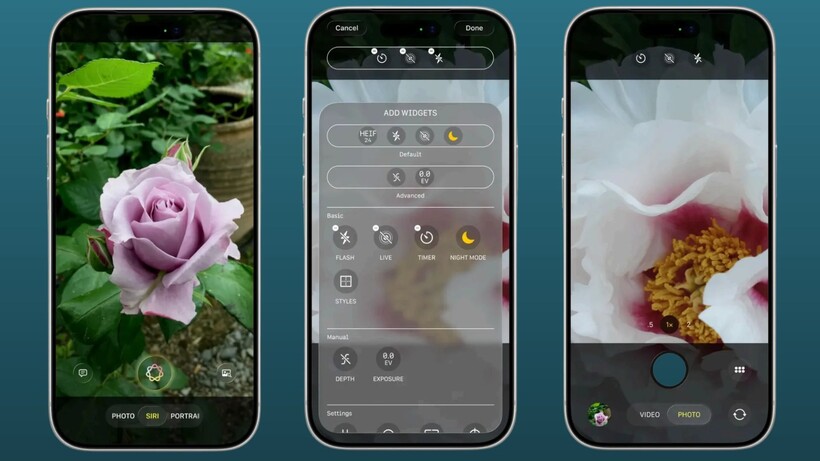
According to Bloomberg, the Camera app update isn’t just a visual refresh. It represents a structural shift, with Apple integrating Siri directly into the camera interface as a dedicated mode. Instead of hiding Siri behind the Camera Control button or system shortcuts, Apple would place it alongside core shooting modes like Photo and Video.
That change alone could make AI-assisted shooting feel more natural and immediate. Apple appears to be positioning it as a gateway into broader “see and respond” experiences. These will likely power future hardware such as smart glasses or other always-on camera devices.
In practical terms, this Siri camera mode replaces the current Visual Intelligence feature. It allows users to point their iPhone at an object and either get an AI analysis or trigger a reverse image search through third-party services like Google. It’s a small step toward turning the camera into an interactive input tool.
Image Credit (Bloomberg)
Advertisement
The company is also reportedly redesigning the interface and moving controls toward the top of the screen, while a new “Add Widgets” panel could let users customise shortcuts more freely. That means swapping in tools like Night mode, depth controls, or timers depending on shooting style.
On the editing side, Apple is testing two new AI tools inside the Photos app: Reframe and Extend. Reframe allows users to adjust composition after a shot is taken, effectively changing perspective without recapturing the image. Extend goes further, using generative AI to fill in missing parts of a photo. For example, it can reconstruct areas that were accidentally cropped out.
There’s also early testing of natural language editing, where users can describe changes using voice or text. Siri would then apply them automatically. However, Bloomberg notes this feature may not arrive in the initial iOS 27 release.
Taken together, these changes point to a broader shift. Apple is gradually turning the iPhone camera experience into something more conversational and AI-assisted, rather than purely manual.
Flip phones are making a comeback, but most US adults aren’t convinced enough to upgrade.
Smartphone brands are trying new phone concepts, like flip and foldable phones, to give us a bigger screen when we want it, while still maintaining the same functionality as the smartphones we’re used to. There’s the Samsung Galaxy Z Fold 7, for instance, and there’s even a rumor that Apple plans to release its first foldable phone.
And if you remember the popular 2000s Motorola Razr, now there are rumors about the Motorola Razr 2026 — it reminds me of my old pink phone. But gone are the days of a basic keypad and a few ringtones. Smartphone brands are adding AI features, such as creating custom emoji, removing background objects from photos, and live translation.
Yet a recent CNET survey says smartphone users aren’t sufficiently impressed by new features and concepts to consider upgrading their phones. Only 12% are motivated by AI integrations and 13% by new phone designs. Instead, price (55%) and longer battery life (52%) are the biggest drivers of their decision to get a new phone.
If most US adults aren’t sold, why are tech brands so adamant? Let’s dive into CNET’s findings and what they mean for the future of smartphones.
The top three motivations for US adult smartphone owners to consider upgrading their devices are price (55%), longer battery life (52%) and more storage (38%). That’s the same top three as last year: In 2025, price was the top motivator (62%), followed by longer battery life (54%) and storage capacity (39%).
Despite AI’s growing presence, only 12% of smartphone owners say AI integrations would motivate them to consider upgrading.
Only 13% of smartphone owners would be motivated to consider upgrading to a new phone concept, such as a foldable or flip phone.
Over half of smartphone owners (58%) experience frustration with their phone’s battery life, and 31% say their phone’s battery doesn’t hold a charge as well as it did when it was new.
Most US adults aren’t motivated by new smartphone features and designs
Smartphone brands, like Samsung and Apple, are building in convenient features, such as a tool to remove unwanted objects from pictures, AI call screening and the ability to draft a message from a prompt. However, CNET found that US adults would consider upgrading for more practical reasons. Over half (55%) of US smartphone users are motivated by price, including 53% of Apple users and 56% of Samsung users.
Yet brands are still exploring new concepts and features, like Apple Intelligence, a built-in AI feature. Then there’s the rumor of a book-style iPhone, potentially followed by a clamshell foldable design. But that’s not what most smartphone owners are after.
Smartphone owners are more convinced by other design and feature factors when deciding on a new phone, such as camera features (27%) and the phone’s display or screen size (22%). Here are the top motivators to consider upgrading for all smartphone users.
Enlarge Image
Zain Awais / CNET
You’ve probably noticed the price of a basic smartphone has increased drastically over the years. Take the iPhone, for example. It was originally $600 for 4GB. But advanced features, the RAM shortage, inflation and tariffs are pushing prices even higher. Now, the baseline iPhone 17 (256 GB) is $800, and the Samsung Galaxy S26 (256 GB) starts at $900.
There’s no way of knowing for sure, but these may be the lowest prices we’ll see on new models for a while, especially as features advance and designs become more complex. So if you’re already in the market for a new phone, you might want to think seriously about pulling the trigger now if you find a good deal.
The top upgrading motivators haven’t changed much over the years
Looking back at CNET’s survey data from 2024 and 2025, and now, people’s motivators for upgrading their phones haven’t changed much. Price, longer battery life and more storage have been top drivers in the past, and despite small dips this year, they’re still key upgrading factors.
Despite design upgrades and new features, smartphone owners are still focused on how much they’re paying and how long they can use their devices without needing a charger. Consumer sentiment about AI integrations dropped hard from 2024 to 2025, but it has edged up slightly in 2026. And smartphone owners aren’t as easily persuaded by phone color or the phone being thinner, either.
Even with these nice-to-have capabilities, smartphone owners are looking at the basics. That includes practical features like battery life and more storage to hold their many important files, photos and apps.
Most smartphone owners want better battery life
Taking a closer look at smartphone users’ hope for longer battery life in a new phone, over half (58%) are frustrated with their current phone’s battery life. Roughly one in three (31%) say their phone doesn’t hold a charge.
The reality is, battery life will decline the longer you have your phone, so you may find your phone’s battery charge doesn’t last as long as it used to. Even though you can replace your phone’s battery, most phone batteries have a lifespan of two to three years before they start degrading.
CNET Director of Editorial Content Patrick Holland examined battery life tests on over 35 current smartphones. And it’s not just iPhones that pack impressive batteries.
Based on CNET’s lab testing, the $1,200 iPhone 17 Pro Max had the best overall battery life, with a 5,088-mAh capacity. Another top performer was the $900 OnePlus 15, with a 7,300-mAh battery.
If you’re looking for a phone with better battery life, consider one with a silicon-carbon battery to increase capacity without requiring a larger phone. The OnePlus 15, Poco F7 Ultra, OnePlus 13R and OnePlus 15R all feature silicon-carbon batteries with large capacities and all performed well in Holland’s testing. Keep in mind that other factors can impact your battery life, like your carrier’s signal, software efficiency and processor.
Methodology
CNET commissioned YouGov Plc to conduct the survey. All figures, unless otherwise stated, are from YouGov Plc. The total sample comprised 2,486 adults, of whom 2,407 owned a smartphone. Fieldwork was undertaken from April 29 to May 1, 2026. The survey was carried out online. The figures have been weighted and are representative of all US adults (aged 18 plus).
To provide the best experiences, we use technologies like cookies to store and/or access device information. Consenting to these technologies will allow us to process data such as browsing behavior or unique IDs on this site. Not consenting or withdrawing consent, may adversely affect certain features and functions.
Functional
Always active
The technical storage or access is strictly necessary for the legitimate purpose of enabling the use of a specific service explicitly requested by the subscriber or user, or for the sole purpose of carrying out the transmission of a communication over an electronic communications network.
Preferences
The technical storage or access is necessary for the legitimate purpose of storing preferences that are not requested by the subscriber or user.
Statistics
The technical storage or access that is used exclusively for statistical purposes.The technical storage or access that is used exclusively for anonymous statistical purposes. Without a subpoena, voluntary compliance on the part of your Internet Service Provider, or additional records from a third party, information stored or retrieved for this purpose alone cannot usually be used to identify you.
Marketing
The technical storage or access is required to create user profiles to send advertising, or to track the user on a website or across several websites for similar marketing purposes.