

Pros
- Compact design
- The convenience of a short-throw lens
- Built-in streaming
Cons
- Nothing bad, but nothing amazing either
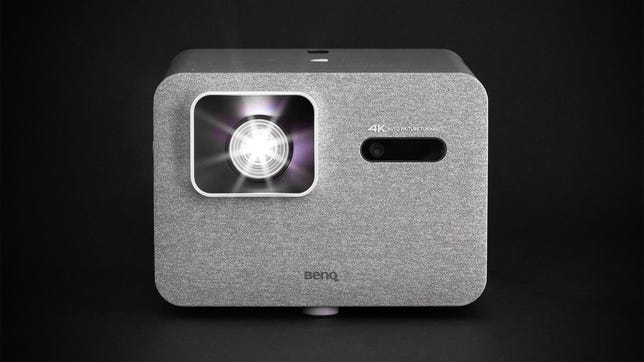
The BenQ TK705STi is a short-throw, Google TV-enabled projector, perfect for small rooms that can’t fit a traditional model. Overall image quality is very good. Brightness is… good. It’s in line with similarly priced competitors, though not class-leading.
The silver and grey design is either classy or mundane, depending on your perspective, but at the very least it’s non-obtrusive, just like its size.
While its objective performance isn’t quite as good as some recent projectors, the image it creates is more than the sum of its parts. It’s pleasing and lifelike, with none of the potential artifacts of its laser-powered brethren.
Also read: Best Projectors of 2026
Specs and such
- Resolution: 4K
- Lumens spec: 3,000 (ANSI)
- Zoom: No
- Lens shift: No
- Light source type and life: LED, 20,000 hours (30,000 ECO mode)
The TK705STi is a short-throw projector, which means it sits farther from the screen/wall than an ultra-short throw projector, but still closer than a traditional or long-throw projector. Make sense? Basically, to create a 100-inch image the TK705STi needs to be a little less than 6 feet away from the screen.
BenQ says the projected image has 3,000 ANSI lumens of brightness, but that’s pretty far from what I measured. In its most accurate mode I got around 1,280 lumens. In its less-accurate Bright mode I got 1,786. These are all reasonable numbers, more than enough to create a bright image and similar to what you’ll find in the price range. But in the projector brightness arms race, these are gentle moonbeams compared to the blinding supernovas of recent Anker, Xgimi and Valerion models. Those are all more expensive, to be fair.
Light output plays double duty with projectors, in that you want a bright image because it’s pleasing to watch, but it also determines the size of the image you can create. That said, it’s fair to question how much light most people need. No projector can compete with too much ambient light and all look better without it. So after a certain point, its brightness is a bit superfluous.
The lens in the TK705STi is fixed, no zoom or lens shift. Behind it all is an LED light source that’s rated for, essentially, the life of the projector (around 30,000 hours).
Connections
- HDMI inputs: 2
- USB port: 1 USB-A, 1 USB-C
- Audio output: 3.5mm analog, eARC
- Internet: Wi-Fi 2.4GHz/5GHz
- Streaming interface: Google TV
- Control: 12v trigger
- Remote: Not backlit
The TK705STi has a fairly standard collection of connections for a modern projector. There’s Google TV streaming, HDMI inputs and even Bluetooth if you want to use it as a speaker. Those speakers share 8 watts of power and, as with most projectors, it’s better off paired with separate speakers and a receiver or a soundbar.
In a nod to traditional home theaters, there’s also a 12-volt trigger port for powering on via a home automation system.
Picture quality
I haven’t reviewed any short throw projectors lately, so I didn’t have any on hand to directly compare to the TK705STi. The ghost of the BenQ X500i, one of my favorites of the last few years, looms large, however, as you’ll see. I’ve included the performance of some similarly priced non-short throw models, but even that’s a bit misleading. Brands such as Xgimi and JMGO drastically drop the prices of their projectors after they’ve been available for a few months. So it’s arguable as to what’s exactly fair to compare the BenQ to in a review, a projector at its full retail price, or one at a discounted, but similar price. I’ll cast a wide net so you can get an idea where the 705STi’s performance sits in comparison.
I spoke about overall brightness above, and to put the TK705STi’s 1,280 lumens (or 1,786 in Bright mode) in perspective it’s roughly the same as the Xgimi Horizon S Max (1,300) which cost a bit more when new, but is slightly less now. Interestingly, Xgimi claimed 3,100 lumens for that projector. So they’re both off by similar amounts. The BenQ’s light output is also close to the JMGO N1S Pro (1,198), which was also more expensive when new. So while there are some projectors that offer even brighter images, the bonkers Xgimi Horizon 20 Max (2,699) comes to mind, they are all currently more expensive. Regardless, 1,280 lumens is more than enough to create a bright image on a 100-inch screen.
The BenQ’s contrast is fine, though not a standout. I measured 545:1. This is below the average of all the projectors I’ve reviewed for CNET, but spot on the median. Much like brightness, its contrast is in line with similarly priced 4K projectors, which is acceptable for the money. Yet, this does mean the image isn’t quite as punchy as some more expensive models, with shadows and black letterbox bars more grey than actually black.
Risking a bit of repetition, color is also good, though not as accurate as some. Overall colors are realistic and pleasing, with accurate-looking skin tones. It’s similarly accurate as the like-priced projectors mentioned above, but less accurate than BenQ’s W4100i and GP520. This is usually an aspect of projector performance BenQ does well, so I was surprised that it was merely average here.
That all said, the end result just sort of works. While “everything is good, but not great” doesn’t sound like praise, it also means that the TK705STi doesn’t do anything wrong, which is where a lot of the competition gets tripped up. A lot of its competitors will mess up how they handle color, or have laser artifacts (more on those in a moment), and overall create an image that technically measures well, but is less appealing to watch than the TK705STi’s. There is a naturalness to the BenQ’s image that’s easy on the eyes, even if the projector’s headline specs aren’t remarkable.
The competition
Modern projectors use two main technologies to create light: LEDs (such as with this BenQ) and lasers. Some models use a combination of both, or add a phosphor, and arguably all lasers are LEDs, but for simplicity these are the main categories. In our testing, most projectors using laser light sources are brighter, and can have deeper colors. A lot of that can depend on the model and how it’s designed, but for this discussion that’s the main “pro” of lasers.
The “cons” are twofold: speckle and chromatic aberrations. Speckle is a sort of shiny grain added to the image, sort of like a sparkle texture or glitter. Depending on how big the image is, and how close you’re sitting, you may not notice this artifact. The other aspect, chromatic aberrations, are only an issue for certain people with glasses, especially high index lenses. Again, depending how close you’re sitting, light coming in to the lenses not in the center of the lens gets bent differently. The result is a split of certain wavelengths, so objects, especially white objects like text on a dark background, will look like they have colored halos. As someone who wears glasses and sits fairly close to a large screen, I personally wouldn’t choose a three-laser projector in my theater.
Instead, I would choose something like BenQ’s own X500i, which is also an LED projector. I reviewed the X500i in late 2024, and I still think about it. It created one of the best overall images of any projector I’ve reviewed in the last few years. That was due in no small part to a fantastic contrast ratio of 1,990:1, one of the best I’ve measured in a reasonably priced 4K projector. Paired with some of the most accurate color of any recent projector, it was gorgeous. Due to my theater’s layout I couldn’t mount it, otherwise I would have bought it. It went back to BenQ over a year ago, but my measurements bolster my memory of it. No other sub-$2,000 4K projector comes close in terms of contrast and accuracy.
However, the X500i is not nearly as bright as this TK705STi, 30 to 50% dimmer depending on the mode. If your goal is the biggest, brightest screen possible, the X500i isn’t that. Its 911-as-measured lumens is plenty for a 100-inch image, however, and looks great doing it.
Little black… uh, grey box
The TK705STi is the consummate “B” student: good, but not great. It’s not a standout in any specific way, but it’s solid all-around and doesn’t do anything poorly. It might not be the brightest model you can buy, but the image it creates is natural and pleasing to watch. This is especially true if you wear glasses, as mentioned above. For smaller, or narrower, spaces, it’s a great option. Personally, I’d get the bigger, and currently cheaper, X500i which creates a tremendous image. That projector is not as bright, however, so you can’t get as big an image as you can with the TK705STi. There are always tradeoffs, but I think that the X500i is wirth it.
Related to the TK705STi is the TK705i, the longer-throw version. I hesitate to call it “long throw” since most BenQ projectors still need less than 10-feet to create a 100-inch image. The TK705i can sit between 87.2 and 113.3 inches (around 7.3 to 9.5 feet) for that size image, while the TK705STi only needs 69.7 (5.8 feet). While they share similar specs the lenses are different so their actual performance is likely somewhat different.

Stephan is the sports journalist for the Maple Grove Report.