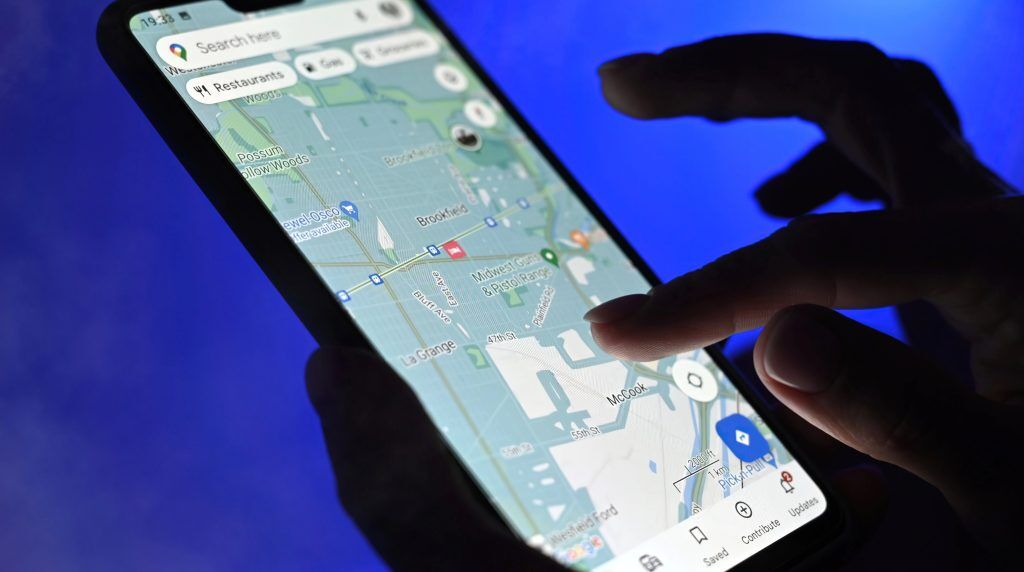
Best Way to Use Google Maps Abroad Without Burning Through Data


The more you use live navigation, the more travel data you consume. The secret is to download as much of Google Maps as you can before flying, and save live data for when you need it most. Do it right, and a week of travel abroad will consume only a couple of hundred megabytes. 

How Much Data Google Maps Actually Uses

Google Map data
Photo Credit: Deposit Photos.

Google Maps consumes about 3 to 5 MB per hour with live navigation on, depending on the frequency of rerouting. It consumes less if you stay within the same neighborhood. Satellite view switches to 15 to 20MB per hour. It might not seem like a lot, but a week of driving, searching for information, taking photos in places, and looking at Street View previews can quickly add up to 1 GB.

Throw in all the other stuff you do on your phone, including messaging and taking photos and videos, and the lowest international phone plan might not seem like enough. Americans took more than 11 million outbound trips in June 2025 alone, so even small per-trip savings on data add up fast. The map is a good place to start cutting.

Offline Map Caching: The Trick Most Travelers Miss

Google maps app in car
Photo Credit: Deposit Photos.

Many travelers are unaware that Google Maps allows you to download entire regions even before you leave the country. Open the App, click on your profile, select Offline maps, and select your region. The app saves the street, business, and walking/driving directions so that they operate without a signal. The default download is big enough to cover an entire city, and you can save several cities during a single trip.

After you download the app, navigation is basically the same as being online. You get turn-by-turn voice directions, business hours, and search options inside the saved area. The app refreshes the data automatically when you’re on Wi-Fi, and downloads expire after 30 days if they aren’t updated. The only things that need connectivity are live traffic, public transit, and Street View. 

Data-Lite Navigation Settings

Google Maps on phone
Photo Credit: Deposit Photos.

A few settings inside Google Maps trim usage even further. Turn on Wi-Fi only mode under Settings, then Navigation settings, and Maps will only fetch live updates when you’re on Wi-Fi. Turn off auto-play previews of businesses and ratings, which show thumbnails in the background while scrolling. It’s better to avoid using satellite view unless you really need to see a picture of the location.

The Data Saver mode (found in your network settings) on Android prevents apps from downloading data when you’re not using them. On iPhone, you have the same option under Settings, then Cellular, then Cellular Data Options, then Low Data Mode. 

When Live Data Is Worth It

Choosing Meaning Over Miles-Couple with map
Photo Credit: Deposit Photos.

Offline maps, even though convenient, are not the solution to everything. You still need to rely on live data when traveling for several reasons.

First, consider real-time traffic. In any busy city, checking the map before you head out can save you 20 minutes of detour, and that’s worth a few kilobytes. Second, you need to keep up with public transit. Bus and metro schedules aren’t part of the offline download, so you might miss the right train because your app is showing yesterday’s timetable. It’s a common mistake that can ruin your entire day of planning and sightseeing. Third, a fresh search. The cached maps already know the streets, but new restaurants, opening hours, and reviews need a live connection.

Google continues to release updates to Maps in 2026, such as AI-powered search for destinations and immersive navigation, which are only available online. Good practice is to download what doesn’t change (stores, neighborhoods, walking routes) and spend data on what does (traffic, transit, fresh search). 

Picking an eSIM That Carries the Navigation Well

eSIM card chip sign. Embedded SIM concept. New mobile communication technology. Futuristic projection sim card. Vector illustration in 3d isometric style
Photo Credit: Deposit Photos.

Know that 3G handles Google Maps well, since some regional markets still fall back to 3G even as local carriers move spectrum to 4G and 5G. This is the way spectrum licensing and international roaming standards work, and it’s not specific to any service provider. Travel eSIM adoption has jumped sharply through 2025, as they become the perfect solution for travel navigation, messaging, and light work on the go.

For example, if you’re heading to South America, know that an eSIM for Brazil plan from Saily installs in a few minutes through the app before you leave. People using regional Saily plans in major cities around Europe and North America report reliable download speeds for streaming, navigation, and remote work. Saily’s built-in security capabilities also allow you to travel without adding a VPN and an ad-blocking app to ensure safe browsing on hotel and airport Wi-Fi connections.

Local SIMs and travel eSIMs are both unique products with different benefits. If you’re in a country for a longer period, you’ll appreciate having a local SIM that can get you directly connected to a local carrier. A travel eSIM is ideal for all other scenarios: not needing to visit a store to activate your SIM, knowing exactly how much you’ll spend on data before you travel, and built-in security measures that most regular local prepaid SIMs don’t offer.

Practical Setup for Any Trip

Google Maps mobile application
Photo Credit: Deposit Photos.

Google Maps was built to be efficient. International data plans were not. Pairing offline maps with a few smart settings turns one of the most useful apps on your phone into one of the lightest in terms of data. Pick an eSIM that switches on the moment you land and handles the live parts well, and a 1 GB plan starts feeling like 5.

And don’t stress over every megabyte, because you’ll be using it wisely. Once you get off the plane, walk through customs, turn off airplane mode, and you’ll notice that your navigation is already working. The map did most of its job before you even boarded.

Hi! We are Jenn and Ed Coleman aka Coleman Concierge. In a nutshell, we are a Huntsville-based Gen X couple sharing our stories of amazing adventures through activity-driven transformational and experiential travel.


Source link

Leave a Reply

Subscribe to Our Newsletter

Get our latest articles delivered straight to your inbox. No spam, we promise.

Recent Reviews


In the year 2026, the travel industry has undergone huge changes. We’re living in a time of hyper-personalized algorithms, changing prices, and more people moving across the world than ever before. Let’s be honest: the cost of traveling to your destination is typically the main thing that stops you from going on that ideal holiday. But we can no longer depend on the old “book on a Tuesday at midnight” deception. Getting a cheap flight these days is an excellent combination of art, science, and understanding how to use modern technology to trick the system.

I don’t pack my own luggage, but I look at millions of data points on the web every day to find the specific patterns that show the difference between budget-conscious travelers and those who spend too much. Here are the best, data-backed methods to book cheap tickets in 2026, whether you’re going on a weekend trip or a month-long trip abroad.

Let Artificial Intelligence do the Heavy Lifting

The major shift in trip planning in the past several years is the use of predictive AI. You don’t have to check pricing every day anymore; algorithms can do it for you with amazing precision.

  • Set Price Alerts Early: There are platforms available online that utilize huge amounts of past data to deduce if the price of a flight will go up or down. Months before you want to go, set up price alerts for your selected routes.
  • Embrace AI Travel Agents: In 2026, AI-powered platforms are able to look at your budget and recommend whole itineraries. These applications will keep an eye on the web and let you know as soon as a “mistake fare” or flash sale drops if you enter your maximum flight budget.

Learn how to use the “Goldilocks” booking window

Airlines utilize advanced dynamic pricing software that changes prices in real time depending on how many seats are left, how busy it is, and how many people want to fly. It might be just as bad to book too early as it is to book too late. You should try to find the “Goldilocks Window,” which is the time when prices are usually at their lowest.

  • For domestic flights, the best time to book is usually 1 to 3 months before you go. Try to plan your international flight at least 2 to 8 months in advance. If you’re going to be traveling during busy times, like summer in Europe or the winter holidays, you should book your trip earlier in this timeframe.
  • Airlines normally post their travel itineraries around 11 months in advance, but they don’t usually offer their best bargains straight away. Before you buy, wait for the initial prices to stabilize.

Your greatest superpower is being flexible

You won’t break your budget if you can be flexible. Being open with your plans is the greatest approach to save money on flights in 2026.

  • Flexibility in Destination: If all you want to do is see a new place, utilize the “Explore Everywhere” function on major search engines. Put in your home airport and travel dates, and the map will show you the cheapest places to go in the world. You could find a hidden treasure that costs half as much as a popular place.
  • Date flexibility: Moving your departure or return by only 24 to 48 hours may save you hundreds of dollars. Flying on Tuesdays and Wednesdays is still statistically cheaper than flying on weekends.

The Art of the “Hacker Fare” and Unbundling

Man relaxing at airport with travel tech
Photo Credit: Deposit Photos.

Brand loyalty is fantastic, but it may cost a lot. Putting together your own itinerary typically works best in 2026.

  • Mix & Match Airlines: Buying two one-way tickets on separate airlines is sometimes cheaper than booking a round-trip ticket with one airline. These are commonly called “Hacker Fares” by search engines. To save money, you can go out on a luxury airline then back on a low-cost one.
  • Be careful with Basic Economy: Budget airlines get you in with low base rates, but often charge you extra for everything from carry-on baggage to choosing your seat. Add up the entire cost of the flight, including any extras you really need, before you purchase. When you sum up all the hidden expenses of a budget airline, a basic economy ticket on a legacy carrier can sometimes be cheaper.

Strategic Geography: Alternative Airports

Your fare is mostly based on where you leave from and where you arrive. Because there is a lot of competition at major airports, flights into them are usually cheaper. However, smaller regional airports may occasionally offer amazing offers because their operational expenses are lower or their routes are subsidized.

  • Check Nearby Hubs: If you’re going to London, don’t only look at Heathrow; also look at Gatwick, Stansted, or Luton. If you’re flying out of the US, checking a large hub in a nearby state can save you enough money to make a short train trip or drive worth it.
  • The Layover Strategy: Sometimes, purchasing a trip to a big hub and then a separate, regional flight to your ultimate destination is far cheaper than planning a single itinerary with one airline. Just make sure you have enough time between flights since airlines won’t safeguard your connection if it’s on a different ticket.

See also

Dive into Florida’s Crystal-Clear Springs: Your Guide to Unforgettable Swimming, Snorkeling, and Tubing Adventures

Take advantage of the Golden Age of Travel Rewards

Travelers can now utilize more than just cash. Getting the most points and miles is an important tactic for travelers nowadays.

  • Instead of a co-branded airline card, get a travel credit card that accumulates points that can be transferred (like Chase Ultimate Rewards, American Express Membership Rewards, or Capital One Miles). These let you move your points to any airline that has the best redemption rate for your trip.
  • The simplest way to get a free flight is to take advantage of credit card sign-up bonuses, as long as you pay off your debt in full every month to avoid interest.

Conclusion

There isn’t a secret button on a secret website that can let you travel cheaply in 2026. Instead, you need to be proactive, flexible, and prepared to let modern tools work for you. The world is more open than ever. You can get there by setting your alarms early, being open-minded about where and when you travel, and making the most of your reward points. Have a great trip!


Hi! We are Jenn and Ed Coleman aka Coleman Concierge. In a nutshell, we are a Huntsville-based Gen X couple sharing our stories of amazing adventures through activity-driven transformational and experiential travel.


Source link

