Bots Now Outnumber Humans on the Internet. Here’s What That Actually Means


The internet was built on the assumption that there’s a human being on the other side of every screen. That assumption no longer holds. Cloudflare’s Radar tool now shows agentic AI bots generating 57.4% of web requests globally, with humans accounting for just 42.6%, a milestone that arrived well ahead of even the most aggressive projections. Cloudflare CEO Matthew Prince had predicted bots would surpass humans by 2027. It happened this month.

“Welp, that happened faster than I predicted,” Cloudflare CEO Matthew Prince said in a post on X on Wednesday. “Thought it would be [at the] end of 2027, then early 2027, but agentic traffic [is] growing so fast that bots have now passed human traffic online for the first time in the Internet’s history.”

He backed up his claim with a post to Cloudflare Radar, the company’s internet measurement system, showing that agentic bot usage is up to 57.4% of total traffic, while human traffic has dropped to 42.6%. 

Prince said in another post that the data is “a bit messy” but “clearly on the other side now,” indicating this is a trend that isn’t going away. 

A graph showing agentic bot usage versus human usage

Agentic AI traffic now exceeds that of real human users.

Cloudflare

These are not the bots you’re looking for

It is important to clarify what Prince refers to regarding web traffic. Regular bots, like search engine scrapers and web performance tools, eclipsed human internet traffic well over a decade ago. There are reports that those same bots exceeded human traffic on small websites even sooner, which led to a lot of small website owners exceeding their hosting usage limits faster than expected. 

The agentic bots Prince is referring to are the systems that search the internet on your behalf when you ask an AI chatbot a question and return the results. Those searches and visits generate real web traffic, even if it doesn’t look that way from your AI chat window. The data means that more AI agents are visiting these webpages than real humans. Humans still physically engage with content more than AI does, but AI visits webpages more often. 

A graph showing Gibraltar's AI Internet usage between humans and bots

The compact British Overseas Territory of Gibraltar has some of the highest agentic AI web traffic usage of any country on Earth. 

Cloudflare

Digging into the data

The above numbers reflect worldwide traffic patterns, but they differ by region. North America as a whole skews more toward bot usage, with bots accounting for 68.6% of activity and humans 31.4%. If you zoom in on the American Midwestthe trend reverses, with humans leading at 54.5% versus 45.5% for bots. The trend is consistent across regions: Broader areas tend to be dominated by agentic bot traffic, while smaller areas within those regions often still show higher levels of human usage.

There are some outliers as well. During peak hours, up to 97% of traffic originating from tiny Gibraltar is bot traffic. Other countries, like Cuba and Laos, sit at the other end of the spectrum, with 80.8% and 84.7% of each country’s traffic coming from human users, respectively. 

North America, Europe and Africa lean toward bots, while Asia, South America and Oceania still see more human internet use most of the time. 

Dead Internet Theory

Interest in something called Dead Internet Theory has increased in recent years, fueled by perceptions that online activity is becoming less human-driven.

The idea behind Dead Internet Theory is that bots and AI generate most of the internet’s activity. The theory seemed far-fetched to many when it emerged in the late 2010s, but it’s becoming harder to argue against as data like Cloudflare’s becomes public. 

The implications become more concerning with additional context: Forty percent of Facebook posts are estimated to be generated by bots. Music-streaming service Deezer announced in April that 44% of new music uploaded to its platform is now AI-generated. And a report from Axios posits that AI generates 52% of all online articles (though not this one — honest).


Source link

Leave a Reply

Subscribe to Our Newsletter

Get our latest articles delivered straight to your inbox. No spam, we promise.

Recent Reviews


2026 has shaped up to be a big year for Milwaukee, and the company shows no signs of slowing down as it expands its product line. For example, it has announced that some solid new Milwaukee hand tools and organizers will be arriving throughout the summer, but that’s not all. At the end of the day, you need somewhere to put all of this stuff, and while the Milwaukee Packout storage system is deep and varied as is, the company will expand the line in the summer months.

More methods for organizing your tools are on the way, too, with the Milwaukee Packout line set to introduce some new entries this summer. They vary in size, purpose, and price point, but they’re all compatible with the wider Packout line. That means they can connect to each other, making transportation easier. In some cases, they’ll be able to help keep tools and other items secure and organized while on the move. Additionally, all of these new Packout products are covered by Milwaukee’s Limited Lifetime Warranty.

So, what new products does Milwaukee have to offer from its Packout line this summer? Here are the drops you can look forward to throughout June and July 2026.

Milwaukee compact crate

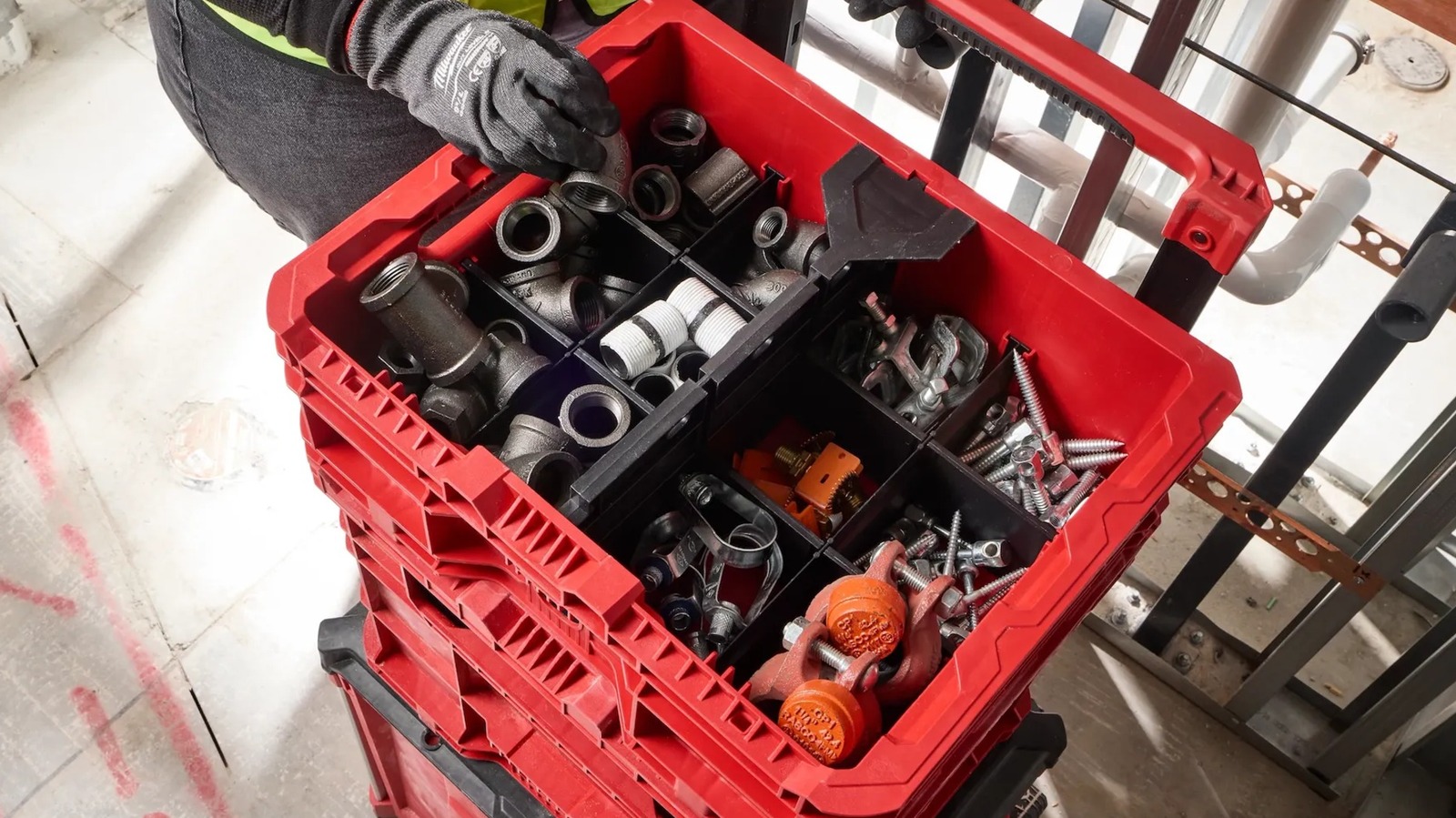
Sometimes, a massive Packout crate isn’t a necessity, which is why the line has its share of smaller options. Yet another will be coming to the Milwaukee catalog in the form of the Milwaukee Packout compact crate, which is set for a June 2026 release and will cost $39.97. It has a 30-pound weight capacity, comes in at 8.75 inches tall, 9.5 inches wide, 15.5 inches long, and 3.75 pounds, and includes two removable dividers to create up to three sections within the crate. The dividers can also be customized by cutting them to size along the pre-made score lines.

This compact crate features a wide front opening for easy access to its contents while on the job, as well as a metal top handle to carry it around on its own. Should you want to add it to your current Packout stack, you can use the connection points at the top and bottom of the crate. Speaking of durability, Milwaukee notes that it has an impact-resistant body along with weep holes to prevent water collection. At the same time, there is some nuance regarding the waterproof nature of Milwaukee Packout products, so keep that in mind before letting this crate get soaked.

Milwaukee Packout low-profile crate

A shorter but equally mighty Milwaukee Packout container is also on its way to customers this summer. The Milwaukee Packout low-profile crate is the shortest of the new releases at just 6.625 inches tall, though it makes up for what it lacks in height with a 15-inch length and an 18.625-inch width. Even though it’s slightly heavier than the compact crate at 4.85 pounds, it wins out in weight capacity with a 50-pound limit. It will be released in June 2026 and will cost $44.97.

For added modularity, the low-profile crate includes three different divider types: eight short, two long, and one for the middle of the container. When combined, they form up to 12 individual sections for tool and accessory organization. In terms of connecting to other Packout containers, it can do so from the top and bottom. Alternatively, built-in side handles are integrated into the design to make it easier to carry the crate on its own. The crate has weep holes for water drainage and an impact-resistant body.

Milwaukee Packout XL crate

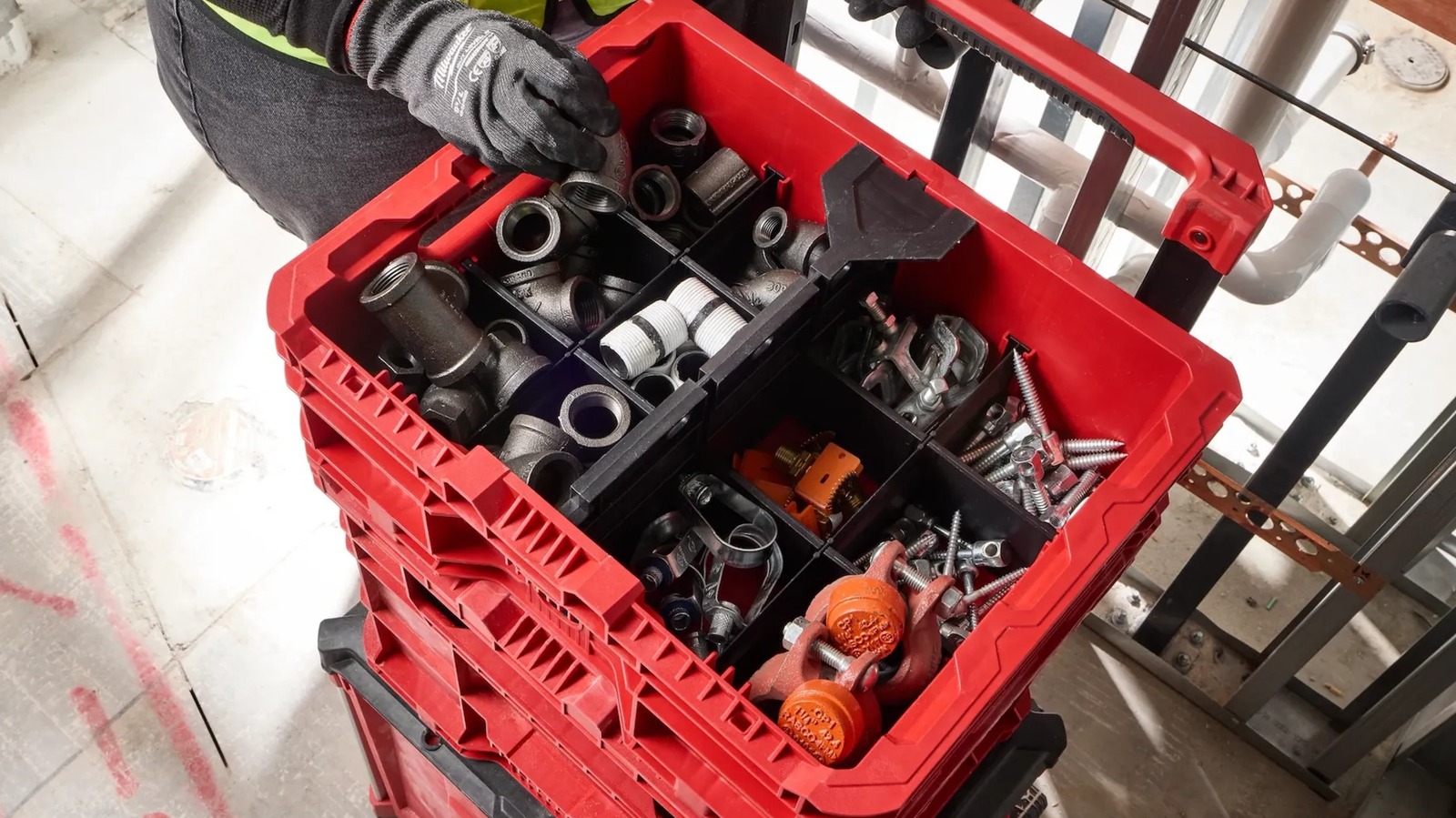
Moving on to one of the larger upcoming Milwaukee Packout releases — even if it ultimately lands somewhere in the middle of the smallest and largest Packout containers for sale — there’s the aptly-named Milwaukee Packout XL crate. This release will hit shelves in June 2026 and comes with a $69.97 price tag. The 8.03-pound crate can take on some serious tools with its 75-pound weight capacity. It measures 15 inches tall, 15.75 inches long, and 18.625 inches wide. Despite its size, it can be hung up on a wall like most other Packout containers.

While some may hang this crate in their workshop, many will use it as part of their mobile Packout stack. You can connect it to your existing setup via the top and bottom connection points. It can also be used with Milwaukee toolbox attachments to hold smaller tools and batteries with connection points on the sides. Alternatively, you can move the crate around using its built-in side handles. It’s advertised as having an impact-resistant body along with anti-water collection weep holes. Suffice to say, there’s more to this seemingly simple crate than initially meets the eye.

Milwaukee Packout Wire Pulling XL Crate

For the most part, the Milwaukee Packout line is so popular because of its versatility. While most entries can be used for just about anything, there are those that come with a specialized function. Case in point, the forthcoming Milwaukee Packout Wire Pulling XL crate, which is designed for dispensing wire. This involves inserting and locking in spools of the user’s needed material, threading the wire through the wire retention slots, and using the fold-down panel to keep the end of the wire from rolling back into the box.

Overall, this crate has the same dimensions and weight capacity as the previously covered Packout XL crate, though it is the heavier of the two at 9.85 pounds. It can accommodate up to six spools, can be stacked onto other Packout containers or hung up, and has an impact-resistant body. This is the most expensive of the new Packout releases at a hefty $119.97, and it’s set to release during July 2026. Alongside the best Milwaukee power tools for electrical work, this crate seems like a vital piece for any Milwaukee-enthusiast electrician’s kit.

New Milwaukee Packout inserts are coming, too

That’s it for the new Milwaukee Packout containers set to debut this summer, but there are more new releases yet to cover. To pair with some of these containers and improve their levels of organization and function, come two new insert sets. First is the divider for the Milwaukee Packout XL crate, which splits the container into two sections. It simply slides down the middle of the crate and fits snugly into place, while retaining its ability to connect with smaller Packout attachments. It will be released in July 2026 for $29.97.

Alongside the Packout XL crate divider is the set of Packout wire pulling inserts for the XL crate. You’ll need these if you end up buying an XL crate and later want to use it as a wire-pulling crate. These inserts allow you to convert it instead of having to buy a new designated wire pulling crate. They attach to two of the inner sides of the crate via T-25 screws and include wire puller guards as well. The Milwaukee product listing says these inserts are meant for 1/2-inch EMT conduit. This insert set also comes out in July and will cost $49.97. 


Source link