

Verdict
The Cambridge Audio MSX Series s a capable mix of satellite speakers and a subwoofer that provides an immersive sound with tight bass, a surprisingly wide soundstage and rich mids for such a compact set of units that can be placed virtually anywhere. The treble can feel a little smooth, though, and once you add a streamer and amp, it can get a little dearer than some active units.
-
Versatile and stylish looks
-
Surprisingly weighty bass
-
Immersive for such small units
-
Treble could do with more bite
-
Can be quite expensive once you add a streamer and amp
Key Features
-
Versatile placement
The smaller size of the main units and sub mean they can be placed in areas that other, more conventional, speakers may not be able to.
-
2.1 system
This Cambridge system includes both a set of stereo speakers and its own subwoofer to provide a more rounded feel.
Introduction
The Cambridge Audio MSX20 and MSX Sub 200 combo represents an intriguing proposition in the brand’s rather hefty hi-fi catalogue.
These products are essentially rehashes of the older Minx series of compact speakers and subwoofers, designed to be versatile and affordable without compromising on audio quality, so they can be placed in more challenging environments where otherwise ‘normal’ speakers couldn’t.
In that regard, it’s quite a unique option, not least for the price – the MSX20 speakers cost £99 each, with the MSX Sub 200 an additional £299.
That isn’t accounting for an amp to power them, or a streamer for a complete system, although it’s still an interesting alternative to powered choices such as the Klipsch ProMedia Lumina 2.1, the dinky Kanto Uki, or even the Cambridge Audio L/R S, if you’re tight on space, or have a unique setup you want to add audio to.
I’ve been putting this combo through its paces for the last couple of weeks to see how well it performs on my sideboard.
Design
- Surprisingly compact
- Redesign provides a more modern look
- Discrete colour choices
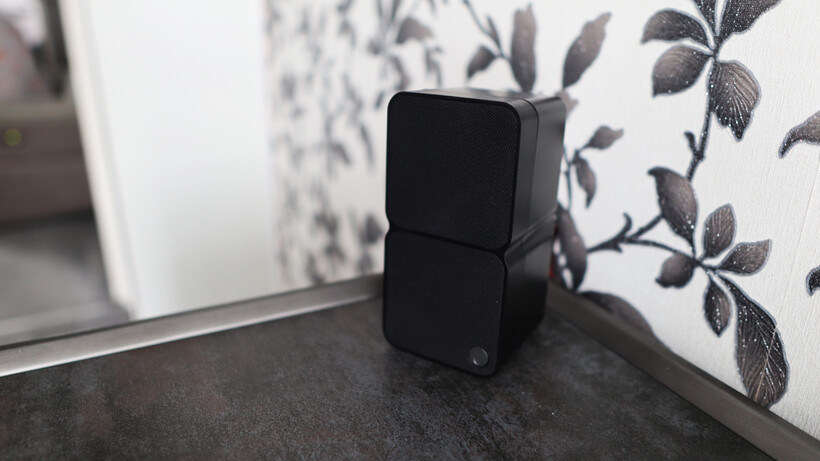
What immediately surprised me about this system was how tiny everything is – the MSX20 speakers are just 155mm high, 79mm wide and 97mm deep, meaning they can be placed virtually anywhere and take up little space on my sideboard against larger speakers.
The MSX Sub 200 is the smaller of the two Cambridge offers (there is the larger and beefier MSX Sub 300 available), but I was still quite surprised at how small it is compared to other subwoofers I’ve seen in sets with active speakers.

The satellite speakers can work either on a table on their own, as I had them, or raised up on their own desk stands – there is also wall mounting available with hardware included in the box to help you out. Cambridge even says you can stack them on top of each other, if you want to, although having them separate will be better for stereo immersion.
The MSX20 is available in either black or white, as is the MSX Sub 200, meaning they can carry a discrete look to blend into your space. I don’t mind this, although it is a shame they don’t also come in a matching silver finish for Cambridge’s other hardware for a more unified look – I appreciate that’s a little nitpicky, though.

On the whole, I appreciate the little redesign these new models have undergone against the older Minx variants, with a new Cambridge logo and a redesigned grille on the front of both the satellite speakers and the sub, bringing them closer to Cambridge’s current portfolio.
Connectivity
- Passive speakers connect by banana plugs
- Subwoofer has RCA line-in and line-out
- Best paired with a streamer and amp
The MSX20 is a passive speaker, and can connect to any amp or AV receiver using either the terminals on the rear, or these can unscrew to reveal slots for 4mm banana plugs, which I chose to use.
The sub houses more connectivity on its rear panel, admittedly, with RCA input and output options, plus a power cable. The input handles a streamer, for instance, while the output goes to the amplifier in this case.

For my testing, these were both Cambridge products, with the affordable MXN10 streamer (in pre-amp mode) and the MXW70 power amplifier, which is where the MSX20 speakers were plugged into.
With the MXN10 in tow, it means this system can work with the likes of Tidal Connect, Spotify Connect, Deezer, Qobuz, internet radio and a DLNA server over Cambridge’s Streammagic app, plus it can handle Bluetooth 5.0, Google Cast and AirPlay 2. It’s also Roon Ready, which is where I spent most of my time with this system.
Physical connections include the RCA line output, plus a coaxial out, optical out, USB-A port and wired Ethernet.

The MXW70 provides 70 watts of power into 8 ohms with the MSX20, with Hypex NCore Class D amplification that’s tuned by Cambridge’s engineers. Connectivity here includes unbalanced RCA, a pair of XLR ports, a 12V trigger in, loudspeaker connections that accept 4mm banana plugs and a power cable.
If you’re about space-saving, I think this half-width combo works well with the MSX20 and MSX Sub 200, although with the streamer at £349 and the MXW70 at £499, it can increase the cost of the overall system.
A more affordable streaming app, such as the WiiM Amp Pro, WiiM Amp Ultra or Eversolo Play can cut costs and the amount of boxes you need down, depending on the physical constraints of your space.
Sound Quality
- Strong bass from subwoofer
- Forward mids and excellent width
- Treble can sometimes feel a little lost
As much as the outside of this unit has changed, the core of the MSX20 isn’t too different to the Minx satellites that preceded it. This means they benefit from Cambridge’s fourth-gen Balanced Mode Radiator, or BMR, tech, which is designed to provide balanced and engaging results from wherever you are in a room.
On their own, these speakers only cover the mids and treble, as they only go down to 120Hz, with the MSX Sub 200 dialled in to handle anything below that. With the subwoofer in tow, I was pleasantly surprised by the amount of bass on offer from such a small set of units.
Of course, it works best when you use the dials on the rear to set crossover, the desired phase and volume of the pounding bass, but once I’d set that up, it was set-and-forget as far as I was concerned.

A good example of this was Off The Wall from Michael Jackson, with its pounding groove from the subwoofer demonstrating a good extension and tight feel, while the satellite speakers handled vocals and the rest of the frequency range. Both here and with Earth, Wind & Fire’s Let’s Groove, the MSX Sub 200 felt more unified with the overall frequency response of the overall system, rather than feeling like a thud in the corner that doesn’t contribute too much.
Steven Wilson’s Luminol features some relentless bass grooves in the opening few minutes alongside a vicious drum groove and hints of guitar work that can be quite difficult for some systems to deal with. The MSX20 and MSX Sub 200 combo impressed me here with the power and strength of the bass, although it didn’t overpower the punch of the drums and guitar work.

The entire system provides a sound with good width and depth, as demonstrated with Luminol and Peter Gabriel’s That Voice Again in my testing. This particular cut from So features a pounding bass, rich vocal and a lot of detailed cymbal work that can be lost with systems sometimes, which isn’t the case here.
I felt the mid-range that the MSX20 provided was rich, as demonstrated with James Taylor’s October Road; his vocals and a warm acoustic guitar sit right up front in the mix, with the ensemble built around it, which was demonstrated wonderfully. In Gloria Estefan’s Get On Your Feet, her vocals sit back in the mix against percussion and electric guitar work, although each was given space and room to breathe.

The one area I was a bit disappointed by was that the top end was quite smoothed over, lacking bite and detail, and sometimes felt a little lost against the low-end and the mid-range. For instance, in Lock All The Doors from Noel Gallagher’s High Flying Birds, the cymbal and percussion hits lacked a bit of presence, feeling a little lost against his vocals, while the competing percussion intro in Steely Dan’s Do It Again had good separation but lacked a bit of punch against other systems.
Should you buy it?
A compact and versatile system
The MSX20 and MSX Sub 200 combo works well if you’re after speakers and a sub that can be placed virtually anywhere in a room, although you will need to budget for a streamer and amp for a complete system.
This system feels a little lacking in the top-end, though, as it lacks a certain bite and sharpness against other systems.
Final Thoughts
The Cambridge Audio MSX20 & MSX Sub 200 is a capable mix of satellite speakers and a subwoofer that provides an immersive sound with tight bass, a surprisingly wide soundstage and rich mids for such a compact set of units that can be placed virtually anywhere. The treble can feel a little smooth, though, and once you add a streamer and amp, it can get a little dearer than some active units.
The main package here is comparable in price to the active Klipsch ProMedia Lumina 2.1, which offers better compatibility with desktop systems with USB-C and the like, and requires less effort to set up.
With this in mind, I think the MSX20 and MSX Sub 200 offer a better overall sound, with better handling of the low-end alongside an immersive sound. For a more affordable and easy-to-use passive system, this combo works rather well, although sometimes you can’t beat the simplicity and versatility afforded by the Cambridge Audio L/R S for a similar price.
How We Test
We test every speaker setup we review thoroughly over an extended period of time. We use industry-standard tests to compare features properly. We’ll always tell you what we find. We never, ever, accept money to review a product.
- Tested over several weeks
- Tested with real world use
FAQs
Yes, the Cambridge Audio MSX20 and MSX Sub 200 have a subwoofer with the MSX Sub 200.
On its own, no, as the Cambridge Audio MSX20 and MSX Sub 200 system is purely built of passive speakers and a subwoofer that need wiring to other components. If you use a streamer, such as Cambridge’s own MXN10, that will offer the brand’s Streammagic app, for instance, to send audio to the speakers and sub.
Full Specs
| Cambridge Audio MSX Series Review | |
|---|---|
| UK RRP | £497 |
| USA RRP | $657 |
| Manufacturer | Cambridge Audio |
| Size (Dimensions) | 210 x 232 x 220 MM |
| Weight | 6.5 KG |
| Release Date | 2026 |
| First Reviewed Date | 10/05/2026 |
| Driver (s) | Two BMR drivers (main units), 6.5-inch active woofer and 2x passive radiators (subwoofer) |
| Ports | Banana plugs/terminals (main units), RCA input and output (subwoofer) |
| Audio (Power output) | 200 W |
| Colours | Black, White |
| Frequency Range | 36 20000 – Hz |
| Subwoofer | Yes |
| Speaker Type | Hi-Fi Speaker |

Stephan is the sports journalist for the Maple Grove Report.




