
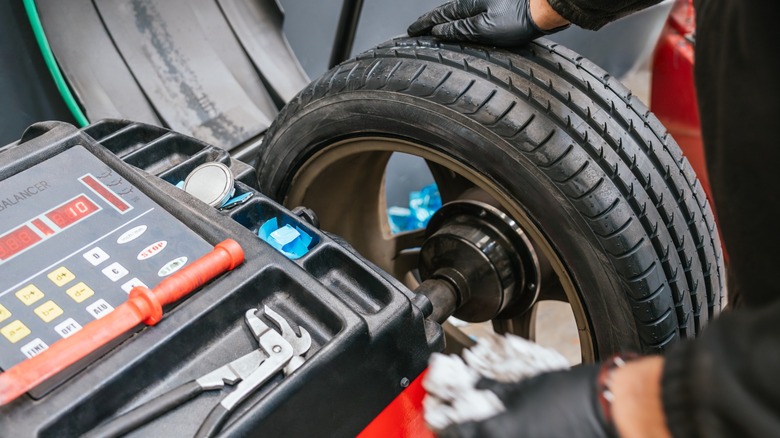

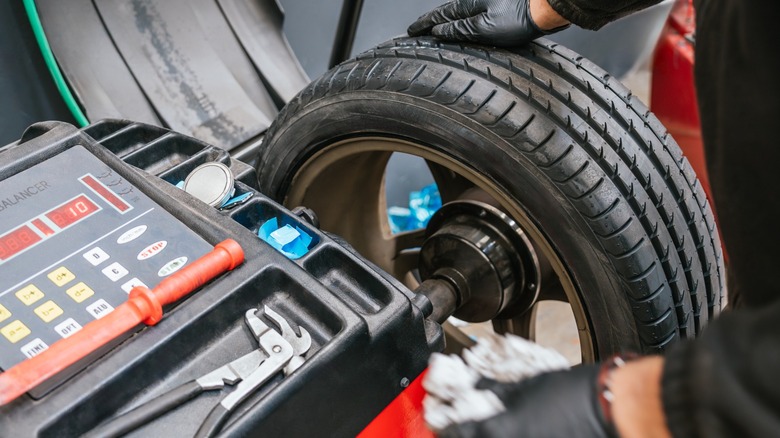
If you’re not sure what balancing tires means or what the process entails, here’s a brief explanation: When your car is speeding down the highway, its tires are spinning at nearly 1,000 revolutions per minute, depending on the size of the tires and the speed you’re traveling. With that much mass spinning at those speeds, the tire and wheel assembly needs to be balanced to limit vibration. While it’s possible to get a tire close to balanced using rudimentary methods, like the Pittsburgh portable wheel balancer from Harbor Freight, a spin balancer provides more accuracy.
Regarding the question about perfectly balancing a tire without any wheel weights, the answer is yes, it is possible. However, the odds of a broken analog clock being right twice a day are higher.
In the short video above, YouTuber CarHax posed a theory that aligning the red dot found on some tires with the wheel’s valve stem is key to improving the odds of achieving balance in the tire-wheel combo without wheel weights. The video evidence of their success documents the absence of any added weights on the wheel and the technician’s preferred red dot alignment before spinning the wheel on the tire machine, which returns messages indicating a perfect balance on the machine’s screen.
So, it’s possible to randomly get balanced tires without weights, but we don’t recommend relying on the red dot alignment without verifying the balance in some way. Also, you’re likely to find yellow dots in addition to red ones on some tire sidewalls.
What the colorful dots on tire sidewalls mean
In addition to opting for the most fuel-efficient tires in 2026, ensuring they are properly mounted will help get the most out of those new tires both in terms of efficiency and life expectancy. While it’s possible to mount a tire on a wheel yourself without using fire or an expensive machine, it’s usually best to let the professionals do that job. However, knowing what to look for when the job is finished will help you advocate for yourself to get the best service possible.
Let’s be honest, the host of the CarHax video got lucky when they got a perfectly balanced tire by placing the red dot in alignment with the valve stem, but that doesn’t mean tire technicians should ignore the red dots when mounting tires on automobile or motorcycle rims.
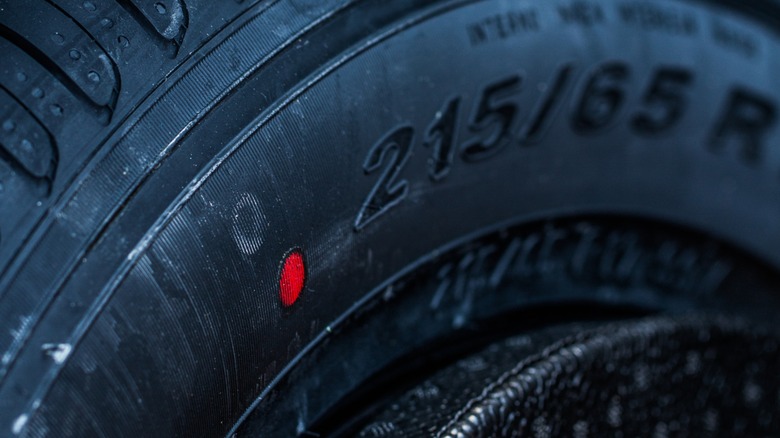
The colored dots signify variations in the tire that occur during the manufacturing process despite tire makers best efforts to make them perfect. Red dots signify the part of the tire with the most radial force variation, or the high spot when it’s spinning.
Yellow dots, on the other hand, indicate the lightest part of the tire. In addition to red and yellow dots, you could encounter other colors like blue or green. These are typically used to indicate quality control checks during the manufacturing process. Finally, some tires don’t have any colored dots at all, so don’t worry if yours don’t have them.
How tire techs use the colored dots for optimal tire balance and performance

If a tire has a yellow dot on the sidewall, tire technicians should mount the tire so that the yellow dot, signifying the lightest part of the tire, is nearest to the valve stem. This is because the valve stem, especially when attached to a tire pressure monitor, adds weight, making that area the heaviest part of the wheel. This relationship allows the tire to balance properly, preventing your car from feeling shaky at 60 mph, while also using as little added weight as possible.
When technicians encounter tires with red dots, they’ll often prioritize them over yellow dots, since it’s not likely that both the yellow and red dots will line up where they’re needed. Red dot priority is especially important if the installation process includes a road force balance. Road force balancing uses a power-driven roller to spin the tire under a load after it’s installed on the vehicle to simulate driving conditions. When mounting the tire, the red dot is matched up to a mark on the wheel that indicates its lowest point of radial runout.

Stephan is the sports journalist for the Maple Grove Report.




