Champions League Soccer: Stream PSG vs. Liverpool Live


73% off with 2yr plan (+4 free months). Now only $3.49/month

ExpressVPN is our current best VPN pick for people who want a reliable and safe VPN, and it works on a variety of devices. Prices start at $3.49 a month on a two-year plan for the service’s Basic tier.


Jump to details


Pros

  • Cutting edge privacy and security
  • Excellent for streaming
  • Easy to use across platforms
  • Strong commitment to transparency
  • Privacy-friendly jurisdiction (British Virgin Islands)


Cons

  • Exceedingly expensive
  • No way to opt-out of potentially unneeded extra features
  • Speed performance getting progressively worse
  • Only eight simultaneous connections

When to watch PSG vs. Liverpool

  • Wednesday at 3 p.m. ET (12 p.m. PT).

Where to watch

  • PSG vs. Liverpool will air in the US on Paramount Plus.

Liverpool will be hoping to avoid a second successive cup disaster on Wednesday as it heads to the Parc des Princes. It faces a Paris Saint-Germain team looking to eliminate a second English team from this season’s UEFA Champions League. 

Arne Slot’s job as Liverpool boss is looking increasingly precarious after Saturday’s 4-0 FA Cup quarterfinal thrashing at the hands of Manchester City. It’s the team’s 15th defeat across all competitions this term — with that result leaving this tournament as the Reds’ last chance of winning this season. 

PSG may feel confident coming into this clash having eased past Premier League Chelsea in the previous round. Luis Enrique’s crew enters this game having opened up a four-point lead at the top of Ligue 1 following Friday’s comfortable 3-1 win over Toulouse. 

PSG vs. Liverpool will be at the Parc des Princes in Paris on Wednesday, April 8. Kickoff is set for 9 p.m. CEST local time in Spain, making it an 8 p.m. BST kickoff in the UK, a 3 p.m. ET or 12 p.m. PT start in the US and a 5 a.m. AEST kickoff in Australia on Thursday.

Liverpool defender Virgil van Dijk  standing with his hands on his hips, holding a pair of shin pads in his right hand.

Liverpool skipper Virgil van Dijk will be expecting a big improvement from his teammates today after accusing them of giving up during their stinging 4-0 defeat against Man City in the FA Cup on Saturday. 

Robbie Jay Barratt/AMA/Getty Images

Watch this: Your Phone is Disgusting: Let’s Fix That

Livestream PSG vs. Liverpool in the US without cable 

American soccer fans can stream this game along with every game of this season’s tournament via Paramount Plus, which has exclusive live English-language broadcast rights in the US for the UEFA Champions League. 

This season introduces a multiview option that lets you watch up to four matches simultaneously and choose your preferred in-game audio. 

Sarah Tew/CNET

Paramount Plus has two main subscription plans in the US: Essential for $9 a month and Premium for $14 a month. Both offer coverage of the Champions League.

The cheaper Essential option has ads for on-demand streaming, but it lacks live CBS feeds and the ability to download shows to watch offline later. Students may qualify for a 25% discount.

How to watch UEFA Champions League games with a VPN

If you’re traveling abroad and want to keep up with Premier League action while away from home, a VPN can help enhance your privacy and security when streaming.

It encrypts your traffic and prevents your internet service provider from throttling your speeds, and can also be helpful when connecting to public Wi-Fi networks while traveling, adding an extra layer of protection for your devices and logins. VPNs are legal in many countries, including the US and Canada, and can be used for legitimate purposes such as improving online privacy and security. 

However, some streaming services may have policies that restrict VPN use to access region-specific content. If you’re considering a VPN for streaming, check the platform’s terms of service to ensure compliance.

If you choose to use a VPN, follow the provider’s installation instructions, ensuring you’re connected securely and in compliance with applicable laws and service agreements. Some streaming platforms may block access when a VPN is detected, so verify whether your streaming subscription allows VPN use.   

James Martin/CNET

Price $13 per month, $75 for the first year or $98 total for the first two years (one- and two-year plans renew at $100 per year)Latest Tests No DNS leaks detected, 18% speed loss in 2025 testsJurisdiction British Virgin IslandsNetwork 3,000 plus servers in 105 countries

ExpressVPN is our current best VPN pick for people who want a reliable and safe VPN, and it works on a variety of devices. Prices start at $3.49 a month on a two-year plan for the service’s Basic tier.

Note that ExpressVPN offers a 30-day money-back guarantee.

73% off with 2yr plan (+4 free months). Now only $3.49/month

Livestream PSG vs. Liverpool in the UK

TNT Sports will broadcast the majority of Champions League games in the UK this season, and this match will be shown live on TNT Sports 1.        

TNT Sports

You can access TNT Sports via Sky Q, Virgin Media and EE TV as part of a TV package.

Alternatively, TNT Sports has a new streaming home with the launch of HBO Max in the UK. It costs £31 either way and comes in a package that includes Discovery Plus’ library of documentary content.

A bundle including HBO Max’s entertainment plan alongside TNT Sports currently costs £31 per month.

Livestream PSG vs. Liverpool in Canada

If you want to stream Champions League games live in Canada, you’ll need to subscribe to DAZN Canada. The service has exclusive broadcast rights to every match this season, including this one.

DAZN

A DAZN subscription currently costs CA$35 a month or CA$250 a year and will also give you access to Europa League and EFL Championship soccer, Six Nations rugby and WTA tennis.

As well as dedicated apps for iOS and Android, there’s a wide range of support for set-top boxes and smart TVs.

Livestream PSG vs. Liverpool in Australia

Soccer fans Down Under can watch UCL games on streaming service Stan Sport, which once again has exclusive rights to show all Champions League matches live in Australia this season.

Stan

Stan Sport will set you back AU$20 a month (on top of a Stan subscription, which starts at AU$12). It’s also worth noting that the streaming service is currently offering a seven-day free trial.

A subscription will also give you access to Premier League and Europa League action, as well as international rugby and Formula E.


Source link

Leave a Reply

Subscribe to Our Newsletter

Get our latest articles delivered straight to your inbox. No spam, we promise.

Recent Reviews


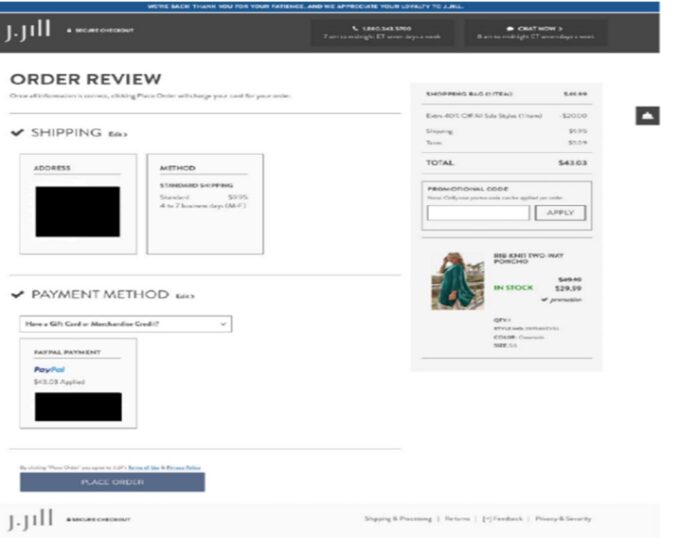
In Cody v. Jill Acquisition LLC, No. 25-937 (S.D. Cal. June 30, 2025), the Southern District of California declined to enforce a retail site’s terms of use and compel arbitration, holding that the plaintiff, who used guest checkout to place an online order at the retail clothing site, did not have adequate notice of the terms and the arbitration clause. This case should serve as a wake-up call for online entities to reexamine electronic contracting processes. It exemplifies how, even if a website’s visual design and its placement of the hyperlinked Terms of Use during user checkout are comparable to other presentations that have been deemed enforceable, a court could still decline to enforce online terms if the context of the transaction is not the typical e-commerce transaction between a registered customer and a retail site. In this case, the court found that by checking out as a guest without creating an account, the user was less likely to expect a continuing relationship and, therefore, the site’s notice and presentation of the terms below the “Place Order” button were not conspicuous enough in this instance to bind the plaintiff.

The plaintiff in Cody filed a putative class action complaint over the site’s pricing policies for alleged violations of the California Business and Professions Code and the Consumer Legal Remedies Act. The defendant moved to compel arbitration, arguing the plaintiff had agreed to the site’s terms of use that contained a “Binding Arbitration Agreement and Class Action Waiver” when plaintiff clicked the “Place Order” button and completed her purchase from the defendant’s website.

Generally speaking, a contract will be enforceable based on an inquiry notice if: (1) the website provides reasonably conspicuous notice of the terms; and (2) the consumer takes some action, such as clicking a button, that unambiguously manifests assent to those terms. When evaluating whether there was an agreement to arbitrate, the court in Cody first considered the visual design of the webpages and found that the visual aspect of the notice was satisfied by the defendant’s website layout. As the court stated, the relevant criteria for evaluating whether the visual elements provide conspicuous notice are whether the advisal is displayed prominently enough that the court can assume a reasonably prudent Internet user would have seen it. Elements such as a “clear and legible” notice on the order page and a hyperlink placed directly above or below an action button formatted in bright, contrasting color and readable font within a relatively uncluttered web page have been favorably cited by courts in past cases.

The court here found the visual design to be adequate because of factors such as the underlined blue hyperlink to the terms of use and its location directly below the “Place Order” button. [See below image from the court opinion of the final contracting screen ].

Although the court recognized that the “design of the website alone might support concluding that the notice would be reasonably conspicuous,” it went on to consider the full context of the guest checkout transaction at issue in Cody.  Here, the court distinguished it from those types of transactions where a user might anticipate “some sort of continuing relationship.” The court emphasized that when considering the notice requirement, the visual design of the website must be examined within that context. As it stated: “This means that courts should expect that a reasonable internet user is more vigilant in looking for contractual terms when the context of the transaction reasonably implies a contractual relationship.” To the court, when a user “simply purchases goods or avails herself of a one-time discount offer,” there is less reason for her to expect a continued relationship beyond the purchase. 

In the case at hand, the court considered plaintiff’s decision to check out as a guest as one where the user did not anticipate a continuing relationship, and compared it with other traditional e-commerce transactions involving registered users where the Ninth Circuit previously found that such context would put a user on inquiry notice that a purchase on the company’s website constituted an agreement to its terms.

“Generally speaking, courts are more likely to conclude that a user anticipating ‘some sort of continuing relationship’ would expect to be bound by terms, whereas a user ‘who simply purchases goods or avails herself of a one-time discount offer’ would be less likely to form such an expectation.”

“This context distinguishes this case from those in which the Ninth Circuit has found that the context of the transaction would put a user on inquiry notice that use of a company’s website or services constituted an agreement to its terms and conditions, including an arbitration provision.”

Thus, despite the adequacy of its visual aspects on the J. Jill site, the court found that proper notice was not sufficiently conspicuous in this case because of the guest checkout context of the transaction (“The context of the transaction therefore weighs against concluding that Plaintiff was sufficiently aware that, by placing an order through jjill.com, she would be entering into an agreement including an arbitration provision”).  

In another recent case, Chabolla v. ClassPass, Inc., 129 F.3d 1147 (9th Cir. 2025), the Ninth Circuit affirmed a lower court’s ruling that declined to send a proposed class action to arbitration. In the ClassPass case, the plaintiff signed up for a trial period for ClassPass, a service that sells subscription packages for access to various gyms and fitness studios, but later took issue when subscription charges resumed after gyms reopened following the COVID-19 pandemic. The contracting process in this case involved several signup screens. [An image from the court opinion of the final screen appears below].

In this case, the court’s decision was a flip, of sorts, of the Cody case, with the Ninth Circuit finding the visual presentation of the terms lacking, even though the context of the transaction would seemingly put the user on notice of an ongoing relationship that would contemplate the user agreeing to site terms. The appeals court found that while a trial subscription opportunity may not indicate an anticipation of an ongoing relationship in all instances, the context neither weighs in favor of nor against the notice requirement. This is because, as the court noted, the other aspects of the context – such as how the purchase is described as a “plan” or a “membership” and how the benefit of ClassPass is to gain access to gyms and fitness studios – conjure the idea of a continuing relationship. Nonetheless, the court ultimately decided that a reasonably prudent internet user would not be deemed to have unambiguously manifested assent to the terms by working her way through ClassPass’s multi-page website checkout process.

Taken together, these two recent decisions show that courts – at least those within the Ninth Circuit – are considering the actual context in which these internet transactions occur when deciding whether an online entity’s contracting and checkout process binds the user to the terms. While visual presentation and web flow design remains important for e-commerce sites, the above two court decisions show that context also matters.

We have previously highlighted the importance of web design in determining if a service’s terms are deemed enforceable. Now, companies might take a second look at their own user registration and e-commerce purchase processes to ensure they offer reasonably conspicuous notice of the existence of contract terms and obtain the user’s manifestation of assent to those terms in all contexts and types of transactions, including those transactions where guest or expedited checkout is used.

Contexts that indicate transient relationships, such as guest checkout or a trial opportunity, may mean that even an ordinary presentation of terms in the form of a hyperlink to the terms located beneath a “Place Order” button – a presentation that is used regularly by many sites – might need to be bolstered, in some cases, to provide the user additional notice that he or she is entering into a transaction that mandates acceptance of contractual terms. As the Cody court commented: “[T]he onus must be on website owners to put users on notice of the terms to which they wish to bind consumers.” Ultimately, the above court decisions accentuate the need for counsel to be involved in the decisions underlying the design and wording of online contracting processes and presentation of terms so entities can attain adequate user notice and assent that would satisfy even the most exacting scrutiny for any type of transaction.


Source link