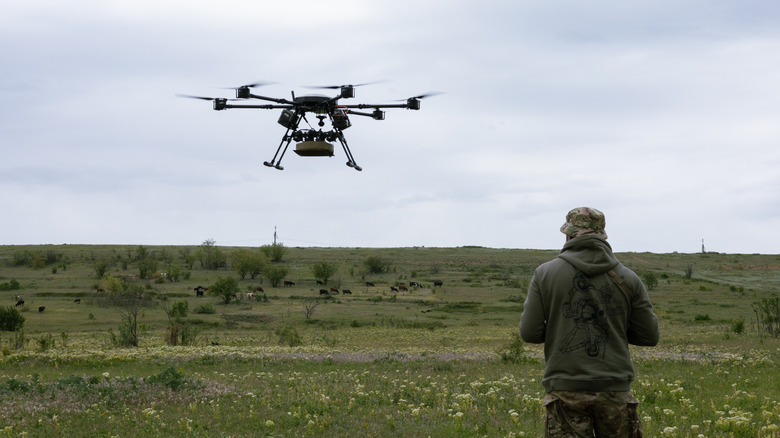
Sending power through the air is one of those unicorn projects that feels like it would be magical, if only someone could get it to work. It’s such a unicorn that multiple groups are pursuing that very thing, and of course, more than a few of them are devoted to making weapons of war work better. All cynicism aside, that’s where we find ourselves today.
A team of Chinese researchers built a drone and a ground vehicle that can keep it aloft for just over three hours at an altitude of around 15 meters. The ground vehicle uses microwave transmitters to wirelessly beam power to the drone, even when both of them are moving. That’s ironic, since China has also used similar tech to knock drones out of the air. The idea is that the armored ground vehicle can deploy the drone and feed it power to keep it aloft for longer missions related to surveillance and strike missions. Drones, like those in Ukraine, are becoming more commonplace on the battlefield.
As you may have guessed, the hardest part is coordinating the position of the microwave transmission while both vehicles are moving. The team relied primarily on GPS signals, real-time position tracking, and on-board controls to keep the antenna aligned.
While the microwaves lose most of the energy it’s sending to the drone — only about three to five percent of the energy made it — one key advantage is the microwaves may be able to manage a whole fleet of drones at once. Other initiatives tried by organizations like the Defense Advanced Research Projects Agency (DARPA) include lasers, which have a much longer range and better efficiency, but can be affected by line-of-sight issues like obstructions and even poor weather conditions.
Advantages of wireless power transmission
Maria Taran/Shutterstock
Of course, some of the advantages of wireless power transmission are obvious. You can get a drone to fly longer than most other drones with fewer breaks and less downtime. This can be a key advantage, especially when using a drone for surveillance and real-time enemy tracking. Keeping drones aloft is a big part of the challenge when deploying them into combat situations.
Another big advantage involves the batteries, which are heavy. Wireless power transmission could enable drone designs with significantly smaller batteries. Weight on board a flying vehicle is an important consideration, so any weight cost you gain from a smaller battery can be reassigned to other sensors, weapons packages, or anything else the drone might need to accomplish its mission.
Of course, this technology is still in its infancy, so there’s more work to be done before you see this in the skies over a battlefield—and hopefully, if you see them, you’re watching on CNN and not out your living room window. But this is still an exciting development in the world of drones who have long been hampered by limited flight times.
For decades, retirement was sold as a finish line.
You worked hard, saved diligently, maybe raised kids, climbed ladders, paid off mortgages. Then one day, you stopped — and travel was supposed to begin. Cruises with matching T-shirts. Bus tours with rigid itineraries. A pace that felt… slower than life itself.
But something has shifted.
Today’s empty-nesters and no-nesters aren’t stepping away from life. They’re stepping into a new version of it. One that values time over things, depth over checklists, and experiences over excess. They aren’t done exploring — they’re just doing it differently.
This isn’t retirement travel. It’s intentional travel. And it’s redefining what the next chapter looks like.
The End of the “Someday” Mentality
Photo Credit: Deposit Photos.
For many travelers in their 50s, 60s, and beyond, the biggest realization isn’t about age — it’s about time.
Someday used to be the plan. Someday we’ll go to Alaska. Someday we’ll walk the Camino. Someday we’ll take that big international trip.
Then the kids grow up. The house gets quieter. The calendar opens up. And suddenly, someday feels less like a promise and more like a question.
That’s when priorities sharpen.
Travel becomes less about squeezing experiences into short vacation windows and more about choosing trips that actually feel fulfilling. No one is trying to “do Europe in 10 days” anymore. They want to linger. To understand a place, not just pass through it.
This shift isn’t about slowing down — it’s about traveling with purpose.
Slower Doesn’t Mean Less Adventurous
Photo Credit: Deposit Photos.
One of the biggest misconceptions about midlife and beyond is that adventure has an expiration date.
It doesn’t.
What does change is how people define it.
Adventure no longer means suffering for the story. It doesn’t require cramped flights, uncomfortable hotels, or racing through destinations to prove something. Instead, it’s about experiences that challenge and inspire — without unnecessary friction.
Think:
• Hiking in national parks with a knowledgeable local guide • Small-ship cruises that reach places big ships can’t • Cycling scenic backroads with support, not stress • Wildlife encounters that prioritize ethics and access • Cultural experiences that invite conversation, not crowds
This generation still wants awe. They still want movement. They still want stories worth telling. They just want to enjoy the journey while they’re at it.
Comfort and adventure aren’t opposites — they’re partners now.
Trading Stuff for Stories
Photo Credit: Deposit Photos.
As homes downsize and closets clear out, something interesting happens: experiences start to matter more than possessions.
Empty-nesters often find themselves asking new questions:
Do we really need more things? Or do we want more memories? More shared moments? More stories we’ll still talk about years from now?
Travel becomes the answer.
Not impulse trips, but carefully chosen journeys that reflect who they are now — not who they were 20 years ago. Trips that feel earned. Trips that align with curiosity, not trends.
This is why destinations with strong sense of place are thriving. Travelers aren’t chasing novelty for novelty’s sake. They’re seeking meaning.
They want to know why a place matters. Who lives there. What makes it special. And how it changed them.
The Rise of Comfort-Forward Travel
Photo Credit: Deposit Photos.
Another defining shift: travelers are unapologetic about comfort.
They’ve done the budget travel. The red-eye flights. The questionable accommodations. Now, they’re willing to pay for ease — not luxury for luxury’s sake, but for peace of mind.
That might mean:
• Direct flights over cheaper connections • Hotels with space, quiet, and thoughtful service • Travel insurance and medical coverage that removes anxiety • Private transfers instead of navigating unfamiliar systems • Slower itineraries with built-in rest
This isn’t indulgence. It’s wisdom.
Travel becomes more enjoyable when logistics fade into the background. When energy goes toward the experience instead of the stress. When you return home feeling restored, not depleted.
For this audience, comfort isn’t about showing off — it’s about showing up fully.
Travel as a Relationship Investment
Photo Credit: Deposit Photos.
With careers stabilizing or winding down, and children living their own lives, many couples rediscover something important: each other.
Travel becomes a way to reconnect.
Shared experiences create new rhythms. New conversations. New inside jokes. A reminder of who you were before life got so busy — and who you’re becoming now.
For solo travelers, it’s equally powerful. Travel offers independence, confidence, and connection on their own terms. Group tours designed for mature travelers, small expedition ships, and guided experiences make it easy to be social without pressure.
This kind of travel isn’t about escape. It’s about enrichment.
Choosing Meaning Over Miles
Photo Credit: Deposit Photos.
The old metric was how many countries you’d been to.
The new one is how deeply you experienced them.
Today’s travelers are fine returning to places they love instead of constantly chasing new pins on a map. They’d rather spend two weeks in one region than bounce between five cities.
They’re choosing:
• Fewer trips, done better • Quality over quantity • Depth over speed
This approach creates room for spontaneity. For conversations with locals. For days without agendas. For moments that don’t photograph well but stay with you forever.
It’s travel that feels human again.
Why This Moment Matters
Photo Credit: Deposit Photos.
This generation sits at a rare intersection: time, resources, and perspective.
They know what they value. They know what they don’t. And they’re done waiting for permission to live fully.
Travel becomes less about proving youth and more about honoring experience. Less about checking boxes and more about checking in — with themselves, with partners, with the world.
They aren’t retiring from adventure.
They’re refining it.
The New Definition of “Later”
Photo Credit: Deposit Photos.
Later no longer means “after everything else.”
Later means now — but smarter.
It means listening to your body without limiting your curiosity. Choosing trips that energize instead of exhaust. Saying yes to experiences that feel aligned with who you are today.
This isn’t the end of the road.
It’s the open stretch.
We’re Not Retiring — We’re Traveling Differently
Photo Credit: Deposit Photos.
This generation isn’t stepping back from the world.
They’re stepping into it — more intentionally, more thoughtfully, and with a clearer sense of what truly matters.
They’re traveling differently because they’ve earned the right to.
And in doing so, they’re proving that the best journeys don’t come after retirement — they come when you decide your time is worth using well.
Hi! We are Jenn and Ed Coleman aka Coleman Concierge. In a nutshell, we are a Huntsville-based Gen X couple sharing our stories of amazing adventures through activity-driven transformational and experiential travel.
To provide the best experiences, we use technologies like cookies to store and/or access device information. Consenting to these technologies will allow us to process data such as browsing behavior or unique IDs on this site. Not consenting or withdrawing consent, may adversely affect certain features and functions.
Functional
Always active
The technical storage or access is strictly necessary for the legitimate purpose of enabling the use of a specific service explicitly requested by the subscriber or user, or for the sole purpose of carrying out the transmission of a communication over an electronic communications network.
Preferences
The technical storage or access is necessary for the legitimate purpose of storing preferences that are not requested by the subscriber or user.
Statistics
The technical storage or access that is used exclusively for statistical purposes.The technical storage or access that is used exclusively for anonymous statistical purposes. Without a subpoena, voluntary compliance on the part of your Internet Service Provider, or additional records from a third party, information stored or retrieved for this purpose alone cannot usually be used to identify you.
Marketing
The technical storage or access is required to create user profiles to send advertising, or to track the user on a website or across several websites for similar marketing purposes.