
Drones have grown out of being support tools that provide reconnaissance to something that entire wars are fought on. And when hundreds of units are deployed at a time, it sometimes makes sense to control them as a group rather than waste time and resources handling each unit individually. China is claiming to do just that with its new drone swarm operations system. The country’s state broadcaster CCTV has shown what it says is an entire fleet of drones being controlled by a single person.
The footage, aired on March 25, showed Atlas — the name of the system — reportedly running a complete operational chain. Three visually similar targets were placed in a strike zone, and Atlas allegedly controlled everything on its own. That includes coordinating reconnaissance, figuring out on its own which one was the command vehicle, opening its launcher, and sending drones after it. At the end of it, the drones are seen locking onto those targets mid-flight and hitting them precisely.
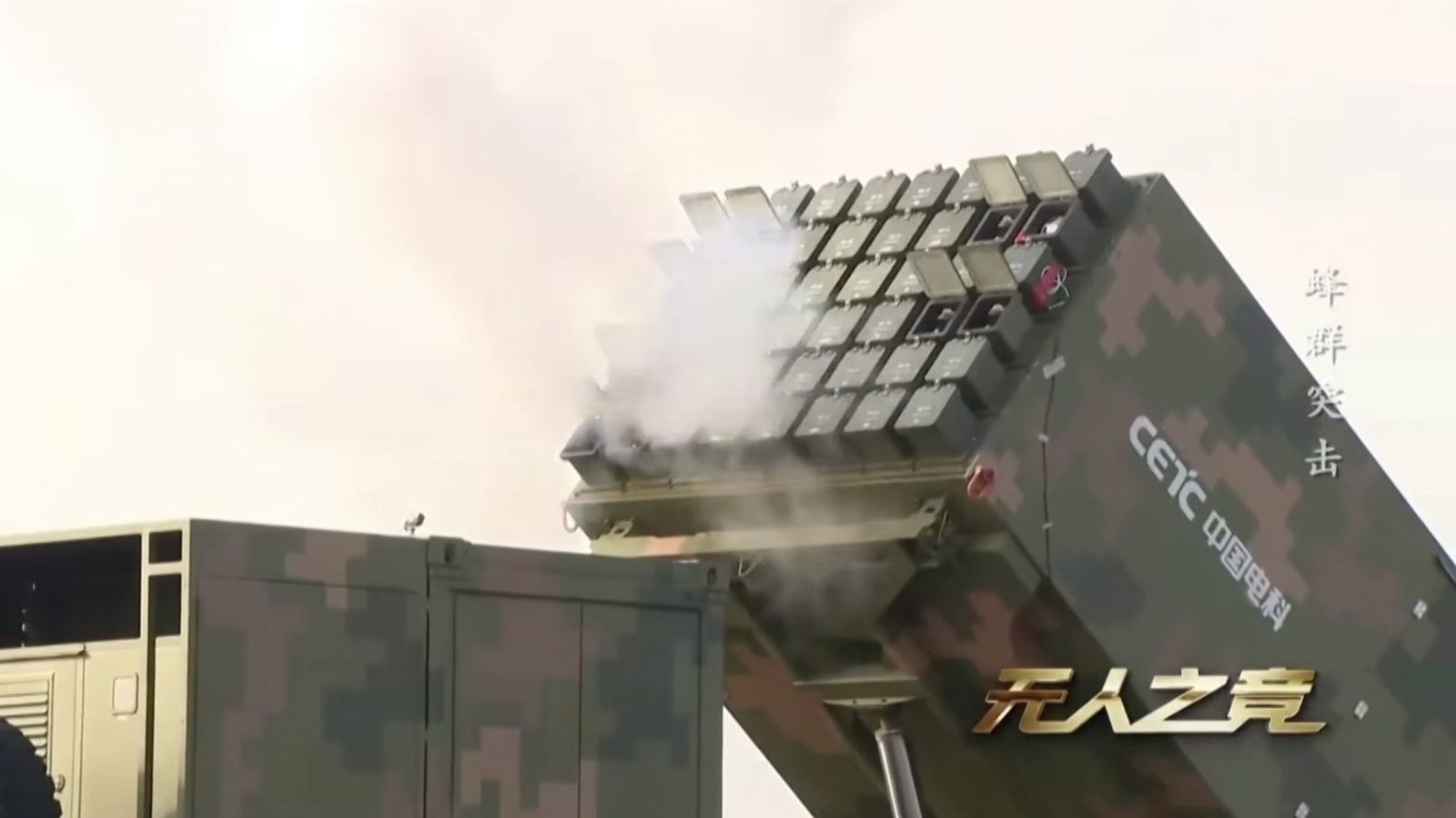
Making all this possible is the Swarm-2 ground combat vehicle, which serves as the launch platform. It first popped up at Airshow China 2024 in Zhuhai, which is the same event where some of China’s most advanced military weapons have debuted. Each Swarm-2 is said to carry and fire off 48 fixed-wing drones. Then there’s a separate command vehicle that can reportedly manage up to 96 drones at once, which means two launchers feeding into a single control point. CCTV compares this to one person flying 100 kites on a single string. A support vehicle rounds out the fleet, handling logistics and maintenance during longer operations in the field. The launch vehicle is seen with the logo of China Electronics Technology Group Corp slapped across its side, which is one of the country’s biggest state-owned defense contractors.
The algorithms tying it all together
Making everything work together so seamlessly is an advanced swarm-control algorithm. The algorithm is claimed to give each drone the ability to make its own decisions. They share information in real time, adjust their positions accordingly, and coordinate tight formations even at high speeds. They’re also smart enough to adapt to environmental factors like wind speed changes and airflow disturbances, all on their own. They don’t have to wait for new instructions for the basic stuff.
Moreover, thanks to a modular design, the system also allows multiple battlefield applications. For instance, the system can also perform saturation attacks. That basically involves flooding enemy air defenses with drones from multiple directions and in multiple waves. Defenders get overwhelmed and simply can’t keep up. It’s worth mentioning here that China is also developing the other side of that equation — its Hurricane 3000 microwave weapon, which is specifically designed to shoot down drones in bulk.
Drones powered by Atlas can also loiter over a target and watch it continuously prior to attack. This significantly boosts precision. And for more long-range applications, drones with ranges stretching up to thousands of kilometers can fly low and slow, making detection difficult — at least initially.
Wang Yunfei, a Chinese military expert who spoke to the Global Times, said that all this has only been possible thanks to China’s massive progress in AI. But China isn’t alone in such advancements, as the U.S. has also been exploring ways to upgrade its own swarm tech with battlefield-tested Ukrainian UAVs.
That said, it’s worth keeping in mind that everything we know about Atlas comes from Chinese state media and state-affiliated experts. None of these capabilities have been independently verified.

Stephan is the sports journalist for the Maple Grove Report.