In the city of Peculiar, a Kansas City suburb, a mayor and a city administrator were forced from their jobs over plans for a data center. In Festus, south of St. Louis, residents thronged city council meetings, leading police to escort out a former council member. And in St. Charles, a St. Louis suburb, local officials enacted an outright ban on data center construction.
The rapid expansion of hyperscale data centers is far outstripping efforts to regulate them in Missouri and other states.
As a result, communities are responding with hastily called moratoriums and divisive local elections to address the massive industrial facilities popping up across America.
Related: What data centers might mean for your electric bill
“Legislation traditionally lags very far behind technology,” said Missouri Rep. Mike Costlow, a Republican who tried to pass a bill regulating data centers this spring, “and that can create some problems.”

According to a Stanford report, the United States now hosts more than 5,400 data centers — 10 times any other country — with hundreds more in development. This rapid growth is driven by cloud computing, streaming services and artificial intelligence use.
The Midwest is one of the hottest growth areas. Missouri has at least 91 active data centers of various sizes, and at least 14 data centers are currently in various stages of development across the state. As they’ve spread, regular local government meetings around the country have been attended by scores of opponents.
State and local regulation has not kept pace with the explosive growth. One data center can use as much electricity as 80,000 households. Some have the potential to use up to 5 million gallons of water daily, as much as a small city.
“Our current laws around zoning, economic development, water and energy use were not at all built for this moment of rampant data center buildout,” said Alli Finn, director of community partnerships at AI Now, a policy research firm based in New York City.
States fail to pass legislation
State legislatures are struggling to regulate data centers. Maine would have been the first to pass a statewide moratorium on data centers, but the governor vetoed the proposal earlier this year. Lawmakers in Georgia also tried to implement a moratorium, but the bill stalled in the session that ended in April.
At the Missouri legislature, lawmakers introduced a number of bills this year in response to the explosive growth of data centers. The proposals included requiring large, nonagricultural water users to get a permit, charging data centers special rates for high water use and banning the use of local tax incentives for large data centers.
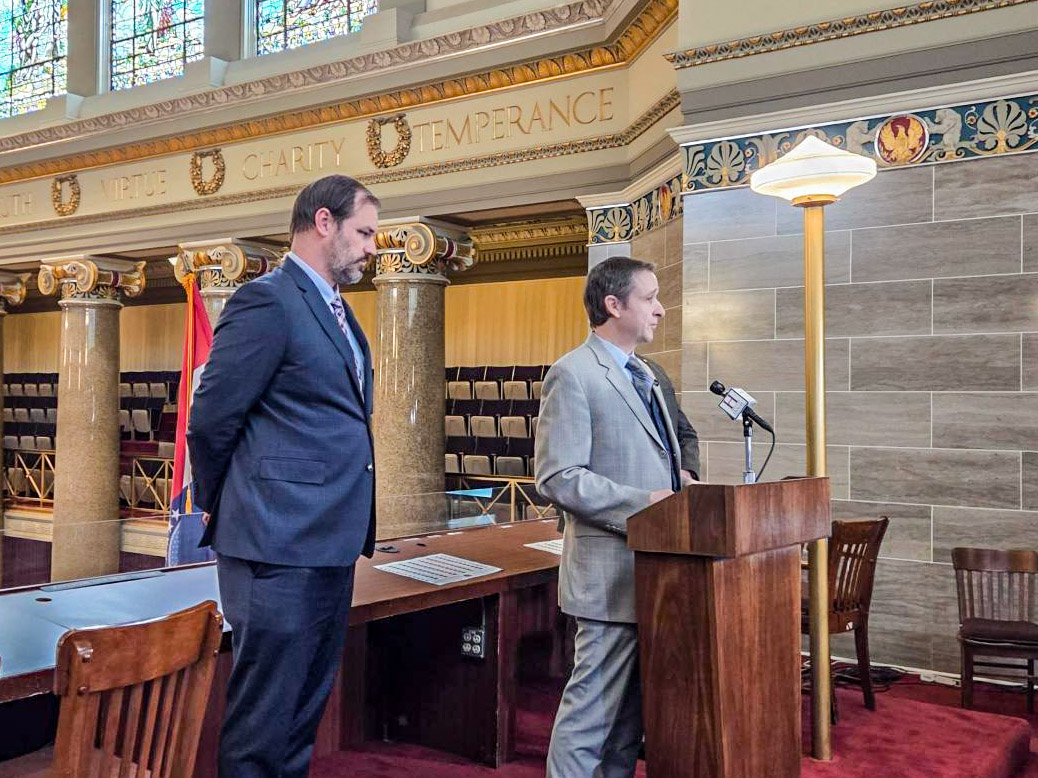
“It’s a bipartisan effort that addresses urgent needs in our state that aren’t going away,“ Republican state Rep. Colin Wellenkamp said at a press conference to introduce one measure, which would have regulated water and electricity use for large-load users. “They’re only going to get more urgent.”

But by the close of the legislative session, Wellenkamp’s bill and others like it still had not made it to the House floor for debate. They would have faced tough fights in the Senate, where they likely would have been referred to the committee chaired by Republican state Sen. Mike Cierpiot.
He said he doesn’t get the opposition to data centers, especially at a local level.
“I don’t really understand it because (of) the taxes they bring to a district for the school districts and for the local governments. The state really doesn’t get much off of it, but the locals do,” Cierpiot said. “Some communities would really benefit from a large data center as far as a tax base.”
The budget in Missouri, like many other states, is constrained as federal funding approved during the COVID-19 pandemic finally runs dry. Missouri is also expecting lower revenues after the legislature approved eliminating the capital gains tax last year.
Data centers could be used to generate revenue for local and state governments, but some lawmakers say transparency and environmental regulations should be in place to ensure that data centers provide benefits.
“As a state, we need more revenue,” said state Rep. Marty Joe Murray, a St. Louis Democrat. “If this is the lever that they are trying to use, we need to make sure we have some regulations in place.”
As state legislation has failed to materialize, local officials have dealt with data centers on their own, often facing backlash.
St. Charles Mayor Dan Borgmeyer saw the benefit of the tax revenue that would have come from a $1 billion data center proposed by developer CRG.
“I’d love to have the $9 million a year,” he said. “Our casino generates about as much.”
But after residents fought back on Facebook and meetings turned into shouting matches, Borgmeyer said there was no hope for data centers in his town. Community members feared potential impacts on their already contaminated water supply and rising electricity rates.
“The public does not want it, and so therefore I’m supporting their wishes,” he said.
In St. Charles, the city council approved a one-year ban on data centers last August. Eight months later, the council approved another measure effectively banning data centers in their town — this time, permanently.

Borgmeyer believes the resistance to data centers was misinformed and overly reactive to things like nondisclosure agreements, which he said are necessary for sensitive business deals.
“A, it’s a highly, highly competitive situation and, B, it’s just not good economics to develop that way where everybody else knows all your business,” he said. “So, the NDA became the villain.”
St. Charles City Council Vice President Justin Faust said transparency is key. He said the data center developer in St. Charles provided limited information, and representatives from the company could not answer basic questions.
“We have to answer to our residents in a timely manner,” he said. “Saying, ‘Trust me, I’ll get that information later,’ is not acceptable on any terms.”
Lessons learned
Former leaders in Peculiar have had two years to reflect on their rejection of a proposed data center in 2024. As detailed in a story by The New York Times, residents were concerned about increased water rates, traffic, noise pollution, light pollution and the loss of their small-town way of life.
Alderman Zach Poland said data center opposition was so “publicly vile” and “vicious” that it led him not to run for office again.
Related: Minnesota residents opposed to data centers look to legislators for moratoriums and transparency
“I was exhausted, frustrated, discouraged and had determined that public service was not for me, and I would be done after my term,” he said.
Poland said communities should not let opposition shut down discussion. He advised other officials faced with data centers to declare their neutrality early.
“If I was to do that again, I think I’d need to be a little bit more bold and say, ‘Just hold on, nothing is done,’” he said.
To Finn, of AI Now, data center regulation needs to be comprehensive.
She co-authored the North Star Data Center Policy Toolkit, which provides a menu of options for local, state and regional authorities. Suggested interventions include establishing conditional use permits, limiting tax incentives and subsidies, implementing air pollution measures, regulating noise, requiring fair labor practices, promoting grid stability and renewable energy infrastructure, and more.
Moratoriums are a good way for communities to give themselves more time to develop regulations, Finn said. But they are not a solution.
“Moratoriums are only as good as what happens when they’re in place or after,” Finn said.
Wellenkamp thinks moratoriums will continue to crop up as long as cooperation is strained between local governments and data center developers.
“If the industry does not answer citizens’ concerns and starts being more transparent, talking to localities, being partners with localities in this buildout, life is just gonna get harder for them,” Wellenkamp said.
In Festus, where residents’ anger led police to intervene, voters recently ousted a slate of four City Council candidates who supported a data center. Now, newly sworn-in council members will now have to deal with the ongoing debate over the proposed $6 billion CRG data center, which the company proposed after failing in St. Charles.
Murray said the state handing down regulations may not be the solution to problems posed by data centers — but elections are.
“That’s what elections are for,” Murray said. “If they feel as though their representative isn’t listening to them on this issue or any other issue, they always have the means to change that person.”
Abigail Cornell contributed to this report.
This story is a product of the Mississippi River Basin Ag & Water Desk, an independent reporting network based at the University of Missouri in partnership with Report for America, with major funding from the Walton Family Foundation.
Related