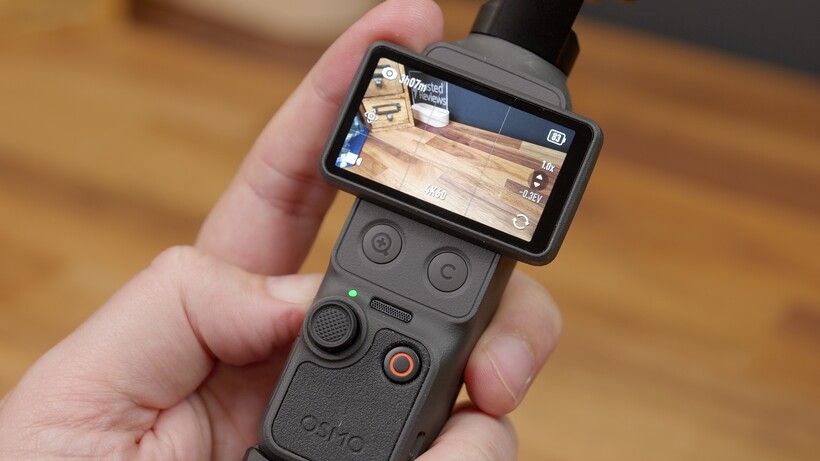

Despite the Pocket 4 only launching back in April, DJI has revealed the Pocket 4P.
Hailed by DJI as being a “pocket cinema camera” that offers “unparalleled vision and cinematic capabilities”, how do you choose between the Osmo Pocket 4P and the Pocket 4? Is one a better choice for your needs than the other?
Ahead of our Osmo Pocket 4P review, we’ve compared its specs to the Osmo Pocket 4 and noted all the differences and similarities that you need to know. Keep reading to see how the two handheld cameras really compare.
Otherwise, visit our round-up of the best action cameras while our DJI Osmo Pocket 4 vs Pocket 3 explains what’s new with the latest iteration.
Specs Comparison
| DJI Osmo Pocket 4 | DJI Osmo Pocket 4P | |
| Sensors | CMOS sensor with 14-stop dynamic range | CMOS sensor with 17-stop dynamic range and 60mm telephoto |
| Max video recording | 4K@240fps | 4K@240fps |
| Colour Profile | 10-bit D-Log | 10-bit D-Log 2 |
| UK RRP | £445 | N/A |
Price and Availability
The DJI Osmo Pocket 4 is available to buy now and has a starting price of £445. However, there are plenty of bundle options to choose from which vary depending on how you plan on using the Pocket 4. For example, at £553 you can opt for the Travel Combo which includes a gimbal clamp, battery handle and magnetic ND filters.
At the time of writing, the exact pricing and availability details for the DJI Osmo Pocket 4P remain at large. While we know it will be available from June 23rd in Beijing with a starting price of ¥3,799, DJI is yet to announce international availability and pricing. We’ll be sure to update this versus once we get more information on the Osmo Pocket 4P.
DJI Osmo Pocket 4P features a 10-bit D-Log 2 Color Mode
The Osmo Pocket 4P is the first to feature a 10-bit D-Log 2 professional color mode. This, according to DJI, will unlock more post-production creative possibilities, while the new D-Log 2 colour will “master” light and shadow.
That’s not to say the Osmo Pocket 4 is a slouch by any means, as it can also shoot in 10-bit D-Log which we found resulted in colours looking vibrant and saturated but without ever looking too hyperreal. With this in mind, we can reasonably expect the new D-Log 2 mode will offer a brilliant colour reproduction.

Osmo Pocket 4P has a portrait telephoto lens
While the Pocket 4 sports just one main sensor (which we’ll go into more detail about later), the Pocket 4P benefits from dual main cameras. This includes a one-inch CMOS sensor plus a 60mm portrait telephoto lens too.
The telephoto lens sports an f1.8 aperture that DJI explains will precisely focus on the “subject’s brilliance”, and of course we’ll have to wait until we review the camera to really see how well it really performs.

Both allow up to 4K 240fps recording
Otherwise, the Osmo Pocket 4 and Pocket 4P enable up to a stunning 4K at 240fps recording. While we’re yet to review the Pocket 4P, we found the Pocket 4’s slow-motion mode to be fantastic and so stable, smooth and colour-rich that we rarely, if ever, felt the need to make tweaks or edits to the shot.

We therefore reasonably expect the Pocket 4P’s own 4K, 240fps shooting to be as superb.
Osmo Pocket 4P’s one-inch CMOS sensor delivers 17-stops of dynamic range
Although at first glance at the specs, you’d be forgiven for assuming the Pocket 4 and Pocket 4P share the same main sensor, there are a few notable differences to keep in mind. While both are one-inch, CMOS sensors, the Pocket 4P delivers 17-stops of ultra-high dynamic range. Instead, the Pocket 4 delivers 14-stops.
This should mean the Pocket 4P will be able to handle high-contrast and low-lighting shots easier than the Pocket 4. Considering we found the Pocket 4 capable of shooting low light scenes but it did tend to appear slightly too dark when used indoors with studio lighting, the promise of an improvement is certainly exciting.
Early Verdict
Of course, it’s difficult to determine how much of an upgrade the DJI Osmo Pocket 4P really is to the Pocket 4 without testing it ourselves first. However, with the inclusion of a telephoto lens, upgraded 10-bit D-log 2 colour mode and a main sensor that delivers 17-stops of dynamic range, the Osmo Pocket 4P looks set to be a brilliant option for content creators.
However, do keep in mind that its global pricing is yet to be announced and that could be a big factor when deciding between the Pocket 4P and the Pocket 4. We’ll be sure to update this versus once we get our hands on the camera.

Stephan is the sports journalist for the Maple Grove Report.