Do Speed Limit Signs On Private Roads Have To Follow Federal Rules?


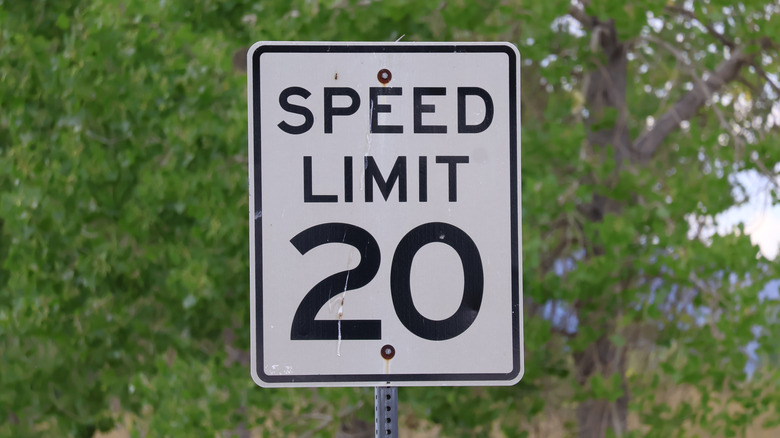
Drive down virtually any public road in America, and it won’t be too long before you see a sign at the roadside. Speed limit signs are among the easiest to spot, although the number you can expect to see on those signs varies a lot between different road types and locations. The fastest speed limit sign in America is an 85 mph sign in Texas, but the vast majority instruct drivers to stick to much lower speeds.

Part of the reason that speed limit signs are so easy to spot is that they look the same wherever you go. Their appearance is governed by the Department of Transportation, which publishes the Manual on Uniform Traffic Control Devices (MUTCD). The manual contains strict rules about the size, color, and shape of each sign type, including speed limit signs.

These rules apply to any road that’s open to public travel and does not have full-time access restrictions. The ownership of the road doesn’t make a difference to whether the rules apply or not, with publicly owned and privately owned roads needing to follow the same guidance.

Public access is the key differentiator between roads where the rules apply and those that are exempt. The MUTCD states that “roadways within private gated properties where access to the general public is restricted at all times” do not have to follow federal signage rules.

What kind of roads do the MUTCD rules apply to?
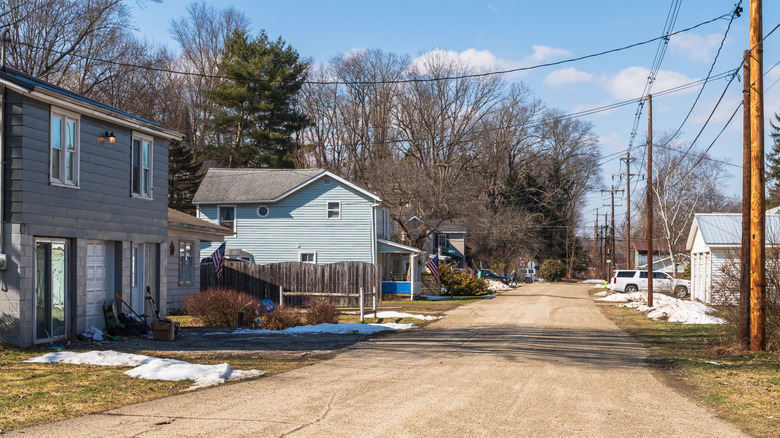
In many other instances, the rules set out by regulators must be followed. The manual lists examples including roadways within shopping centers and office parks, schools, universities, and recreational parks, as places where the standard rules all apply. These roadways are all intended to be used by the public, and so they must have signs that any driver will be able to instantly recognize.

If you’re looking to place a speed limit on a private road, there are a few limitations worth keeping in mind. Firstly, although it’s not illegal to post a speed limit on a private road, you’ll need to be the owner of the road in order to do so. Owners are then also responsible for the maintenance of the sign.

The other main limitation is that a speed limit sign on a private road isn’t necessarily legally enforceable. Rules can differ between different states and counties, but to take just one example, in North Carolina, law enforcement can’t ticket a driver for exceeding a posted limit on a road that isn’t part of the city street network. However, they can still potentially ticket a driver if they see a car driving on that road at a speed that officers deem unsafe for the conditions.

While speed limit signs on a private road can act as a deterrent for speeding delivery drivers or other road users, they’re not the only tool that can be used to lower road speeds. Deploying traffic calming measures like speed humps has also been shown to effectively slow drivers down, although they can cost a lot to install.


Source link

Leave a Reply

Subscribe to Our Newsletter

Get our latest articles delivered straight to your inbox. No spam, we promise.

Recent Reviews


A day before SpaceX’s initial public offering, which set stock market records, a giant inflatable figure of the company’s CEO, Elon Musk, appeared in Times Square in New York.

An unflattering caricature of a bare-chested Musk, with the words “SpaceX’s Grok makes AI child porn” on its chest and back, the inflatable was the centerpiece of a demonstration organized by the advocacy group Safe AI Now. The goal: tie the landmark financial offering to deepfake sexualized images of children generated by SpaceX’s AI platform, Grok.

The protest took place just outside Nasdaq’s global headquarters on West 42nd Street on Thursday.

A representative for SpaceX did not immediately respond to a request for comment.

A spokesperson for SAIN said in an email that because SpaceX owns Grok, it makes child porn. “A company that enables child porn is inherently unstable and puts American investors and retirement funds at risk. SpaceX shareholders are on the hook for every Grok lawsuit, criminal investigation, and regulatory fine that is coming,” the spokesperson said.

The organization describes itself on its website as “a coalition of faith leaders, family advocates, child development experts, online safety organizations, legal professionals, technologists, and concerned citizens working to ensure that artificial intelligence advances human flourishing.” SAIN is effectively anonymous; it does not identity any of its leadership or any individuals associated with the group on the website.

The effigy, the spokesperson said, was chosen as a metaphor for Musk and the companies he owns or is associated with, including the social media platform X and the satellite broadband provider Starlink, which have been absorbed into SpaceX along with Grok and xAI. (Musk’s automaker, Tesla, is separate.)

“Much like Musk and his companies, it is inflated, full of hot air, and could pop at any minute — it served as a warning to investors eager to buy into Musk’s SpaceX IPO today,” the spokesperson said.

Grok’s history of deepfakes

CNET AI Atlas badge; click to see more

Ever since Musk introduced Grok in late 2023 and made it available to premium subscribers on X (formerly Twitter), the AI platform has had fewer guardrails than rivals such as ChatGPT and Claude.

It has a history of promoting antisemitism and hate speech while also allowing users, with its image-generation features, to do things such as undress photos of celebrities with AI-generated images or to create sexualized images of children. Those types of images have led to criminal investigations and lawsuits, and xAI made changes it said were meant to address Grok’s problems. 

But as Wired reported on Thursday, Grok continues to host sexualized deepfake images and videos of well-known women. 


Source link