
My review of LG’s Sound Suite home cinema system is (finally) in, and my verdict is that it’s a fun, powerful, and occasionally frustrating home cinema system.
Sound Suite is pretty much the first of its kind, being the first soundbar system in the world to feature Dolby Atmos FlexConnect (or DAFC). What’s Dolby Atmos FlexConnect, I hear you ask?
Despite DAFC’s introduction sometime in 2023, it hasn’t gained much traction. The engines haven’t really revved; we seem to be stuck in neutral.
But with the LG Sound Suite providing an long overdue spotlight on Dolby Atmos FlexConnect (shall we call it DAFC from now on?), it could be on the cusp of having a moment. But can it capitalise on it, and is this tech for the many or for the few?
An inauspicious start
DAFC was announced at IFA 2023, and at the time, the only brand putting their weight behind it was TCL. At the following CES, Hisense revealed compatible speakers.
But these were only individual speakers, not full systems. There was no mention of soundbars or subwoofers, just speakers dotted around a room that connected wirelessly and synched with a TV’s speakers to provide a glimpse of FlexConnect’s potential.
DAFC wasn’t necessarily a novel idea. Other brands had implemented their own versions of it, but it felt as if Dolby wanted to democratise the surround space. Taking the convenience of wireless sound and marrying that with the ability to scale up your sound system over time. I’ve moaned about home cinema brands not doing enough to make surround sound accessible, but DAFC seemed like tech that would bring surround sound within anybody’s reach.

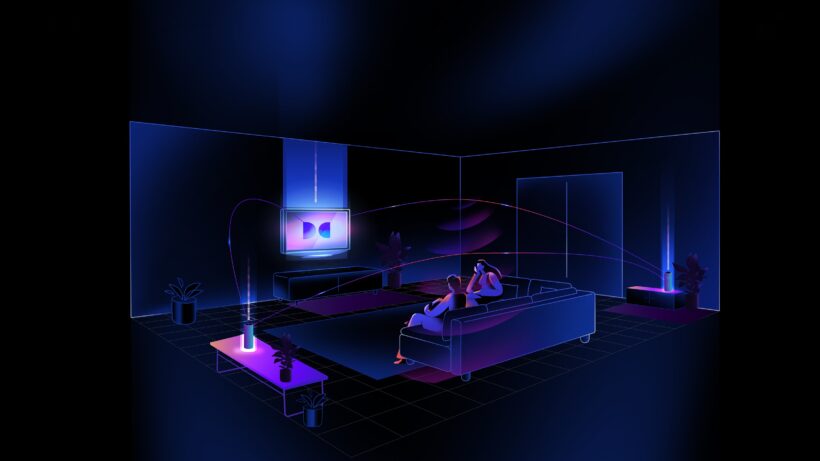
The clever part about FlexConnect is that it understands the position of each speaker in the room in relation to one other, and has the ability to compensate and optimise the sound for the room it’s in. No need to move your furniture around.
The system’s algorithms understand the number of speakers available and place sound accordingly, with ‘phantom speakers’ filling in the gaps where there weren’t any physical speakers through clever processing. The more speakers you have, the better, of course; but FlexConnect doesn’t necessarily need a full surround system to create an immersive hemisphere of sound.
That said, with this technology at manufacturers’ disposal, you would have expected more interest, but similar to Dolby Vision 2, uptake has been slow. TCL announced speakers in 2024, but we’re well into 2026 and it’s hard to find any stock.
And what’s the name of Hisense’s DAFC speaker? Couldn’t tell you. I can’t find any information about it online.
LG to the rescue… sort of
Its taken time, but we have a fully-fledged sound system that supports FlexConnect. LG’s Sound Suite sets a marker down in terms of expectations, though it doesn’t embrace the full concept of brand agnostic speakers partnering together. Sound Suite only works within LG’s home cinema ecosystem – so the promise of connecting speakers from multiple brands (similar to Auracast) is still yet to reach fruition.
But the Sound Suite shows the potential of the system. The ability to place speakers anywhere in the room, recalibrate (which takes less than 20 seconds) and get going again is very convenient in a world where people aren’t the most knowledgeable about technology and where possible, want the barriers to entry reduced to make it more accessible. If tech such as this is to take off, it needs to be easy to understand.

The main issue I had with the Sound Suite is that connectivity between the speakers themselves can fall away. The ThinQ app suggests either network instability or a group connection problem (my feeling is that it’s the latter), and other reviewers have noted these issues too, so I’m not alone in having these problems.
Is it a Dolby problem or an LG problem? I think it’s the latter and not a fundamental issue with Dolby’s tech, but despite it being three years since its debut, there are teething issues. Tech needs to be easy to understand, but it also needs to work.

Premium or mass market?
This is another area where DAFC needs to figure out what it wants to be. Is it technology for the masses, as TCL’s Z100 more affordable speakers try to be? Or is it a premium piece of home cinema tech? Can it exist as both?
Pricing is of course important. Dolby will see this as technology designed to be enjoyed by as many people as possible – the line I heard at a TCL event in Paris was that Dolby wasn’t being prescriptive (yet) on how DAFC can be integrated and was offering freedom to manufacturers in terms of how they utilised the FlexConnect software.
Thay made it seem as if Dolby is interested in seeing an ecosystem built first, as currently brands can ‘escape’ full compatibility in terms of speaker from brand A working with speakers from brand B. But that in the near future, Dolby would bring in more stringent rules and boundaries to avoid the market for these speakers being fragmented.

A rosy version of that future is one where all DAFC speakers could talk to one another, but I suspect that’s not what many brands want. Swapping in and out soundbars and speakers from different brands and with different capabilities, even though technically they should all be able to adapt to one another, doesn’t seem like something brands would want to do.
Other limitations rear their head in terms of compatibility. LG’s Sound Suite only works with (select) LG TVs starting from 2025. Would that be true of other brands? Are updates needed to unlock DAFC compatibility? If you’ve got a TV older than a few years ago, it’s likely it won’t be compatible with DAFC.
There are obstacles in the path of Dolby Atmos FlexConnect, and we’ve reached a point where we could use some clarity on the matter.
It’s become clear some brands aren’t, or were never, interested in the tech and have developed their own versions of it. Sony has its Bravia Theatre Quad and Bravia Theatre Trio speakers. Samsung’s Q-Symphony is similar, as is LG’s own WOW Orchestra while Hisense also has its Hi-Concerto. DAFC could have been the overarching tech that unites them all, but that hasn’t been the case.
So in the here and now, Dolby Atmos FlexConnect is a cool piece of technology – there are still some aspects it needs to figure out: price, who’s it for, broader compatibility – and with all the home cinema brands unveiling their 2026 line-ups, I doubt we’ll hear much talk about DAFC this year.
It’s in need of some momentum, and I’m hoping it’ll find some. DAFC could be a game-changer, but to change the game, it needs to be in it in the first place.

Stephan is the sports journalist for the Maple Grove Report.