Google overhauls its AI plans – which one should you now choose?


Google's Gemini AI

Lance Whitney/ZDNET

Follow ZDNET: Add us as a preferred source on Google.


ZDNET’s key takeaways

  • Google has introduced a cheaper AI Ultra plan at $100 a month.
  • The full Ultra Plan is now $50 cheaper at $200 a month.
  • Certain AI Pro subscribers also get YouTube Premium Lite for free.

Looking to subscribe to one of Google’s Gemini AI plans? That decision just got trickier thanks to the latest changes. Yes, Google has rejiggered its various AI plans with lower prices and more features.

Also: Google I/O 2026 live: The latest updates

At its I/O conference on Tuesday, Google kicked off another variant of its most expensive AI Ultra plan, but with a lower price tag. Aimed at developers, tech workers, and creative pros, the lower-cost version will run $100 a month. At that price, the subscription offers the following benefits.

  • A usage limit five times higher than the AI Pro plan in both the Gemini app and the AI-powered Google Antigravity agentic development tool
  • Priority access to Google Antigravity
  • Integration with the new Gemini 3.5 Flash for quicker testing and debugging of your computer code
  • 20TB of cloud storage to house those hefty databases and media content
  • A YouTube Premium individual plan with ad-free access to YouTube videos

Also: OpenAI’s new image watermarks make it easier to spot AI fakes – here’s how

For developers and other pros who want the full AI Ultra plan, Google has cut the monthly price from $250 to $200. At that cost, you get a usage limit 20 times higher in the Gemini app and Google Antigravity, along with an array of other perks.

More new features for every plan

Whether you opt for the full AI Ultra plan or the new and cheaper variant, a couple of other features are heading your way.

Gemini Spark. Available only in the US, Gemini Spark is a new AI agent that aims to follow your commands to perform specific assignments on its own, under your direction. Spark can navigate across Google’s different products and services to handle complex tasks more quickly than you could manually. Rolling out to testers this week, Spark will launch as a beta in the US next week for all Google Ultra AI subscribers.

Also: Google’s new AI Search box is here – along with agents and 5 more upgrades

Project Genie. Currently available as a Google Labs experiment, Project Genie is a research prototype that lets you conjure up your own interactive virtual worlds. By supplying text descriptions and images, you’re able to create mini games and other environments populated by your own characters. Genie is now popping out of its experimental bottle and heading around the globe to all Google AI Ultra users on the $200 plan. Plus, you’ll be able to tap into Google’s Street View to add a dose of reality to your fictional lands.

If you’re a developer or other pro eyeing one of the two Ultra plans, the less expensive variant may be your best bet. If you find yourself hitting its limits, you can always switch to the more expensive subscription. Otherwise, that $100-a-month price tag makes the cheaper one quite tempting.

Ah, but Google isn’t forgetting about people on its other AI plans, including Plus and Pro.

Gemini Omni. Rolling out globally to all four AI plans (Plus, Pro, and the two Ultras) is the new Gemini Omni model, designed to generate videos. Omni takes a multimodal approach, which means you can add your own text, images, and videos to create your short video productions. You can fashion the characters, scenes, visuals, sounds, and effects, and then edit your video to fine-tune it. Omni will take the stage in the Google Flow video generator to help achieve greater consistency in character and voice from one scene to another.

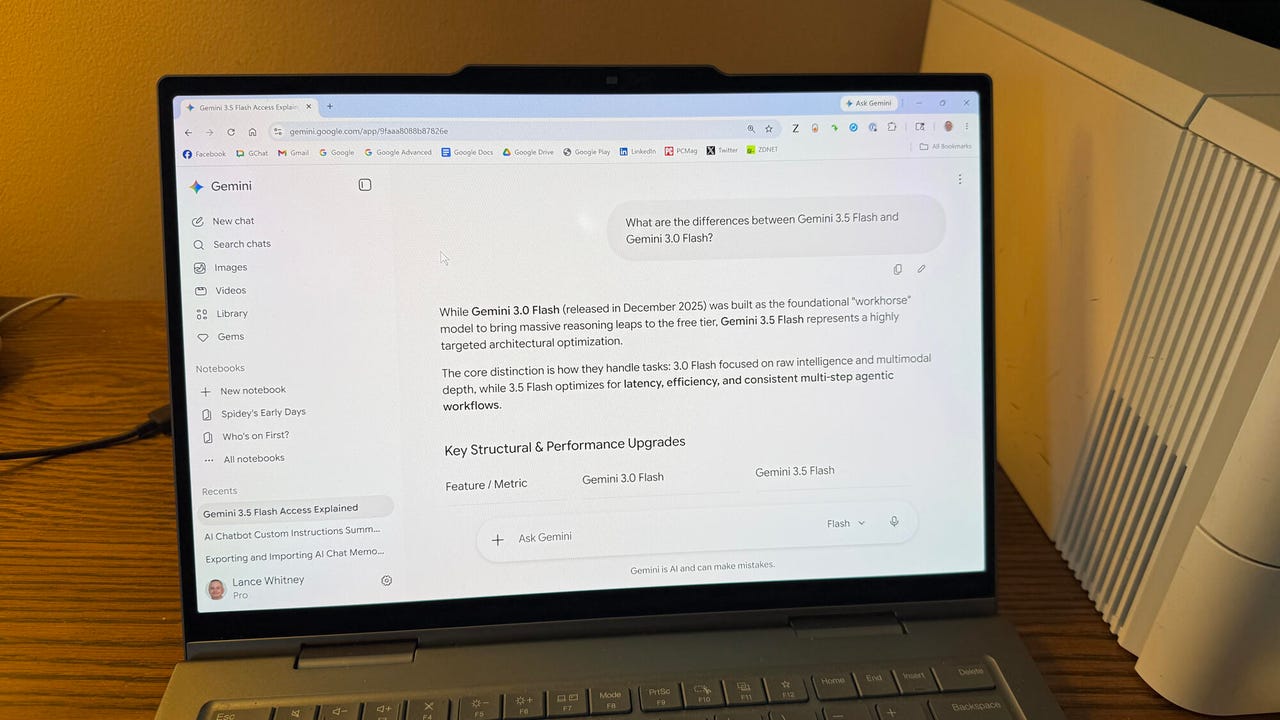
Gemini 3.5 Flash. Now rolling out globally across all four Google AI plans, the new Gemini 3.5 Flash frontier model promises faster speeds and greater understanding than its predecessor, especially for agentic and coding tasks.

Also: I tested ChatGPT Plus vs. Gemini Pro to see which is better – and if it’s worth switching

AI inbox in Gmail. Already available to AI Ultra plans and now rolling out to AI Plus and AI Pro plans in the US, Gmail’s AI inbox aims to help you better manage your inbox. Analyzing the torrent of emails you likely receive, Gemini will suggest items for your to-do list, mark those items as done, draft replies, and find links to related files in Google Docs, Sheets, and Slides.

Daily brief. Accessible to all Google AI subscribers, the daily brief is another feature moving from experimental status to full availability. Here, an AI agent scours your emails, calendar appointments, and Gemini chats to see what’s new, urgent, or overdue. The daily email you receive compiles all those items into a digestible, readable list and suggests next steps. The goal is to review your priorities and take action on the most pressing ones.

YouTube Premium Lite plan at no extra charge

And there’s one more thing.

YouTube Premium Lite. Free access to YouTube Premium is already included in a Google AI Ultra plan. But now it’s expanding. Over the next few days, AI Pro subscribers in certain countries will get a free YouTube Premium Lite plan at no extra charge. In contrast to a full Premium plan, the Lite flavor quashes ads for gaming, fashion, beauty, news, and other topics but still displays them for music and many other videos.

Also: YouTube Premium vs. Premium Lite: Is the cheaper tier still your best deal?

Google measures how much you use Gemini to make sure you stay within the limits of your plan. But the way your use is calculated has now changed. Instead of treating each prompt as equal against your limits, Google is using a compute-based model. This approach factors in the complexity of your prompt, the features you use, and the length of your chat. Your limit will refresh every five hours until you reach your weekly quota.

If you hit your limit, you’ll be shifted from the larger AI models to the smaller ones. AI Pro and AI Ultra subscribers can also purchase AI credits on the go if they need to continue using the more advanced models for Google Antigravity, Google Flow, and the Gemini app.

Unless you’re a developer who needs an Ultra plan, the decision comes down to the AI Plus plan at $8 a month and the AI Pro plan at $20 a month. The Plus subscription limits how much you can use Gemini and other AI features by imposing stricter quotas. If you’re currently looking for a Gemini plan but don’t anticipate heavy usage, you may want to opt for the AI Plus subscription and save yourself $12 a month or $144 a year.

Also: Google’s AI Overviews will show you advice from other people now

Another option, though, is to look for a discount. For example, Verizon offers a perk: you pay $10 a month for an AI Pro subscription. This is the main reason I stick with the Pro plan; otherwise, I would seriously consider the Plus plan.

Whichever plan you choose, remember that Google charges for them on a monthly basis. That means you can always switch to a different subscription from one month to another to see which one works best.





Source link

Leave a Reply

Subscribe to Our Newsletter

Get our latest articles delivered straight to your inbox. No spam, we promise.

Recent Reviews


If Game Two of their first-round playoff series with the Denver Nuggets saved the 2025-26 season for the Minnesota Timberwolves, Game Three showed why it should be saved. 

The Timberwolves were a different beast while decisively thumping the Nuggets, 113-96 Thursday night at Target Center, in a game that wasn’t nearly that close. These Wolves were the mythical creature we’d heard about in preseason lore, purposefully locked and loaded to be both marauding and staunch. They owned both ends of the court, gleefully transferring back and forth from irresistible force to immovable object. 

A quartet of Timberwolves deserve special mention, but it begins with Jaden McDaniels. After his team had toppled Denver to even the series at a game apiece Monday night, McDaniels used the sizable chip on his shoulder to etch some graffiti into the public discourse, casually castigating the most prominent Nuggets players by name as “bad defenders” in a matter-of-fact manner that had the media compelling him to confirm what he had just said. 

Trash talk is fleetingly fungible in the jaundiced social environment of 2026, functioning more like coupons than currency in that it needs to be rapidly leveraged before its expiration date. The common perception naturally was that McDaniels was calling out the Nuggets. But in a more subtle, profound way, he was also putting his teammates on notice. 

All season long the Timberwolves have procrastinated on their full potential, frequently demonstrating that their preseason talk about maturity and commitment was cheap. By contrast, those words uttered by McDaniels were expensive. He had just picked a fight with the opponent, leaving open the question of how many of his teammates would join him in the fray. 

That he would lead the charge was established early, after the Timberwolves’ top two scorers, Anthony Edwards and Julius Randle, had each missed a pair of open looks against Denver’s bad defenders in the game’s first 90 seconds.  

With the game still scoreless, the NBA’s best pick-and-roll combo, Nikola Jokic and Jamal Murray, were clustered around the foul line with Minnesota’s best defenders, McDaniels and Rudy Gobert. As they jammed up Jokic, McDaniels picked the ball loose and started sprint-dribbling the other way. To no one’s surprise, Donte “Ragu” DiVincenzo was also on his horse in transition, receiving a pass from McDaniels and then lobbing it back for a Jaden slam against a hapless Murray and Murray’s late-arriving teammate, Cam Johnson, who committed the foul that allowed McDaniels to finish with the “and-1” free throw. 

On the Timberwolves next offensive possession, McDaniels muscled his way to two offensive rebounds, feeding Ragu off the first one for a missed three-pointer, which he corralled for the second one and executed the putback in traffic. It was McDaniels 5, Nuggets 0, setting the tone for a game in which not only did the Wolves never trail, but never let the lead go under double digits after McDaniels made a consecutive pair of driving layups eight minutes into the game. 

“Spectacular. I thought his activity offensively in the first quarter was outstanding,” said Wolves coach Chris Finch after the game. “He was inspirational.” 

Among the most inspired were McDaniels fellow wing players, Ragu and Ayo Dosunmu. Ragu is exactly the kind of player who will have your back in a squabble, and his galvanized performance seemed borne of satisfaction that someone else had clarified the mission. As usual, the Timberwolves were at their best with him on the court: +20 in the 32:54 he played, -3 in the 15:06 he sat. 

“He makes so many hustle plays, momentum plays, different styles of plays.” Finch raved. “He’ll make a shot, get a transition bucket, he’ll rebound, get a steal, blow something up. So many different plays. He’s just a basketball player.”

Related: How the Timberwolves sparked a season-saving Game 2 comeback over the Nuggets in Denver

Then there was Ayo, whose fearless, blazing, bee-lines for the bucket were quicksilver kryptonite for a Nuggets defense that is neither swift nor rugged. “I’ve been waiting for him to wake up a little bit in this series,” Finch accurately observed. “The downhill mindset that he played with all season for us was back.”

Back with the sort of multipurpose propulsion that leaves witnesses with giddy whiplash. Ayo led the team with 25 points and 9 assists in 32 minutes of time-lapse hoops, the lone blemish being three clanks from long range. Why chuck treys when you can so easily undress players in the paint? Ayo was 10-for-12 on two-pointers and none of those dozen shots came from anywhere but beneath the rim. Five of his nine dimes likewise yielded layups or dunks, which means he personally accounted for 30 of the 68 points in the paint by the Timberwolves on Thursday, doubling up the Nuggets’ 34.

Which brings us to the non-wing in Game 3’s ring of honor, Rudy Gobert. For the third straight game, Gobert blunted the supposed advantage Denver had with the magical playmaker Nikola Jokic at the controls. Suffice to say that in the last five quarters, Jokic has shot 8-for-33 from the floor. If that continues, the Nuggets are toast in this series. 

When I asked Finch after the game if the herculean job Gobert was doing on Jokic made planning his defense simpler and better thus far, he replied, “Rudy is making all of us look good right now with his defense.” 

Amen.

If there is an asterisk on this game, it would be the absence of Denver’s brutishly versatile power forward Aaron Gordon. Nuggets coach David Adelman should be given a lot of credit for his honesty and transparency in dealing with the media during his first full season at the helm, but it came back to bite him and his team during the pregame presser, when he was clearly rattled and dejected by the sudden unavailability of Gordon, whose playing status went to “probable” to “out” in a period of a few hours due to a chronic calf strain. 

Gordon is far and away his team’s best defender, making the timing of his injury especially troublesome in the wake of McDaniels laying down his marker. Rattled is a good way to describe the entire team’s performance in the first quarter, an emotional wounding that needs to heal as fast as Gordon’s body if the Nuggets are going to be competitive in a series that had dramatically been flipped on its head over the past three days. 

That the Timberwolves played with such dominance despite mediocre outings from Ant and Randle would be a good thing for both of those current cornerstones to keep in mind. Ant was beset by foul trouble and Randle had a solid second quarter, but it stood out that neither player fully embraced what so often works on offense when the Wolves are at their best: Push the pace, move the ball, move without the ball, and make quick decisions. Ant and Randle can still be first among equals and blend into that catechism if they stay attuned to the possibilities of a greater good, one that all of sudden doesn’t have to end with them being postseason fodder for the Spurs or the Thunder. 

Not when you’ve got three wings at a collective peak, with a chaser of Rudy semi-clowning the Joker. 


Source link