Googlebook vs. Chromebook: Why I’m hopeful that both laptop brands can coexist


Chromebook vs. Googlebook

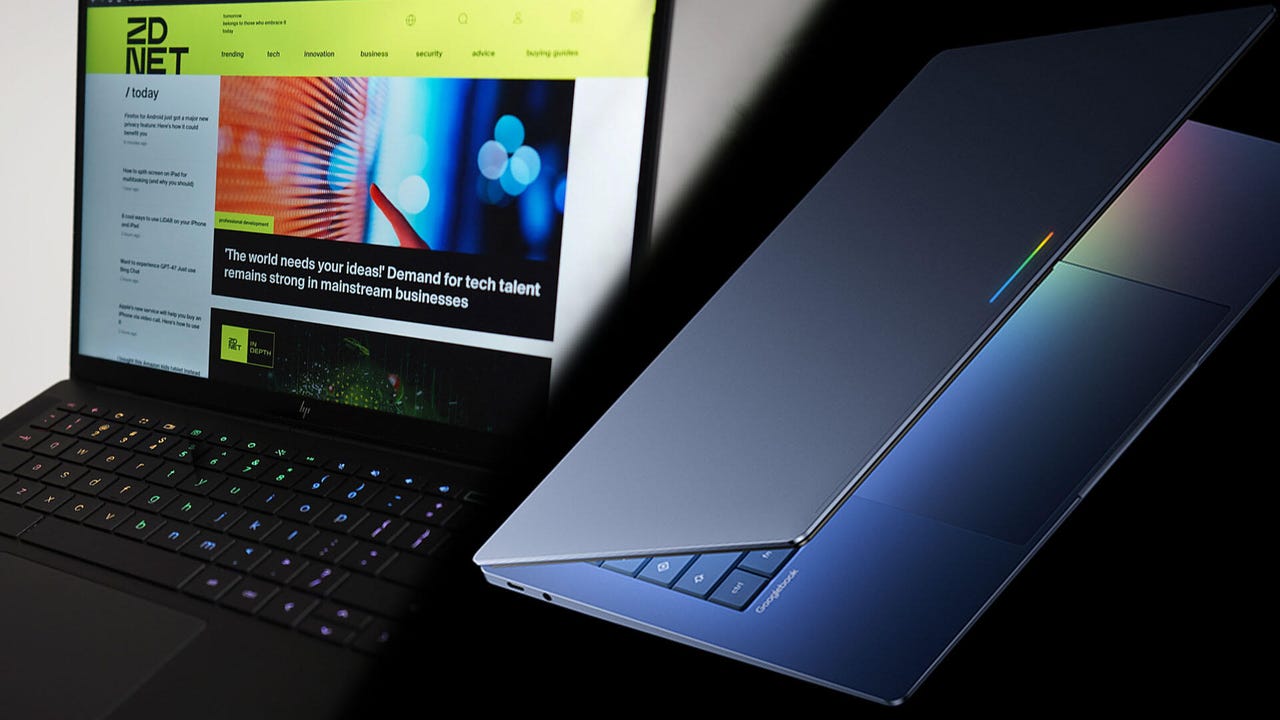
Kerry Wan/ZDNET and Google

Follow ZDNET: Add us as a preferred source on Google.


ZDNET’s key takeaways

  • Google announced the Googlebook, a new premium laptop line.  
  • Chromebooks will continue to receive support. 
  • Chromebooks focus on affordability, while Googlebooks aim for a premium experience.

During a recent briefing ahead of its I/O developer conference, Google revealed the Googlebook, a new category of laptops that combines ChromeOS OS and Android into a single operating system. 

The advent of this original system raises an important question: Are Chromebooks going away? According to Google, the answer is a resounding “No”. In a virtual roundtable, Alexander Kuscher, Google’s tablet and laptop lead, clarified “Chromebooks are not dead” — at least for now.

Why Chromebooks will continue

Even if Google wanted to end support for Chromebook tomorrow, it realistically couldn’t, as they’re embedded across multiple consumer sectors. Bryan Lee, VP of ChromeOS Enterprise Go-to-Market, told ZDNET that “Chromebooks have become an invaluable tool for educational institutions, businesses, and consumers… We absolutely intend to continue investing in those experiences and supporting those users.”

Plus, Chromebook have a 15-year head start over Googlebooks. It’ll likely take years for the latter to reach a similar level of adoption.

Also: The best Chromebooks for students in 2026: Expert tested and reviewed

The other key factor is intent. Chromebooks are primarily designed for everyday users. Googlebooks, on the other hand, are more premium devices, aimed at pros and power users — particularly with Android smartphones. In fact, one of the Googlebook’s defining features is a merged OS, enabling seamless access to their Android smartphone on the laptop with no download required.

Lenovo Chromebook Plus

Kyle Kucharski/ZDNET

And finally, there is Google’s long-term commitment to ChromeOS. The company has pledged to continue supporting and updating Chromebooks through 2034 so they’re not disappearing anytime soon. Still, that raises another question: What happens after 2034? Will Google eventually phase out Chromebooks and ChromeOS in favor of Googlebooks and its operating system? Maybe.

The future of Chromebooks

Google, as a company, has never been shy about discontinuing products and services in favor of newer initiatives. Just look at the Google Graveyard; there are 300 entries as of this writing. 

Remember: the Googlebook is touted as a “premium” machine. Down the line, it’s possible that Google could introduce a new line of midrange Googlebooks that directly overlap with the Chromebook market. Not seeing any point in keeping two affordable lines, it may one day pull the plug on Chromebooks, but the Googlebook market would need to be well-established at that point.

Also: Windows rivals to MacBook Neo are here – but I’m more excited for Google’s response

As of now, nothing has been confirmed. We’re still eight years away from the currently stated end-of-support date for ChromeOS. Lee also told ZDNET that more Chromebooks are currently in development, and the company is restocking BackMarket with ChromeOS Flex USB drives

For those who don’t know, these are flash drives preloaded with ChromeOS Flex. They allow users to install Google’s lightweight operating system onto older laptops. BackMarket highlights them as a way to breathe new life into aging Windows 10 PCs (or even older MacBooks). 


Source link

Leave a Reply

Subscribe to Our Newsletter

Get our latest articles delivered straight to your inbox. No spam, we promise.

Recent Reviews


Researchers in South Korea developed a wearable system that uses seven smart rings to read finger and hand motions to translate American Sign Language and International Sign Language into text. The purpose is to make communicating easier between those who sign and nonsigners without needing a separate human interpreter. 

AI Atlas

According to the study, published Friday in the journal Science Advances, the system reliably recognized 100 ASL and ISL words during testing. It also performed well with users the system had not seen before, and it didn’t require recalibration for each person. Because the system detects words in sequence, it can produce sentence-level translations without extra training on grammar. 

ASL and ISL are the everyday languages of more than 72 million deaf and hard-of-hearing people. However, most hearing people do not know any words in these languages or have a very basic understanding. That gap makes certain tasks, like ordering at a restaurant or asking for help, much more difficult. 

A graphic shows two illustrated people talking in sign language, ASL and ISL. The graphic also shows the different components of the ring as well as pictures of hands modeling the rings.

A concept of how the rings work in the real world. 

American Association for the Advancement of Science (AAAS)

Existing sign language translator prototypes often rely on bulky gloves that can distract from or block natural hand movement or feel uncomfortable for the wearer, which limits real word adaption. Camera-based technologies can work well in controlled environments but are often limited to those places where a camera can be set up with a clear line of sight, the researchers wrote. 

To solve these problems, the researchers designed sensing rings for each finger that can capture precise motion and finger position while letting the hands move naturally. The rings can detect both signs that involve movement, like the words for “dance,” “fly” and “sun,” and signs that are held still, like “I” and “you.”

“These advances suggest that [the device could enable] barrier-free public translation systems for unseen users and unrestricted daily assistive interfaces,” the authors wrote in the study. 

The authors are affiliated with Yonsei University, Hankuk University of Foreign Studies and the Korea Institute of Science and Technology, among others. While the technology is still experimental, the authors wrote that the technology has the potential to ease communication difficulties. The underlying idea could also help improve controls for other systems, like virtual or augmented reality.

“Beyond sign language translation, the ring-type, wireless, and modular architecture of (wirelessly connected, ring-type sign language translators) may also be extended to other gesture-driven applications such as virtual or augmented reality control, touchless device interfaces, or rehabilitation monitoring systems where fine-grained hand movement tracking is essential,” they wrote.


Source link