GOP US Senate endorsement goes to Navy SEAL Adam Schwarze


DULUTH, Minn. – Michele Tafoya, who broke with GOP tradition in vowing to continue her quest for retiring Sen. Tina Smith’s seat, may be an exception to an unofficial rule: a candidate who fails to get the Republican Party’s endorsement nearly always loses the nomination.

After six rounds of balloting that eliminated other candidates, including former NBA player Royce White, the endorsement went to former Navy SEAL Adam Schwarze, who received the support of nearly 63% of the GOP delegates.

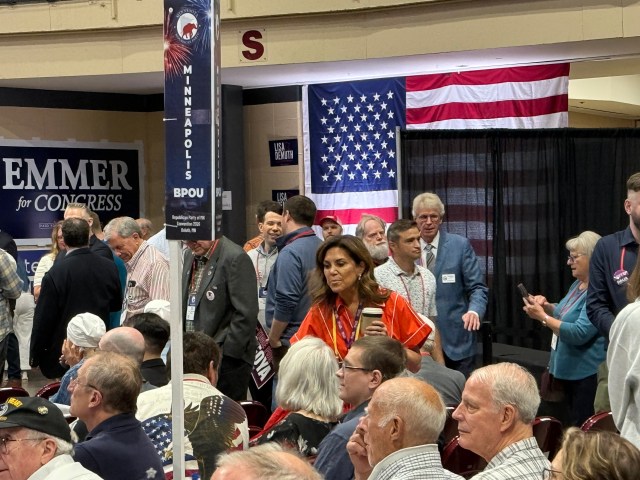
In speeches on the convention floor Friday in Duluth, Schwarze urged delegates to reject Tafoya’s pitch that she was the most “electable” candidate and said Republicans could win the Senate race “without compromising our values.” 

In a victory speech, Schwarze thanked delegates and said, “I will not compromise.”

“I will fight in D.C. and we will fight to take back our state together,” he said. 

Despite her loss at the convention, Tafoya, who had already said she would buck the state party by not abiding by the convention’s choice, said her campaign will continue moving full speed toward the August primary election.

But that carries some risk. 

A non-endorsed GOP candidate has not won a Republican primary since 1994, when Arne Carlson, who was considered too moderate for the delegates at that year’s Republican Party convention, went on to be his party’s nominee and win reelection to the governor’s office.

“Unlike the Democrats, the Republican track record in Minnesota of bucking the convention in recent history has not worked out well,” said Hamline University political science professor David Schultz.

Tafoya, a former sports broadcaster, does not have the advantage of being an incumbent like Carlson. But she does have the full support of the National Republican Senatorial Convention (NRSC), plenty of name recognition, the ability to raise a lot of campaign cash and is media savvy.

She touted those strengths in appeals to delegates Friday, but couldn’t earn above 37% of the votes. 

Losing the endorsement has cost Tafoya the support of the state Republican Party, but Schultz said that’s a very small loss, especially since she’s backed by the NRSC, which would pour millions of dollars in the race if Tafoya wins the Aug. 11 primary and is considered competitive in a general election.

“The Republican Party in Minnesota is still in the most part broke,” Schultz said.

In the November general election, Tafoya would likely face either Democratic Lt. Gov. Peggy Flanagan or U.S. Rep. Angie Craig, D-2nd District, who shares something with Tafoya – she also rebelled against the party convention process.

Tafoya was a victim of an increasingly strong trend in national politics. To win party endorsements – and to a large extent party primaries – candidates have to appeal to their party’s base voters, which are strongly conservative when it comes to the GOP and progressive for Democrats.

Chisago County delegate Tony Kaufman, who supported Schwarze, said the party activists who cast ballots at the GOP state convention are the most knowledgeable when it comes to picking a political candidate.

“When you support the endorsement process, you’re supporting an informed base, an informed constituent, and that’s why we’re excited about it, and that’s why we choose to abide by the endorsement,” Kaufman said. “Because it’s not only the Republican Party, we want the citizens of Minnesota to be able to have the same opportunity to be able to get behind a candidate.”

But party-endorsed candidates who appeal to the extremes of both parties have to win the support of independents and the more moderate voters in their parties to win the general election.

So, it was her moderation that prevented Tafoya from winning the nomination.

She previously called herself a “pro-choice Republican” (though more recently has said states should outlaw abortions after 12 weeks of pregnancy) and once wrote an “open letter” to President Donald Trump asking him not to run for reelection.

Tafoya has also said Extreme Risk Protection Orders, or “red flag” laws, which allow courts to temporarily remove weapons from individuals who are a danger to themselves or others, are the “most sensible” ways to combat mass shootings, raising the hackles of 2nd Amendment enthusiasts.

She attempted to distance herself from her past statements at the convention. 

“I will never compromise my conservative values,” she said.

Tafoya’s previous remarks gave Curtis Rethwisch, a Lincoln County delegate who supported Schwarze, pause. 

“If it was just word of mouth and campaign smears I wouldn’t give it any credibility, but I watched the videos,” he said. “The words came right out of her mouth.”

Schwarze, in contrast, checked all the boxes for him. 

“I don’t have to give up anything on my principles and my morals with him,” he said. “He’s pro life, he’s pro build a wall, he backs Trump.” 

U.S. Senate candidate Michele Tafoya, talking to delegates at the Republican Party’s state convention Friday, May 26, 2026, in Duluth, will run in a primary after failing to earn the party’s endorsement.

When Kendall Qualls first ran for governor in 2022, he rejected Tafoya, who was then his campaign co-chairman, as his choice for lieutenant governor because he said Tafoya was pro-choice and not in line with GOP values. 

Yet, in a state that has not had a Republican in state-wide office for 20 years, Tafoya has already done well in polls that have put her head-to-head with both Flanagan and Craig.

John Kline, a former Minnesota Republican congressman who introduced Tafoya at Friday’s convention, called her the “only candidate here who can and will win in November.” 

An Emerson College poll conducted in February, about a month after Tafoya entered the race, showed Flanagan receiving 47% of the support of the respondents and Tafoya 41%. The same poll showed Craig beating Tafoya 47% to 40%.

“That doesn’t put her in the winning category, but at this point that’s not bad,” Schultz said.

In a general election, Schultz said Tafoya is “where she should be on the issues.”

“At that point, she has a shot at attracting independents,” he said. “She picks up a different group of Republicans. People at the conventions are the most extreme.”

He also said Tafoya’s gender would be a boost when it came to the crucial votes of suburban women and her diverse background – her father was Hispanic – may also help in a general election. 

But to face either Craig or Flanagan, Tafoya must win over the Aug. 11 primary. 

Schultz said Tafoya “has a chance to squeak through” the primary, where GOP conservatives will be overrepresented. By that time, Tafoya’s campaign is likely to start an advertising blitz, both on television and the internet.

There will also be more scrutiny of Schwarze, who has made controversial remarks about birth control.

Still, the convention results show he has the firm support of the conservative wing of the GOP and of those most supportive of Trump.


Source link

Leave a Reply

Subscribe to Our Newsletter

Get our latest articles delivered straight to your inbox. No spam, we promise.

Recent Reviews


Flip phones are making a comeback, but most US adults aren’t convinced enough to upgrade. 

Smartphone brands are trying new phone concepts, like flip and foldable phones, to give us a bigger screen when we want it, while still maintaining the same functionality as the smartphones we’re used to. There’s the Samsung Galaxy Z Fold 7, for instance, and there’s even a rumor that Apple plans to release its first foldable phone

And if you remember the popular 2000s Motorola Razr, now there are rumors about the Motorola Razr 2026 — it reminds me of my old pink phone. But gone are the days of a basic keypad and a few ringtones. Smartphone brands are adding AI features, such as creating custom emoji, removing background objects from photos, and live translation. 

Yet a recent CNET survey says smartphone users aren’t sufficiently impressed by new features and concepts to consider upgrading their phones. Only 12% are motivated by AI integrations and 13% by new phone designs. Instead, price (55%) and longer battery life (52%) are the biggest drivers of their decision to get a new phone. 

If most US adults aren’t sold, why are tech brands so adamant? Let’s dive into CNET’s findings and what they mean for the future of smartphones.

  • The top three motivations for US adult smartphone owners to consider upgrading their devices are price (55%), longer battery life (52%) and more storage (38%). That’s the same top three as last year: In 2025, price was the top motivator (62%), followed by longer battery life (54%) and storage capacity (39%). 
  • Despite AI’s growing presence, only 12% of smartphone owners say AI integrations would motivate them to consider upgrading. 
  • Only 13% of smartphone owners would be motivated to consider upgrading to a new phone concept, such as a foldable or flip phone. 
  • Over half of smartphone owners (58%) experience frustration with their phone’s battery life, and 31% say their phone’s battery doesn’t hold a charge as well as it did when it was new.  

Most US adults aren’t motivated by new smartphone features and designs

Smartphone brands, like Samsung and Apple, are building in convenient features, such as a tool to remove unwanted objects from pictures, AI call screening and the ability to draft a message from a prompt. However, CNET found that US adults would consider upgrading for more practical reasons. Over half (55%) of US smartphone users are motivated by price, including 53% of Apple users and 56% of Samsung users. 

Yet brands are still exploring new concepts and features, like Apple Intelligence, a built-in AI feature. Then there’s the rumor of a book-style iPhone, potentially followed by a clamshell foldable design. But that’s not what most smartphone owners are after. 

Smartphone owners are more convinced by other design and feature factors when deciding on a new phone, such as camera features (27%) and the phone’s display or screen size (22%). Here are the top motivators to consider upgrading for all smartphone users.

Zain Awais / CNET

You’ve probably noticed the price of a basic smartphone has increased drastically over the years. Take the iPhone, for example. It was originally $600 for 4GB. But advanced features, the RAM shortage, inflation and tariffs are pushing prices even higher. Now, the baseline iPhone 17 (256 GB) is $800, and the Samsung Galaxy S26 (256 GB) starts at $900. 

There’s no way of knowing for sure, but these may be the lowest prices we’ll see on new models for a while, especially as features advance and designs become more complex. So if you’re already in the market for a new phone, you might want to think seriously about pulling the trigger now if you find a good deal.

The top upgrading motivators haven’t changed much over the years

Looking back at CNET’s survey data from 2024 and 2025, and now, people’s motivators for upgrading their phones haven’t changed much. Price, longer battery life and more storage have been top drivers in the past, and despite small dips this year, they’re still key upgrading factors.

Despite design upgrades and new features, smartphone owners are still focused on how much they’re paying and how long they can use their devices without needing a charger. Consumer sentiment about AI integrations dropped hard from 2024 to 2025, but it has edged up slightly in 2026. And smartphone owners aren’t as easily persuaded by phone color or the phone being thinner, either. 

Even with these nice-to-have capabilities, smartphone owners are looking at the basics. That includes practical features like battery life and more storage to hold their many important files, photos and apps. 

Most smartphone owners want better battery life

Taking a closer look at smartphone users’ hope for longer battery life in a new phone, over half (58%) are frustrated with their current phone’s battery life. Roughly one in three (31%) say their phone doesn’t hold a charge. 

The reality is, battery life will decline the longer you have your phone, so you may find your phone’s battery charge doesn’t last as long as it used to. Even though you can replace your phone’s battery, most phone batteries have a lifespan of two to three years before they start degrading. 

CNET Director of Editorial Content Patrick Holland examined battery life tests on over 35 current smartphones. And it’s not just iPhones that pack impressive batteries.

Based on CNET’s lab testing, the $1,200 iPhone 17 Pro Max had the best overall battery life, with a 5,088-mAh capacity. Another top performer was the $900 OnePlus 15, with a 7,300-mAh battery. 

If you’re looking for a phone with better battery life, consider one with a silicon-carbon battery to increase capacity without requiring a larger phone. The OnePlus 15, Poco F7 Ultra, OnePlus 13R and OnePlus 15R all feature silicon-carbon batteries with large capacities and all performed well in Holland’s testing. Keep in mind that other factors can impact your battery life, like your carrier’s signal, software efficiency and processor. 

Methodology

CNET commissioned YouGov Plc to conduct the survey. All figures, unless otherwise stated, are from YouGov Plc. The total sample comprised 2,486 adults, of whom 2,407 owned a smartphone. Fieldwork was undertaken from April 29 to May 1, 2026. The survey was carried out online. The figures have been weighted and are representative of all US adults (aged 18 plus). 


Source link