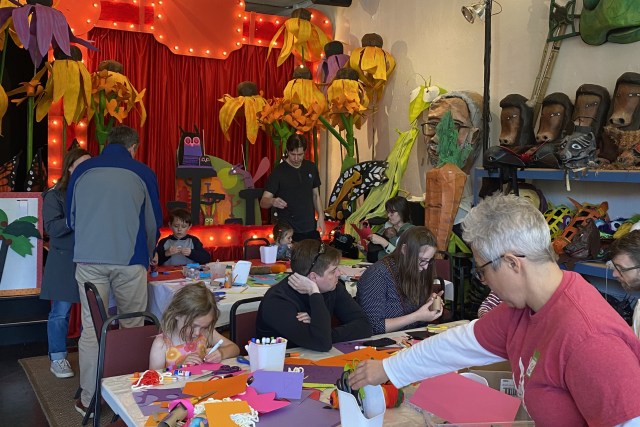
Minneapolis’ In the Heart of the Beast Puppet and Mask Theatre was bustling on Saturday, its new Hennepin Avenue location packed with people building masks and touring the puppet library as part of Doors Open Minneapolis.
Not long ago, it could’ve hosted even more visitors. But after decades at the Avalon Theatre on Lake Street, Heart of the Beast is moving forward with a much smaller footprint, operating as a renter rather than an owner. The move followed the 2023 decision to release its signature MayDay Festival, which now operates under its own nonprofit, allowing the theater to find a sustainable path in a more modest space.
The changes at Heart of the Beast reflect the broader, uneven landscape for arts groups in the Twin Cities. Between the May 4 groundbreaking at North Minneapolis’ Upper Harbor Terminal and the late April news that Jungle Theater is selling its building on Lyndale Avenue, the scene is a mix of hopeful and bleak developments. Meanwhile, after more than two years shuttered, the Cowles Center is in a soft opening phase before a planned grand re-opening in October.
From 2023: Heart of the Beast is spiffing up — not selling — the art deco Avalon Theatre, its longtime home
As these institutions refigure their business models amid declining philanthropic dollars and changing audiences, the arts community as a whole continues to search for stable footing six years after the first COVID-19 shutdowns.

In January, during the height of Operation Metro Surge, the Jungle announced it was cancelling the remainder of its 2025/2026 season, meaning its production of “Wolf Play” would not be presented.
Founded in 1991, the Jungle became a neighborhood cornerstone known for high production values in an intimate, 140-seat setting. But small audiences by design meant ongoing struggles to pay for overhead. “We did a ton of work to clean up the books and reduce expenses,” said Board Chair Richard Thompson. “There’s a certain point where it’s hard to cut costs as a way of getting out of a bind. What you need is greater revenues.”
While the building is on the market, Thompson said the board is still weighing options: “Would the Jungle organization stay in the building? It’s a possibility. Would the Jungle Theater retain ownership? That’s what I don’t know,” Thompson said.
The Heart of the Beast is a test case for what happens when a theater lets go of its building. It sold the art deco Avalon Theater to LUL Bros Properties LLC, which has taken on several other development projects on Lake Street and owns Quruxley Restaurant, serving Somali cuisine, on the adjacent block.
Steve Ackerman, Heart of the Beast’s community partnerships and site director, said the new owners plan to turn the Avalon into an event space. Meanwhile, the puppeteers are adjusting to their new home, which can fit about 80 audience members – about a quarter of Avalon’s capacity. The smaller space means less freedom to create large whimsical gestures like waffles flying down a zip line, as happened at one memorable show in the old space.
“The other space financially was tough to uphold,” Ackerman said, citing money-sucks like roof work and an HVAC system. Its size “was awesome for big puppets. But then it was also like, what if we try this smaller space? So far it’s working out.”
While some theaters scale down, the city’s flagship dance center is attempting a comeback. The Cowles Center, which went dark at the start of 2024, is moving toward an October relaunch under new operator Arts’ Nest. The nonprofit is still finalizing its contract with the city, which has maintained the facility since its closure. Jenna Papke, Arts’ Nest’s director, is currently arranging rental events at the venue, including an upcoming Zenon Dance Company spring showcase.
Ben Johnson, Minneapolis’ director of arts and cultural affairs, sees arts organizations’ changes as part of a generational shift. As corporate sponsorships and legacy donations dry up, the city has stepped in with, for example, a Bridge Fund for Dance helping to keep Cowles Center alive.
“It’s the only place I know that has a specific fund for dance programming,” Johnson said. Organizations – and cities – can no longer rely on “a great age of philanthropy and corporate sponsorship,” he said. “There’s a very active art scene, a lot of audiences, but the underlying structure is cracking. I think people have taken their art scene for granted.”
Meanwhile, a massive new venue is coming to the Northside riverfront. On May 4, leaders broke ground on the 8,000-person capacity Community Performing Arts Center, a partnership between First Avenue and the Minnesota Orchestra and part of the 48-acre Upper Harbor Terminal project.
For the surrounding community, the hope is for more than just a venue: A community benefits agreement will direct $3 from every ticket sold back into the Northside.
From 2021: Supporters of Minneapolis’ plan for the Upper Harbor Terminal say it will bring real change to the northside. Some who live there remain unconvinced.
Markella Smith, co-chair of the project’s citizen-led collaborative planning committee, said the groundbreaking represents a new expectation of being included. “Communities were clearly not just asking to be included, but expecting to be considered, respected and reflected in what is built in North Minneapolis,” she said.
As stakeholders celebrated the start of construction, the message was one of long-term commitment. “This is a day many people thought might never come,” First Avenue owner Dayna Frank told the crowd. “We’re so excited to build the next great Minneapolis destination, and an economic engine for the Northside.” The project is an all-hands-on-deck effort, reflecting the kind of coordination often required to move local arts projects of this scale forward.
As organizations city-wide navigate the changing arts landscape, the focus has shifted toward how the Twin Cities can be a container for different models of the arts to coexist, from neighborhood theaters to amphitheaters attracting audiences from across the Midwest. The future of the local scene may well depend on whether the city and its partners can continue to find ways for both neighborhood mainstays and major new venues to thrive.
Related