An historic sit-in over gun control legislation DFL lawmakers staged at the state Capitol Thursday night continued into late Friday morning.
The protest surrounds a gun control bill that has passed the Senate but not gotten a vote in the House. The legislation is a direct response to the deadly Annunciation school shooting and would ban assault weapons and magazines that can hold more than 17 bullets, among other things.
Before launching the sit-in around 9 p.m. Thursday, DFL lawmakers and protesters put up a united front to urge the House to take a vote.
Related: In passing assault weapons ban gun legislation, Minnesota Senate DFL shows unified front
Here’s what happened in those critical hours leading up to the sit-in.
Protesters swarm the Capitol
The Senate passed its omnibus bill on gun control May 4, sending it to the House for consideration. Unlike the Senate, which has a slim DFL majority, the House is tied 67-67 – meaning the bill is likely to fail on a party-line vote unless a GOP lawmaker flips on the issue.
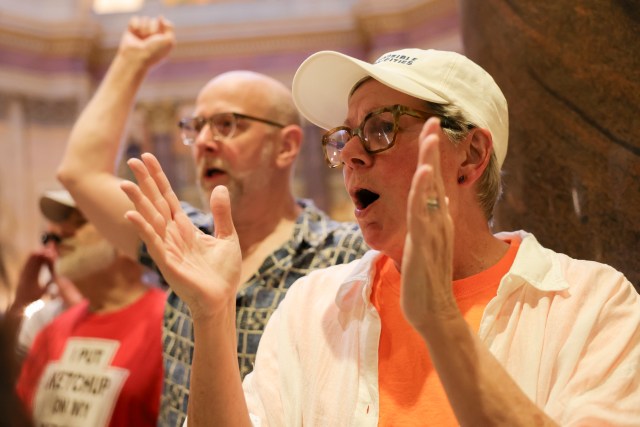
Still, the dozens of protesters who swarmed the Capitol on Thursday made one thing clear: they want a vote anyway.
“Minnesota constituents and voters deserve to know where their representative sits on this issue,” said Maggiy Emery, executive director of Protect Minnesota, one of the groups that sent protesters to the Capitol.
The morning of that vote, protesters lined the hallway near the entrance to the House floor. As lawmakers arrived for an 11 a.m. floor session, DFLers entered the main doors – cheered by protesters – while members of the GOP entered the side door, avoiding the crowd.
“We didn’t have a single Republican who refused to take up the vote come in through our crowd,” Emery said. “So I think they’re paying attention to the fact that we’re here.”
The clock is ticking for passage of any legislation, let alone a response to the Annunciation shooting that happened less than a year ago. Gov. Tim Walz announced a tentative deal on several legislative priorities on Wednesday night, but it included nothing about guns.
“It makes me wonder, ‘Why don’t you want to vote on this?’ And I think we all know it. If this bill comes to the House floor, it will pass,” Walz predicted at a press conference Thursday.
The ultimate decision as to whether a vote in the House will take place rests with House Speaker Lisa Demuth, R-Cold Spring.

She spoke to reporters at 1:45 p.m. on Thursday ahead of a 2 p.m. floor session. Asked about the pressure to take a vote, Demuth said the House had already voted on the issue – in committee – where it failed on party lines.
“We have absolutely taken votes, they just haven’t turned in the way that we’re hearing some people want,” she said.
Demuth said what has gone through committee, and is included in the bipartisan deal, is funding for various school safety programs. That includes dollars focused on mental support, mobile crisis grants and anonymous threat reporting.
Rep. Harry Niska, R-Ramsey and House floor leader, said at the same press briefing that Republicans are interested in bipartisan solutions to both school and lawmaker safety.
“What’s been really disappointing, and I think very telling to Minnesotans, is that Democrats are willing to work on bipartisan solutions when it comes to public official safety, when it comes to Capitol safety – and they’re not holding those hostage to demands for gun bans that they know won’t pass,” he said.
Six hours of debate
The 2 p.m. House floor session wasn’t scheduled to include any discussion about guns. But it ended up including over six hours of debate on that topic – not on the bill at the center of the day’s advocacy, SF4067, but the similar HF5140 bill that would also ban assault weapons and high-capacity magazines.
Rep. Matt Long, the House DFL floor leader, raised the secondary bill for discussion, saying the first one “has disappeared and is being held hostage somewhere.”
“Minnesotans want a vote. They want action on gun violence prevention. They want action to take into account what has happened in our communities after the tragedy at Annunciation school,” Long said.
During the lengthy debate, lawmakers covered nearly every well-worn argument for and against gun control.
Democrats stressed the need to remember the victims of gun violence – not just at Annunciation, but in suicides, domestic violence disputes, other school shootings and acts of violence made easier by guns. They cited alarming rates of violence in the U.S. and the need to remove dangerous weapons from their widespread availability.
Related: Months after Annunciation shooting, Minnesota lawmakers are not close on school safety or gun legislation
GOP lawmakers said removing guns wouldn’t solve the problem, given the availability of deadly weapons of other forms, and stressed the need to protect Americans’ Second Amendment right to bear arms. They also pointed to their willingness to support school safety measures in other forms.

On the actual bill, GOP lawmakers called the move by the DFL – technically, a vote to suspend the rules to bring the bill to a floor vote – political theater because of the zero-sum chance it would pass.
“We’ll continue until midnight Sunday to work on measures that can actually pass, that can actually become law, that can improve safety, that are proven. Democrats can continue to focus on symbolic fights,” Niska said.
Predictably, the vote failed 67-67 on party lines.
The evening’s session ended with a chant to “hold the vote” and a call for the sit-in.
Demuth said the session would resume at noon Saturday.
“Together we can sit, sing, stand, do a healing dance, and we can vote. It’s OK to change your mind. Show us your courage, let us leave this gun violence behind. Until we hold the vote, we will sit,” said Rep. Liish Kozlowski, DFL-Duluth.
The House DFL is live-streaming the sit-in on Instagram.
Related