We may receive a commission on purchases made from links.
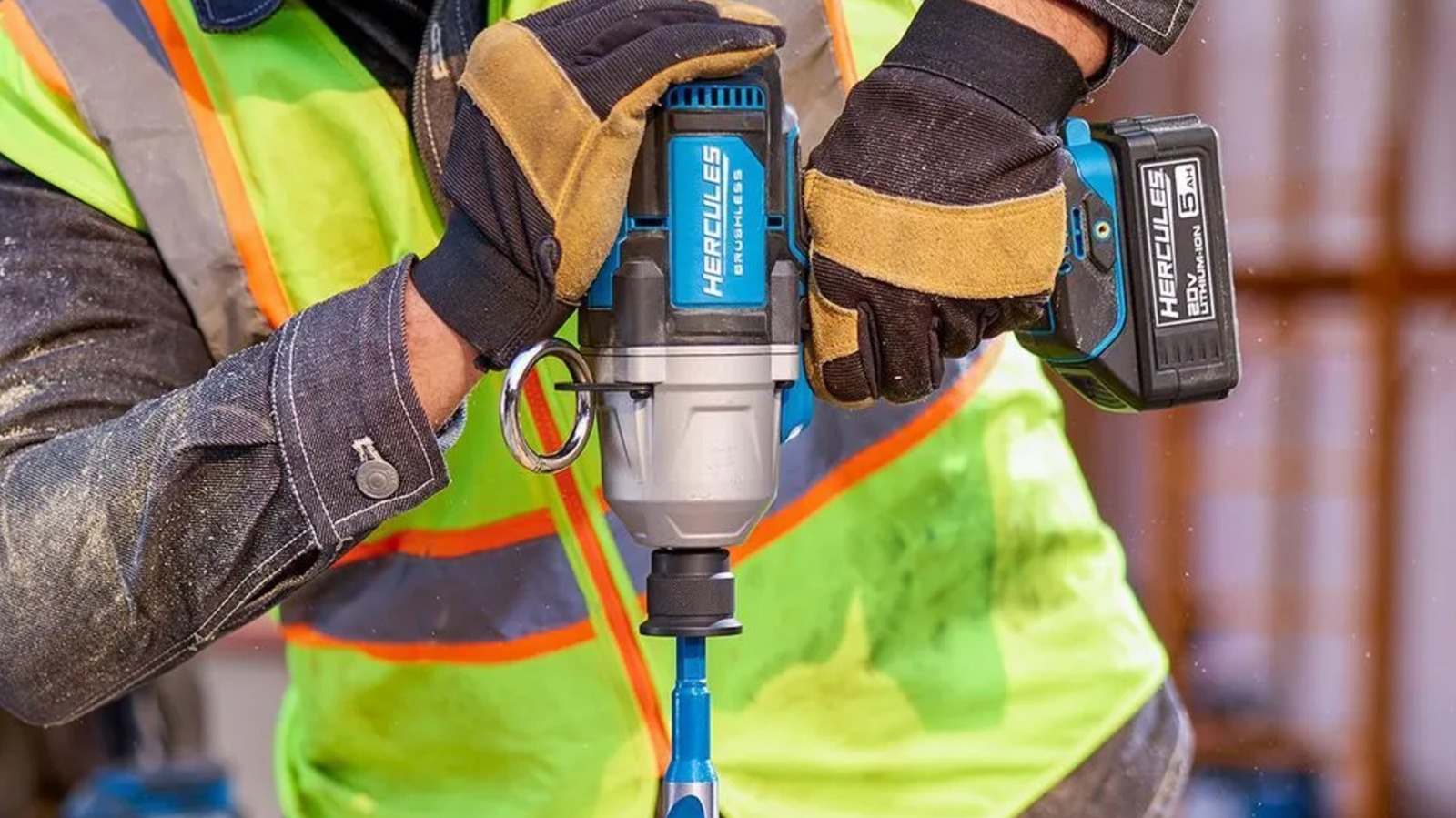
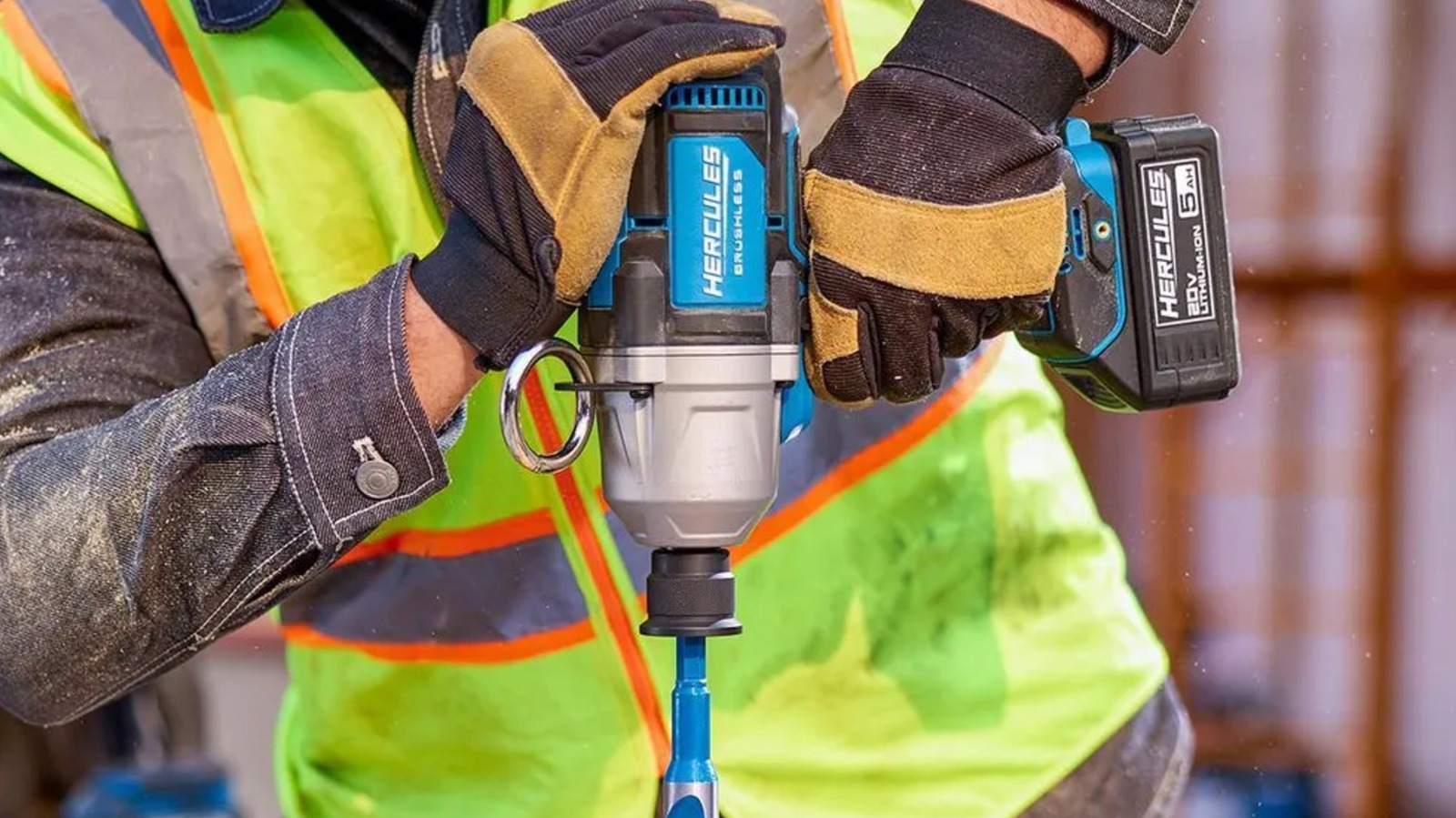
Harbor Freight is far more than a run-of-the-mill hardware store. The chain has plenty of exclusive items for sale, with multiple power tool brands that are actually owned by Harbor Freight. One of these is Hercules, which specializes in power tools, batteries, and jobsite essentials. It’s always making additions to its lineup, too, as evidenced by the new Hercules 20-volt brushless and cordless high-torque impact wrench. Given its affordable price, one has to wonder how it stacks up against a near-equivalent tool from power tool giant Milwaukee.
There is some overlap between the Hercules and its closest Milwaukee rival, the M18 Fuel brushless and cordless high-torque impact wrench. These include the presence of an LED light, variable speeds, and included tethering rings. But there are more differences than similarities. First and foremost is price: Hercules’ impact wrench retails for $229.99, while Milwaukee’s costs $429.00. Hercules’ model requires an 18-volt battery, while Milwaukee’s needs a 20-volt unit. Milwaukee’s impact driver is lighter at 5.85 pounds compared to Hercules’ 6.75 pounds, and also comes with One-Key compatibility for tool tracking and jobsite inventory cataloguing.
Expanding on this tool comparison, it’s important to look at how these two impact wrenches perform on the job. Here’s what users can expect from both the Hercules and Milwaukee impact wrenches.
How the two impact wrenches perform
Fastening torque is one of an impact wrench’s most important stats, and while both products are impressive — if not on par with the most powerful impact wrenches available — there are some differences here. The Powerstate brushless motor in Milwaukee’s impact wrench provides up to 750 foot-pounds of torque. The Hercules model also has a brushless motor, but its torque tops out at 700 foot-pounds. Hercules advertises 1,200 foot-pounds of bolt breakaway torque, while Milwaukee doesn’t provide that particular spec for this impact wrench.
There’s also the matter of speed. While each impact driver offers four variable speed settings, their ranges differ slightly. Hercules promises speeds between 0 and 2,100 RPM, while Milwaukee advertises a 0 to 2,200 RPM range. The latter also comes with Milwaukee’s Redlink Plus technology, which maintains communication between the battery, motor, and charger to mitigate issues such as overheating, overloading, and other potentially dangerous faults.
Additionally, we here at SlashGear ranked Milwaukee at the top of the list of every major cordless impact wrench brand, so there’s some level of reassurance to be had by going with the pricier product. Overall, the two products are quite evenly matched in terms of basic specs. Expanding further, though, it’s worth taking a look at the battery and warranty situations for these tools.
Battery and warranty information
While not directly tied to the tool’s performance, an impact wrench’s warranty is also important to be aware of. Hercules’ impact wrench comes with a 5-year limited warranty. Any faults that arise during that period, not related to user error or abuse, will entitle the user to a free repair or replacement. Milwaukee also offers a 5-year limited warranty for its impact wrench, providing its customers with free repair or replacement should the tool fail due to faults on Milwaukee’s part.
Hercules recommends running its impact wrench with a 20-volt 5 Ah extended-performance battery pack, which retails at Harbor Freight for $74.99, charges in around 90 minutes with a basic Hercules charger, and comes with a 3-year limited battery warranty. Meanwhile, Milwaukee’s impact wrench listing suggests the M18 RedLithium XC5.0 extended capacity battery pack that costs $169.00 and charges in around 105 minutes with a standard charger. Milwaukee’s battery also comes with a 3-year limited warranty.
At the end of the day, both appear to be capable impact wrenches from brands with some time and experience under their belts. Still, which one would be the right choice for you is a matter that only your needs, power tool budget, and feelings about either (or both) brand can fully answer.
Wrangell–St. Elias is America’s largest national park. Tucked inside its 13 million acres sits McCarthy, one of the country’s most remote and rugged frontier towns.
From boomtown to ghost town and back again, McCarthy has lived many lives. Today, for the first time in nearly a century, travelers can step into a reborn community—one with a vibrant local spirit, stable infrastructure, unique accommodations, and more adventure than you’d ever expect at the literal end of the road.
See Wrangell-St. Elias Scenery
Wrangell–St. EliasNational Park is bigger than Switzerland, with taller mountains. Nearly two-thirds of the park is designated wilderness, making it the largest single protected wilderness area in the United States. The range holds more than 1,700 square miles of glacial ice, more than the rest of Alaska combined. Within the park’s borders lie some of the most significant glaciers on Earth, including Malaspina (North America’s largest piedmont glacier), Hubbard (Alaska’s longest tidewater glacier), and Nabesna (the world’s longest valley glacier).
For all its vastness, only two gravel roads enter the interior: the 60-mile McCarthy Road and the 43-mile Nabesna Road. McCarthy offers the most accessible vantage point—and the scenery is impossible to avoid. Wilderness surrounds you on all sides. Every direction is a postcard.
Soar on a Flight See
Reaching McCarthy is part puzzle, part pilgrimage. The drive demands a capable vehicle and is usually off-limits for standard rental cars. Shuttles run from the end of the pavement at Chitina, but that’s still a four and a half hour drive from Anchorage.
Flying is an easier option to reach McCarthy. Regularly scheduled passenger service flies in from Gulkuna and Chitina as well, with options to charter flights from Anchorage. Once you arrive, the tiny McCarthy airport becomes your gateway—to town, to the outside world, and to flightseeing adventures you’ll never forget. Flightseeing reveals the true scale of the landscape. Even after 90 minutes in the air, you’ll walk away knowing you’ve only glimpsed a fraction of this wilderness.
The most popular tour—a 150-mile loop—takes you over river canyons, mining relics, private airstrips, and ancient marine sediment formations that feel strangely like Arizona. Watch for Dall sheep grazing on impossible slopes before crossing onto the Root and Kennicott glaciers. You’ll pass the towering Stairway Icefall, the world’s largest continuous icefall, and sweep past Kennecott before circling back toward McCarthy for a scenic, wind-assisted approach.
Visit Historic Kennecott
In the summer of 1900, “Tarantula” Jack Smith and Clarence Warner spotted a patch of green on a hillside and assumed it was good sheep pasture. Instead, they discovered the richest concentration of copper ore ever found.
By 1909, production had begun, and by 1911 the 196-mile Copper River & Northwestern Railway was finished, connecting the new mining town to Cordova. Kennecott grew rapidly, boasting Alaska’s first x-ray machine and the world’s first ammonia leaching plant.
Just as quickly, it emptied. When the last train left on November 10, 1938, it carried the worker and the copper, but left nearly everything else behind. Rugged isolation preserved the site in near-perfect time-capsule condition.
Today, the National Park Service manages many of Kennecott’s historic buildings. Listed on the National Register of Historic Places and designated a National Historic Landmark, it’s the best surviving example of early 20th-century copper mining in the world.
Take a Kennecott Mill Tour
The only way to explore the 14-story concentration mill is on a guided tour, and it’s absolutely worth it. After hiking to the top of the mill, you follow the entire path copper ore once traveled: from the aerial tram terminus to the crushing floors to the rail-loading platforms at the base.
Guides bring the story to life with tales of tenacity, ingenuity, and hardship in one of the harshest working environments imaginable. The mill isn’t just a structure, it’s the beating heart of Kennecott’s history.
Explore the Root Glacier
Kennecott (with an “e”) takes its name from the Kennicott Glacier (with an “i”), a massive but debris-covered glacier often mistaken for a giant pile of mine tailings. The nearby Root Glacier, by contrast, is clean, bright, and full of dramatic features: blue pools, ice fins, waterfalls, crevasses, canyons, and moulins formed by the immense pressure where the two glaciers meet.
The Root Glacier is one of the most accessible glaciers in Alaska, requiring only a 5–7 mile round-trip hike once you reach Kennecott. Guided half-day tours are the most popular option and include crampons, essential safety gear, and expert insight into an ever-changing landscape. The best guides know exactly where to find the day’s most spectacular features. Pairing a glacier hike with a mill tour makes for a perfect full day in Kennecott.
Dive into McCarthy History
McCarthy and Kennecott grew up together. McCarthy was the turnaround point for trains and the unofficial leisure district for the otherwise dry and disciplined mining town up the hill. Bootlegging, gambling, and prostitution flourished.
You can trace that history by visiting the McCarthy–Kennecott Historical Museum in the old depot or by staying at Ma Johnson’s Hotel, an authentic boarding house transformed into a living museum. Wander the historic cemetery to meet the legendary and notorious residents of McCarthy’s past—including Rose Levine-Silberg, whose unsolved murder still fuels local lore.
On summer weekends, don’t miss McCarthy Rose, a locally produced show at the Golden Saloon that tells the town’s story through Rose’s life and mysterious death.
Drink up the Golden Saloon
True to its sin city roots, the Golden Saloon is the only saloon in a National Park and the center of evening entertainment in Wrangell St. Elias National Park. Not only is it the venue for McCarthy Rose, but it has live music, trivia nights, a full bar and all your pub food favorites. Visitors and locals alike come together to tip back a pint or two of suds and swap stories of adventure and discovery.
Savour Wilderness Gourmet
The combination of history and luxury makes McCarthy a unique basecamp for accessible adventure. Part of that equation is delicious food, and here are some of our favorites
The Salmon & Bear (McCarthy): Our personal favorite. With a Wine Spectator “Award of Excellence” and a menu focused on local ingredients—like wild-caught Copper River Red Salmon—it’s a culinary surprise in the middle of the wilderness. No wonder it was just featured in National Geographic Traveller Magazine: Culinary Collection.
The Golden Saloon (McCarthy): I’m convinced that the best cheeseburger and fries are earned after a full day of adventure. Come for the food, stay for the entertainment. It’s an experience that must be experienced.
The Potato (McCarthy): A beloved local staple known for scratch-made Alaskan comfort food and legendary hand-cut curly fries. Their motto says it all—why be fancy when you can be delicious?
Kennicott Glacier Lodge (Kennecott): Offers a nightly fixed plated dinner featuring fresh-baked bread, salad, entrées like halibut or filet mignon, sides, and homemade dessert.
Meetza Wagon (Kennecott): Slow-cooked meat specialties served with glacier views that are almost as delicious as the food itself.
Take a Hike
When you’re in the middle of the largest National Park, the hard part isn’t finding a trail, it’s choosing one. Here are two options to consider.
Easy: From McCarthy, follow the wagon road toward Kennecott and turn left before Blackburn Cabin to reach the Kennicott Glacier Trail. The 4-mile out-and-back to the toe of the glacier is mellow and scenic. Don’t forget to stop by the old McCarthy cemetery.
Hard: For a lung-and-leg burner, the Bonanza Mine Trail climbs roughly 4,000 feet in 8–9 miles from Kennecott. The rewards: sweeping valley views that rival the Grand Canyon for sheer volume. AllTrails puts it best: “Strong fitness, steady footing, and alpine awareness are crucial.” Also crucial—timing your descent so you don’t miss the last shuttle back to McCarthy.
Make a Splash White Water Rafting
Fed by the meltwater of the Kennicott Glacier, the McCarthy River begins at a stunning glacial lake before tumbling under the iconic footbridge. A gravel road traces much of the river’s west bank, making logistics ideal, except for the cold, fast water and remote location.
That’s where McCarthy River Tours shines. Their guides are excellent, their gear (including drysuits) is top-notch, and their half-day combination trip—flatwater on the lake followed by a Class II/III run—is pure fun.
Drive the Road to McCarthy
The Muppets say getting there is half the fun. Maybe not when “there” is McCarthy—but the drive is part of the adventure. The 60-mile gravel McCarthy Road demands patience, preparation, and a sense of humor. Here’s the formula:
Step 1: Rent the right vehicle. Most car rental companies ban gravel roads, which is why we went with Alaska 4×4 Rentals. We never needed 4WD, but the clearance was comforting.
Step 2: Fill up in Kenny Lake or Chitina. A 120-mile out-and-back needs at least a half-tank with margin.
Step 3: Take your time. The roadside scenery is phenomenal—from Anchorage to Chitina to McCarthy. Our best moose sighting happened on McCarthy Road (though we were too excited to take a photo—classic).
Step 4: Plan for parking. Google sometimes lies at the end of the road. You cannot drive across the private bridge into town. Park at the footbridge and either walk the short ¾ mile into McCarthy or take a shuttle. The Copper Town Shuttle has a free loop from footbridge to McCarthy that leaves every 30 minutes from the footbridge
Gateway to the Backcountry
McCarthy is the gateway town to America’s largest wilderness area. It has everything you’ll need for a fully supported trip from backcountry guides to bush pilots. St Elias Alpine Guides has a fully trained staff for backcountry adventures from hiking to paddling, including lessons. Wrangell Mountain Air has skilled bush pilots who can land you in the wilderness for a true backcountry camping experience…and, just as importantly, pick you up again. In McCarthy, the end of the road is just the beginning.
Chill Out
With so many adventures, it’s easy to forget to slow down. Grab a surprisingly good espresso at the McCarthy Center Store. Sit with the history that surrounds you. Step outside at night to see the stars blaze across a truly dark sky. Then wander into the Golden Saloon and swap stories with colorful locals or fellow wanderers. Sometimes the best thing to do here is absolutely nothing.
Parting Thoughts on McCarthy
McCarthy has transformed from a forgotten ghost town into a fully realized destination. The McCarthy Lodge Resort offers one-of-a-kind lodging at Ma Johnson’s and the Kate Kennedy House, plus budget-friendly rooms at the Lancaster’s Backpacker Hostel. There are enough restaurants to keep you full for a week, and enough adventures to keep you busy for a month. That said, lodging and fine dining options are scarce so make your reservations early.
If you’re short on time, the essentials are:
You can squeeze those into two days, especially if you pair the mill tour with the half-day glacier hike. But with McCarthy’s remoteness, rich history, and irresistible charm, we recommend staying longer. This is the kind of place that rewards those who linger.
Safeguard your digital information by using a VPN. We love NordVPN as it is superfast for streaming Netflix
Stay safe on the go and stay connected with an eSim card through AloSIM
OurPacking Favs:
We LOVE Matador Equipment for their innovative products and sustainability focus. Their SEG45 is a game changer when you need large capacity while packing light.
Travel in style with a suitcase, carry-on, backpack, or handbag from Knack Bags
Packing cubes make organized packing a breeze! We love these from Eagle Creek
Like it? Pin it for later on Pinterest!
Hi! We are Jenn and Ed Coleman aka Coleman Concierge. In a nutshell, we are a Huntsville-based Gen X couple sharing our stories of amazing adventures through activity-driven transformational and experiential travel.
To provide the best experiences, we use technologies like cookies to store and/or access device information. Consenting to these technologies will allow us to process data such as browsing behavior or unique IDs on this site. Not consenting or withdrawing consent, may adversely affect certain features and functions.
Functional
Always active
The technical storage or access is strictly necessary for the legitimate purpose of enabling the use of a specific service explicitly requested by the subscriber or user, or for the sole purpose of carrying out the transmission of a communication over an electronic communications network.
Preferences
The technical storage or access is necessary for the legitimate purpose of storing preferences that are not requested by the subscriber or user.
Statistics
The technical storage or access that is used exclusively for statistical purposes.The technical storage or access that is used exclusively for anonymous statistical purposes. Without a subpoena, voluntary compliance on the part of your Internet Service Provider, or additional records from a third party, information stored or retrieved for this purpose alone cannot usually be used to identify you.
Marketing
The technical storage or access is required to create user profiles to send advertising, or to track the user on a website or across several websites for similar marketing purposes.