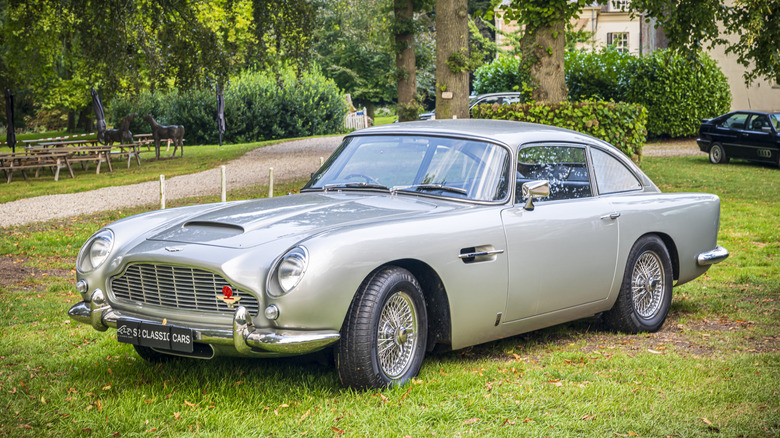

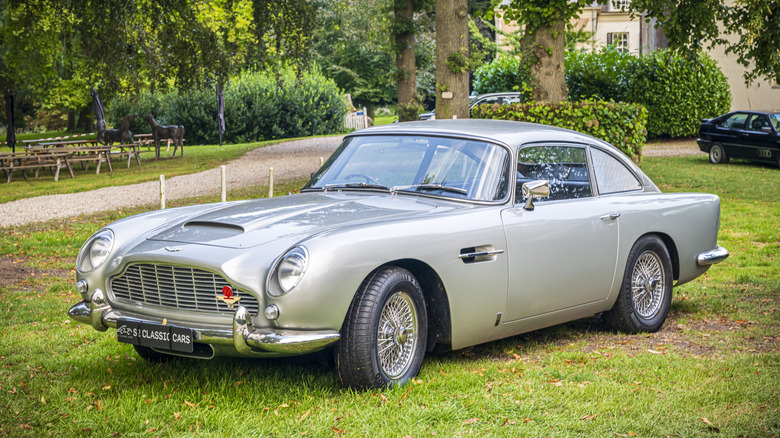
One of James Bond’s most recognizable rides, the 1963 Aston Martin DB5 is an icon. As proclaimed by Aston Martin itself, it’s often referred to as the “most famous car in the world” as well as the “most beautiful Aston Martin ever made.” These are both bold claims, but its looks are undeniable. We dubbed it one of the best-looking Aston Martins ourselves, noting its large yet classy grille as one of its most prominent features, along with its chrome accents. However, did the DB5 have the performance to match?
For the time period, it definitely impressed. The DB5 shot to 60 miles per hour in 7.1 seconds and had a top speed of 142 mph. But, surprisingly, this is not as fast as the DB4 it was meant to replace. The DB4 GT, a more lightweight trim of the previous model, was able to reach over 150 mph, making it one of the fastest cars of that time period.
The Aston Martin DB5’s iconic design, engine, and movie appearances
The DB5 debuted in 1963 and was only in production for two years. It’s the successor of the DB4, which came out in 1958. Meant to be more luxurious than the DB4, the DB5 had a more elegant look and upgraded features, like power windows. This also made it a bit heavier, so the powertrain had to be upgraded to make up for it.
The Aston Martin DB5 featured a straight-six engine that was increased to 4.0 liters to compensate for its extra weight. The DOHC engine produced 286 horsepower and 280 lb-ft of torque at 4,500 rpm, giving it 42 more horsepower than the DB4. It was also given an upgraded five-speed manual gearbox.
The Aston Martin DB5 didn’t really need to be the fastest car out there to gain respect. Appearing in “Goldfinger” in 1964 solidified the vehicle as an icon. Fitted with machine guns, tire slashers, a rotating license plate, and an ejector seat, the DB5 blended beauty with bravado, and it was still plenty fast enough to escape Goldfinger’s henchmen. James Bond’s original DB5 prototype, which appeared in eight Bond films, was sold for $4.6 million in 2010.

Stephan is the sports journalist for the Maple Grove Report.