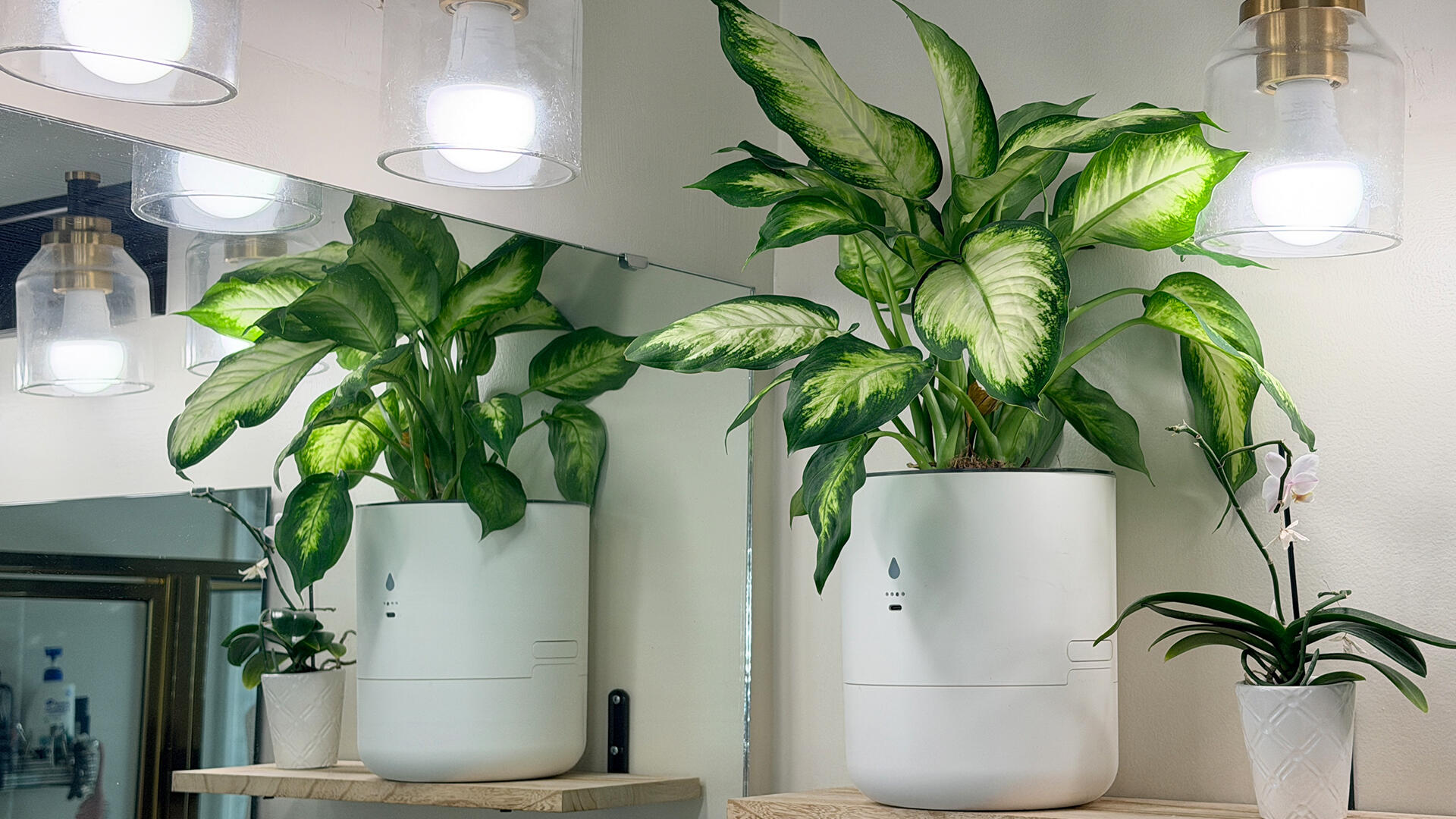

pros and cons
- Adjusts watering to its surroundings
- Learns how to maintain each plant
- Long battery life
- Bridge required
- Costs add up with each planter
Follow ZDNET: Add us as a preferred source on Google.
As a stereotypical plant-hoarding, book-loving, socially anxious millennial who writes about smart home tech for a living, I live for inventions like the LeafyPod. This smart planter lets you repot your own plant (as long as it fits) with your own potting soil, and then it basically takes care of it for you.
Also: 10 useful smart home gadgets that make life so much easier (and most are discounted)
I’ve had a Dieffenbachia in my LeafyPod for almost two months and am just now getting around to refilling its water reservoir for the first time. This, combined with app support and several months of battery on one charge make for a complete package for your plants.
If this all makes you think, why would my planters need Wi-Fi? Let me prove why the LeafyPod is such a useful invention.
Why a smart planter?
The LeafyPod had the only plant that thrived when I couldn’t get up to water it.
Maria Diaz/ZDNET
I recently suffered a series of fractures from a fall that kept me in bed for the better part of four weeks. Since I couldn’t even get up without help, much less walk around for more than a minute or two at a time, watering my plants fell quite low on my priority list.
Also: I stopped leaving these 7 common household devices plugged in, and my energy bill noticed
As a result, most of my plants died, including the almost $100 worth I’d bought at Lowe’s right before my injury. The only plant that’s thriving is the Dieffenbachia that’s sitting pretty in the LeafyPod. A few of my older plants survived thanks to my kids’ sporadic help and the plants’ hardiness, but none are as healthy as the Dieffenbachia.
How the LeafyPod works
When I repotted that plant to the LeafyPod, I just added soil as needed and filled the water reservoir. The LeafyPod is rechargeable, so you don’t have to keep it plugged in to use it. I fully charged it before putting it in its permanent spot, and the battery is still only a third depleted after almost two months.
When setting up the LeafyPod app, you can add the plant that you’ve potted, and it’ll tell you about its water and light needs. Once the planter is charged and set up in the app, the LeafyPod will learn to adjust its watering based on its surroundings. The planter learns whether your home is dry or humid, and how much sunlight your plant gets, so it can water it more or less often.
Also: Oneisall Ease S1 review: Finally, a smart litter box that doesn’t cost an arm and a paw
You do need a bridge to connect the LeafyPod to the app and see your planter’s status remotely, which must remain plugged in to work. Each bridge lets you connect multiple planters (LeafyPod doesn’t specify how many), and costs $48, though you can buy it as part of the starter pack with a planter.
The app shows you all the plant’s details, how much sunlight it’s getting, and keeps a record of each watering session.
ZDNET’s buying advice
After testing different types of smart planters geared more toward home agriculture, like the Plantaform and Gardyn, which require proprietary seed pods and growing medium, as well as water refills every 1 to 3 weeks. The LeafyPod is obviously a different type of smart planter than the Plantaform and Gardyn, but it’s likely a better choice for entry-level users, plant lovers, and even plant killers.
Also: 15+ best Alexa commands to make your home work smarter (Prime not required)
The LeafyPod starter pack is currently on sale for $127, which includes a planter and a bridge. This is more expensive than an average planter, but the LeafyPod is anything but average. My recent experience proved that even if you’re a plant killer, your LeafyPod will help you redeem yourself by keeping your houseplants alive.