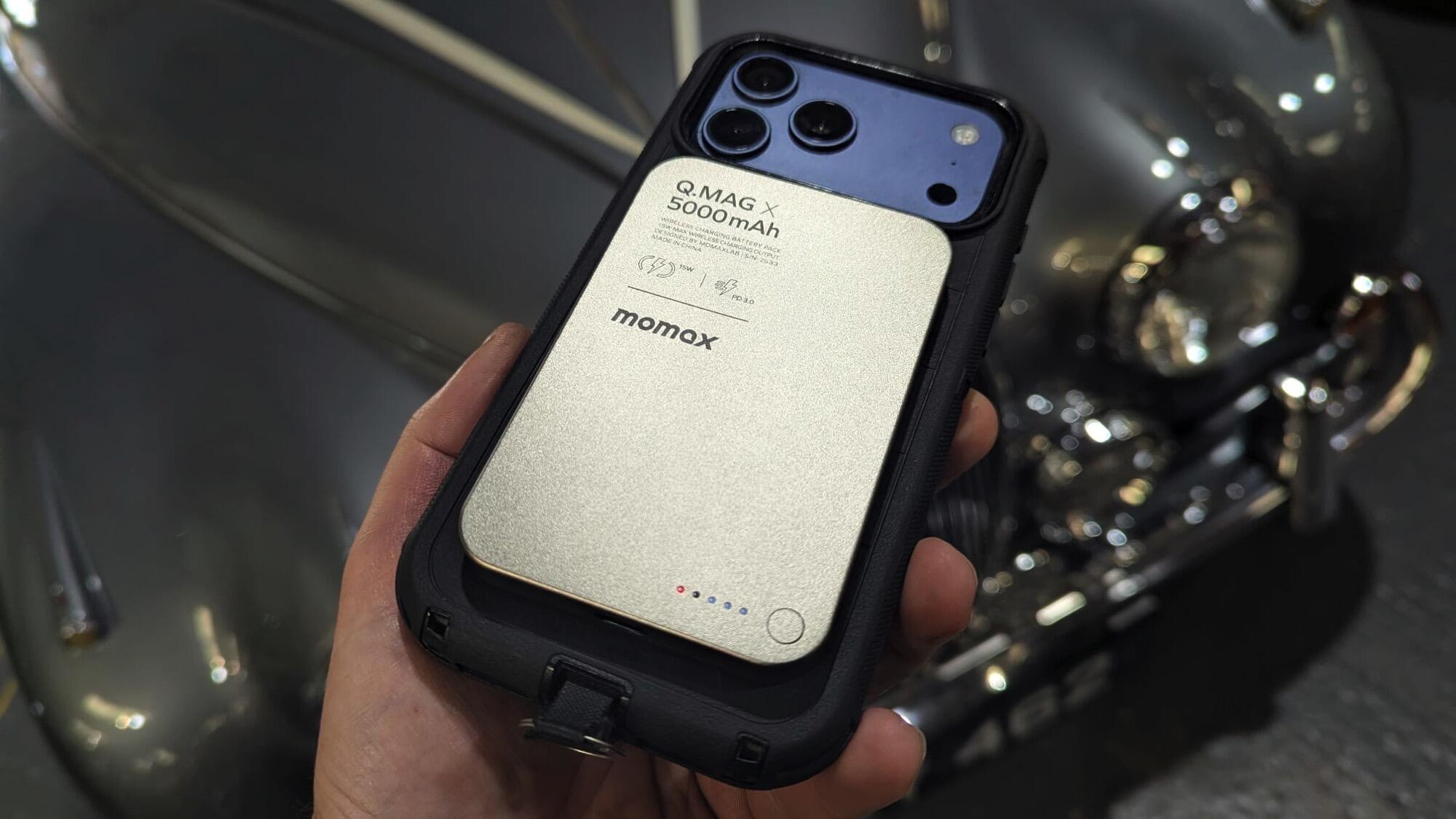
I tested a portable battery with graphene heat dissipation – and cracked it open for proof


img-1664.jpg

pros and cons

Pros

  • Exceptionally thin and light
  • Can charge two devices simultaneously
  • Keeps cool even when being used hard.
Cons

  • Aluminum and glass aren’t particularly robust.

Follow ZDNET: Add us as a preferred source on Google.


There are many “MagSafe” magnetic wireless battery packs on the market. Some are great, some are various grades of dismal. And sometimes, devices are head and shoulders above the rest. These packs are well-built, using quality components, and assembled with care.

Also: I set up a $4 router reboot timer, and it’s made my internet reliably faster

The Momax Q.Mag X is one such power bank. It’s thin, it’s light, it’s stylish, and it’s cool — in every sense of the word.

It’s a good-looking power bank

The Q.Mag X is a 5,000 mAh/19.35 Wh power bank that magnetically clamps to your iPhone to charge it up while you’re on the move. The capacity is such that it won’t draw attention at airports, and the CCC logo means that it will even make it past the stringent security at Chinese airports. 

Also: Switch to plug-in solar? My advice after testing the DIY energy tech at home

The unit has a premium look and feels good in the hand, thanks to its glass and aluminum construction. It’s not the most robust power bank on the market — for that, you need something like the Nitecore NW5000 or the Dark Energy Poseidon Nano — but if good looks are what you’re after, this is the device for you.

One of the few power banks that comes with a polishing cloth.

One of the few power banks that comes with a polishing cloth.

Adrian Kingsley-Hughes/ZDNET

But there’s more to the Q.Mag X than good looks. And to keep it looking good, the bank even comes with a microfiber polishing cloth.

Thin, light, and cool

First off, it’s thin. In fact, it’s spookily thin, at only 8.3 mm/0.33 inches. That’s the thickness of a pencil, and it’s only fractionally thicker than the thinnest point on an iPhone 17, which is 7.95 mm/0.31 inches thick.

It's a beautiful power bank!

It’s a beautiful power bank.

Adrian Kingsley-Hughes/ZDNET

The bank is also very lightweight, at only 125 g/4.4 oz, making it only 5 g/0.18 oz heavier than the carbon fiber-clad Nitecore NW5000. 

Also: Should you buy a solid-state battery pack in 2026? My advice after weeks of testing

On the front is a 15W Qi2-compatible wireless charger that works with iPhones ranging from the 12 to 17 series, AirPods with the wireless charging case, and Android handsets with wireless charging. For everything else, there’s a 20W USB-C port on the bottom. And good news for those with more than one device — the power bank supports simultaneous wireless and wired charging. 

It also supports pass-through charging, so you can charge a wireless device as the power bank charges, which is perfect for overnight charging. The unit supports all popular charging protocols, and it has the usual built-in safety features. 

The Momax Q.Mag X is only 8.3 mm/0.33 inches thick!

The Momax Q.Mag X is only 8.3 mm/0.33 inches thick.

Adrian Kingsley-Hughes/ZDNET

The Q.Mag X is also cool during use, surprisingly so for a 15W MagSafe power bank, which can sometimes feel like hand warmers. This device only ever got slightly warm at most. The Amazon listing mentioned graphene heat dissipation, which wouldn’t surprise me in the least, as there were no hot spots on the unit either while charging or being charged (I’ll get back to this area in a bit).

I really like the Q.Mag X. I know it’s just a power bank, but it’s so well made. The device perfectly combines beauty and functionality. I’ve enjoyed using it for the past few weeks when out and about.

Also: This Anker power bank is so close to being my ultimate charging accessory – here’s what’s missing

Which is why the next bit broke my heart. Yes, I needed to see if the power bank used graphene for cooling, and there was only one way to find out. 

Time to take a look inside!

Time to take a look inside.

Adrian Kingsley-Hughes/ZDNET

Time to crack it open

It was time to get the spudger out, be destructive, and look inside (I know I shouldn’t be using a metal spudger near a live lithium-ion battery, but I’ve been doing this for years). I regretted having to do this task, but it had to be done. 

It took some getting into!

This device took some getting into.

Adrian Kingsley-Hughes/ZDNET

I learned a few things.

First, yes, the battery has a graphene coating. Graphene looks like black paint, but it’s a form of carbon with excellent thermal conductivity and infrared emissivity, so it’s sprayed onto metals, plastics, and electronics to spread and dissipate heat. 

That black coating on the battery is graphene, a great material for dissipating heat.

That black coating on the battery is graphene, a great material for dissipating heat.

Adrian Kingsley-Hughes/ZDNET

I also found out that the unit is very well built. It took some getting into, and there’s ample sealant, adhesive, and thermal silicone keeping it together. 

Well, it's never going back together!

Try putting this device back together.

Adrian Kingsley-Hughes/ZDNET

Also, Momax hasn’t skimped on the parts that you can’t see. The components used are top-notch, and it’s been put together well.  

ZDNET’s buying advice

I’ve tested a lot of wireless power banks, but the Momax Q.Mag X is a standout, both outside and in. And for just under $30 (the price varies depending on the deals available), it’s a steal. You should especially consider one if you often find yourself in heated environments that can put batteries in danger.

If you need more power, Momax have a scaled-up 10,000 mAh version. Same quality, more capacity, for less than $10 more.  


Source link

Leave a Reply

Subscribe to Our Newsletter

Get our latest articles delivered straight to your inbox. No spam, we promise.

Recent Reviews


If Game Two of their first-round playoff series with the Denver Nuggets saved the 2025-26 season for the Minnesota Timberwolves, Game Three showed why it should be saved. 

The Timberwolves were a different beast while decisively thumping the Nuggets, 113-96 Thursday night at Target Center, in a game that wasn’t nearly that close. These Wolves were the mythical creature we’d heard about in preseason lore, purposefully locked and loaded to be both marauding and staunch. They owned both ends of the court, gleefully transferring back and forth from irresistible force to immovable object. 

A quartet of Timberwolves deserve special mention, but it begins with Jaden McDaniels. After his team had toppled Denver to even the series at a game apiece Monday night, McDaniels used the sizable chip on his shoulder to etch some graffiti into the public discourse, casually castigating the most prominent Nuggets players by name as “bad defenders” in a matter-of-fact manner that had the media compelling him to confirm what he had just said. 

Trash talk is fleetingly fungible in the jaundiced social environment of 2026, functioning more like coupons than currency in that it needs to be rapidly leveraged before its expiration date. The common perception naturally was that McDaniels was calling out the Nuggets. But in a more subtle, profound way, he was also putting his teammates on notice. 

All season long the Timberwolves have procrastinated on their full potential, frequently demonstrating that their preseason talk about maturity and commitment was cheap. By contrast, those words uttered by McDaniels were expensive. He had just picked a fight with the opponent, leaving open the question of how many of his teammates would join him in the fray. 

That he would lead the charge was established early, after the Timberwolves’ top two scorers, Anthony Edwards and Julius Randle, had each missed a pair of open looks against Denver’s bad defenders in the game’s first 90 seconds.  

With the game still scoreless, the NBA’s best pick-and-roll combo, Nikola Jokic and Jamal Murray, were clustered around the foul line with Minnesota’s best defenders, McDaniels and Rudy Gobert. As they jammed up Jokic, McDaniels picked the ball loose and started sprint-dribbling the other way. To no one’s surprise, Donte “Ragu” DiVincenzo was also on his horse in transition, receiving a pass from McDaniels and then lobbing it back for a Jaden slam against a hapless Murray and Murray’s late-arriving teammate, Cam Johnson, who committed the foul that allowed McDaniels to finish with the “and-1” free throw. 

On the Timberwolves next offensive possession, McDaniels muscled his way to two offensive rebounds, feeding Ragu off the first one for a missed three-pointer, which he corralled for the second one and executed the putback in traffic. It was McDaniels 5, Nuggets 0, setting the tone for a game in which not only did the Wolves never trail, but never let the lead go under double digits after McDaniels made a consecutive pair of driving layups eight minutes into the game. 

“Spectacular. I thought his activity offensively in the first quarter was outstanding,” said Wolves coach Chris Finch after the game. “He was inspirational.” 

Among the most inspired were McDaniels fellow wing players, Ragu and Ayo Dosunmu. Ragu is exactly the kind of player who will have your back in a squabble, and his galvanized performance seemed borne of satisfaction that someone else had clarified the mission. As usual, the Timberwolves were at their best with him on the court: +20 in the 32:54 he played, -3 in the 15:06 he sat. 

“He makes so many hustle plays, momentum plays, different styles of plays.” Finch raved. “He’ll make a shot, get a transition bucket, he’ll rebound, get a steal, blow something up. So many different plays. He’s just a basketball player.”

Related: How the Timberwolves sparked a season-saving Game 2 comeback over the Nuggets in Denver

Then there was Ayo, whose fearless, blazing, bee-lines for the bucket were quicksilver kryptonite for a Nuggets defense that is neither swift nor rugged. “I’ve been waiting for him to wake up a little bit in this series,” Finch accurately observed. “The downhill mindset that he played with all season for us was back.”

Back with the sort of multipurpose propulsion that leaves witnesses with giddy whiplash. Ayo led the team with 25 points and 9 assists in 32 minutes of time-lapse hoops, the lone blemish being three clanks from long range. Why chuck treys when you can so easily undress players in the paint? Ayo was 10-for-12 on two-pointers and none of those dozen shots came from anywhere but beneath the rim. Five of his nine dimes likewise yielded layups or dunks, which means he personally accounted for 30 of the 68 points in the paint by the Timberwolves on Thursday, doubling up the Nuggets’ 34.

Which brings us to the non-wing in Game 3’s ring of honor, Rudy Gobert. For the third straight game, Gobert blunted the supposed advantage Denver had with the magical playmaker Nikola Jokic at the controls. Suffice to say that in the last five quarters, Jokic has shot 8-for-33 from the floor. If that continues, the Nuggets are toast in this series. 

When I asked Finch after the game if the herculean job Gobert was doing on Jokic made planning his defense simpler and better thus far, he replied, “Rudy is making all of us look good right now with his defense.” 

Amen.

If there is an asterisk on this game, it would be the absence of Denver’s brutishly versatile power forward Aaron Gordon. Nuggets coach David Adelman should be given a lot of credit for his honesty and transparency in dealing with the media during his first full season at the helm, but it came back to bite him and his team during the pregame presser, when he was clearly rattled and dejected by the sudden unavailability of Gordon, whose playing status went to “probable” to “out” in a period of a few hours due to a chronic calf strain. 

Gordon is far and away his team’s best defender, making the timing of his injury especially troublesome in the wake of McDaniels laying down his marker. Rattled is a good way to describe the entire team’s performance in the first quarter, an emotional wounding that needs to heal as fast as Gordon’s body if the Nuggets are going to be competitive in a series that had dramatically been flipped on its head over the past three days. 

That the Timberwolves played with such dominance despite mediocre outings from Ant and Randle would be a good thing for both of those current cornerstones to keep in mind. Ant was beset by foul trouble and Randle had a solid second quarter, but it stood out that neither player fully embraced what so often works on offense when the Wolves are at their best: Push the pace, move the ball, move without the ball, and make quick decisions. Ant and Randle can still be first among equals and blend into that catechism if they stay attuned to the possibilities of a greater good, one that all of sudden doesn’t have to end with them being postseason fodder for the Spurs or the Thunder. 

Not when you’ve got three wings at a collective peak, with a chaser of Rudy semi-clowning the Joker. 


Source link