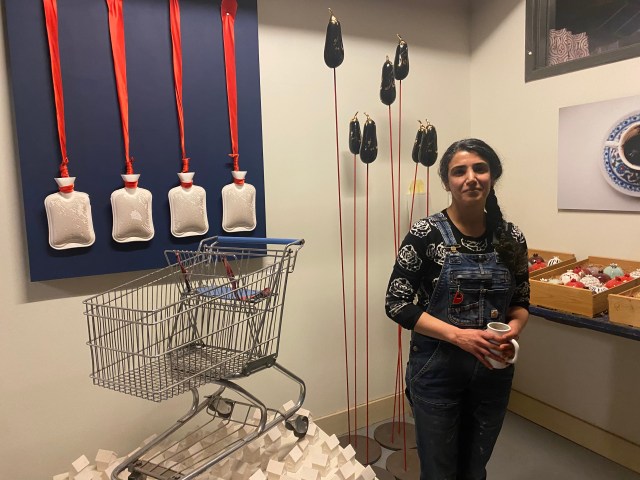
At the Northern Clay Center in Minneapolis, a garden of ceramic eggplants rises from the floor, each attached to a reed-like steel mount. On each, Persian script in gold paint transliterates an English-language profanity (starting with an “f” and ending with a “u.”)
The installation, “This is Not an Eggplant,” is by Iranian artist Katayoun Amjadi. And the eggplants – a staple of Persian cuisine and also a phallic symbol in emoji-speak – have taken on new resonance amid the United States’ war in Iran.
Amjadi, artist in residence for City Art St. Paul, is part of Minnesota’s small community of Iranian artists navigating their creative pursuits while the U.S. engages in war against Iran. I spoke with several of them, including textile and installation artist Ziba Rajabi and singer Aida Shahghasemi.
Related: My husband fled the Iranian regime. Now we grieve those left behind.
“It was a very difficult day, Tuesday, for all of us,” Amjadi said, referencing President Trump’s dire threat on April 7 to Iranian civilization. “We intuitively knew this [war] was not about liberating people,” she said. “Saying it that bluntly, out in the open, was a surprise – and at the same time a validation of our intuitive feelings.”

Through their work, the artists said, they are seeking truth, solace and healing.
‘I call it therapy sessions’
In response to political tensions, Amjadi, who teaches art at St. Olaf College and the University of Minnesota, has been leading art workshops for refugees and displaced people. And she’s opened up her studio to friends.
“I call it therapy sessions,” she said. “A friend comes over and we’ll sit and create something together and just have tea and spend time together. I see more value in this kind of work now.”
Born in Tehran, Amjadi’s family immigrated to California in 2002. She moved to Minnesota to study art in 2010 and opened a studio in Minneapolis in 2015. That was the end of what she calls “the time of hope,” when relations between the U.S. and Iran were more positive.
Last month, I met Amjadi and Rajabi for tea in Northeast, where they have studios in the same building. Rajabi, too, remembers the “time of hope” beginning in 2009 when the U.S. and other world powers began negotiating with Iran.

“They were lifting the sanctions one by one,” said Rajabi, who also teaches at St. Olaf. “Everything was getting so much better.”
Since the U.S. began launching strikes on Iran, Rajabi has found it difficult to focus on creating and teaching art. She removed a text from her curriculum by artist Agnes Martin about the nature of beauty.
“How can I defend beauty in this world?” she said.
For an upcoming solo exhibition at the Minneapolis Institute of Art, she plans to create a communal space for grieving.
Related: Iranian-American negotiations fell apart, my brother is still in Iran
“I think many of us around the world have been going through these moments of grief in the past few years – including Minneapolis,” Rajabi said.
The centerpiece, an installation titled “Kotal” (2026), will incorporate her handmade textiles and invite visitors to rest on cushions and carpets while listening to music.
Despite current events, Rajabi doesn’t see “Kotal” as political. “I just happened to be born in a place saturated with political seeds, and now I’m living in a country that is in a long-term conflict with where I come from,” she said. “But this work itself is about human experience.”

‘I just can’t detach’
Singer Aida Shahghasemi moved to Minneapolis from Tehran when she was 13 years old, attending high school in Eden Prairie and college at the University of Minnesota. Though trained in Persian classical music, she has gravitated toward the jazz tradition and often collaborates with artists in the Twin Cities’ lively experimental scene.

Shahghasemi’s parents and most of her relatives still live in Iran. They can use landlines to call her, she said, but she can’t call them. “I don’t have access to anyone,” she said.
Rather than producing songs, Shahghasemi has felt drawn in recent months to music from her past. An untitled song from 2025 sounds like a love song, she said, but it’s really about Iran. “It’s someone who’s saying whatever I do, I can’t forget you,” she said. “The fact is, regardless of what I do, I just can’t detach from that part of who I am.”
In another song, “Mirror,” she describes her connection to Iran like a dysfunctional relationship. “We all want something better, but we are continuing in very similar cycles of not showing up authentically,” she said. “And I think that’s very relevant to what’s happening right now.”
On May 6, Shahghasemi will perform at the “New Americans New Beginnings” fundraiser for the International Institute of Minnesota, held at the Renaissance Minneapolis Depot ($160). She’s also planning a musical residency at Berlin in July.
Ziba Rajabi’s exhibition, “A Belly Laugh at a Funeral,” opens July 18 at the Minneapolis Institute of Art (free). It will incorporate Shahghasemi’s music.
Katayoun Amjadi’s work, including “This is Not an Eggplant,” can be seen through April 19 at the Northern Clay Center as part of the group show “A Rising Tide Lifts all Boats” (free). Also showing is a haunting exhibit called “A World Unseen (未见之界),” featuring ChengOu Yu and Jing Huang.
Related