Three years ago, the Minnesota Legislature resoundingly agreed to put a down payment on removing all lead pipes from the state.
That resulted in Rep. Mary Franson, R-Alexandria, and other lawmakers approving $240 million in funding toward that goal. They invested the money with no illusions about the need for subsequent installments.
So with funding running out this year, and no federal support slated to come through after 2027, another splash should be a slam dunk, right? It may still come through, but Franson and other leaders on Wednesday warned that time is running short to get it done this session.
Related: Minnesota has an ambitious goal to replace lead lines by 2033. More funding is needed to keep it on track.
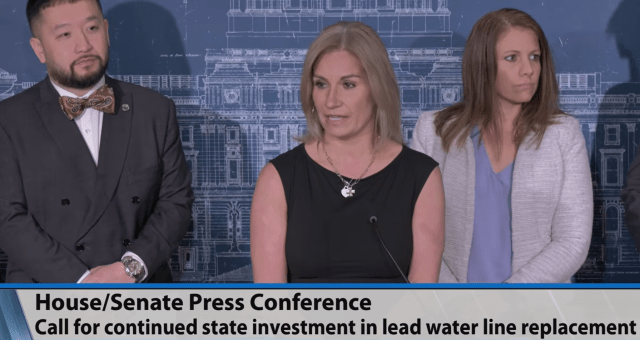
“Cities of every quarter of the state are mapping, identifying and replacing those pipes, and it is our responsibility to continue supporting that work,” Franson said during a press conference at the Capitol. “The need is too great, it is too urgent, and it is too important to drop the ball and let up.”
Franson joined Rep. Fue Lee, DFL-Minneapolis, who co-chairs the House Capital Investment Committee with her, and Sen. Sandra Pappas, DFL-St. Paul, chair of the Senate Capital Investment Committee, at the presser. On committee tours around the state before this session, water infrastructure needs floated to the top of conversations, Lee said.

“The most important thing we heard was that no matter the zip code, water and water infrastructure is key, and lead service line is part of that conversation,” he said.
How widespread is the need?
The number of known lead pipes is somewhere around 90,000 statewide, said Joel Smith, president of LIUNA, a union representing 14,000 laborers in Minnesota and North Dakota. He described replacing the lines as a public health, rather than a partisan issue.
“We’re asking lawmakers to get the job done before you go home,” he said.
Lines are distributed fairly evenly throughout Minnesota, running underground in metro St. Paul, in Greater Minnesota cities like Moorhead, and in rural areas like Pipestone.
St. Paul Regional Water Services will have replaced about 6,000 lines by the end of this construction season. Another 18,000-20,000 need funding for their removal, said Racquel Vaske, the utility’s general manager.
Each identified lead pipe is costing, on average, about $10,000-$15,000 to replace, although estimates can shoot up even higher. Keeping on track with a federal goal to replace all problem lines by 2037 — Minnesota has a loftier goal to get it done by 2033 — is worth the investment this year, said Bradley Peterson, executive director of the Coalition of Greater Minnesota Cities.
“There’s nothing better that we could spend our precious dollars on this year than lead line replacement,” he said.
How can lead service line replacement get funded this session?
Cash, also known as money from the state’s general fund, is in short supply this session. Gov. Tim Walz’s budget recommended using $7 million of it for the state’s lead service line replacement grant program.
That figure says more about how little cash is available than what is actually needed. In comparison, the estimated cost to replace remaining lead pipes is closer to $1 billion.
A bipartisan group of lawmakers, including Franson and Lee, backed bills in the House and Senate to invest $250 million in the program using general funds starting in 2027. No one at the press conference indicated this route had an open path forward this session.
That leaves funding through bonding, the state’s tried-and-true way of borrowing money to pay for local infrastructure projects, as the most realistic option. On behalf of the Senate DFL, Pappas said she’s proposing $100 million in appropriations bonds for lead service line replacements this year.
Related: Minnesota combats lead in drinking water with ambitious – and costly – lead pipe replacement plan
Why appropriation bonds, and not the general obligation bonds usually used for public infrastructure projects? Because appropriation bonds, not general obligation bonds, can raise funds to improve private property, and lead pipes oftentimes run under private land.
The lawmakers said conversations are ongoing behind the scenes on what any bonding bill will or won’t include this year. Pappas noted her committee’s ranking minority member, Sen. Karin Housley, R-Stillwater, couldn’t be at the press conference, but has expressed support for a bonding bill.
In any proposal, lead service line funding will be an “important component,” Lee said.
Related