
Follow ZDNET: Add us as a preferred source on Google.
ZDNET key takeaways
- DistroWatch is a beloved site among Linux users.
- The site ranks distributions based on page hits.
- Jack Wallen takes the top 10 and reorders them based on usability.
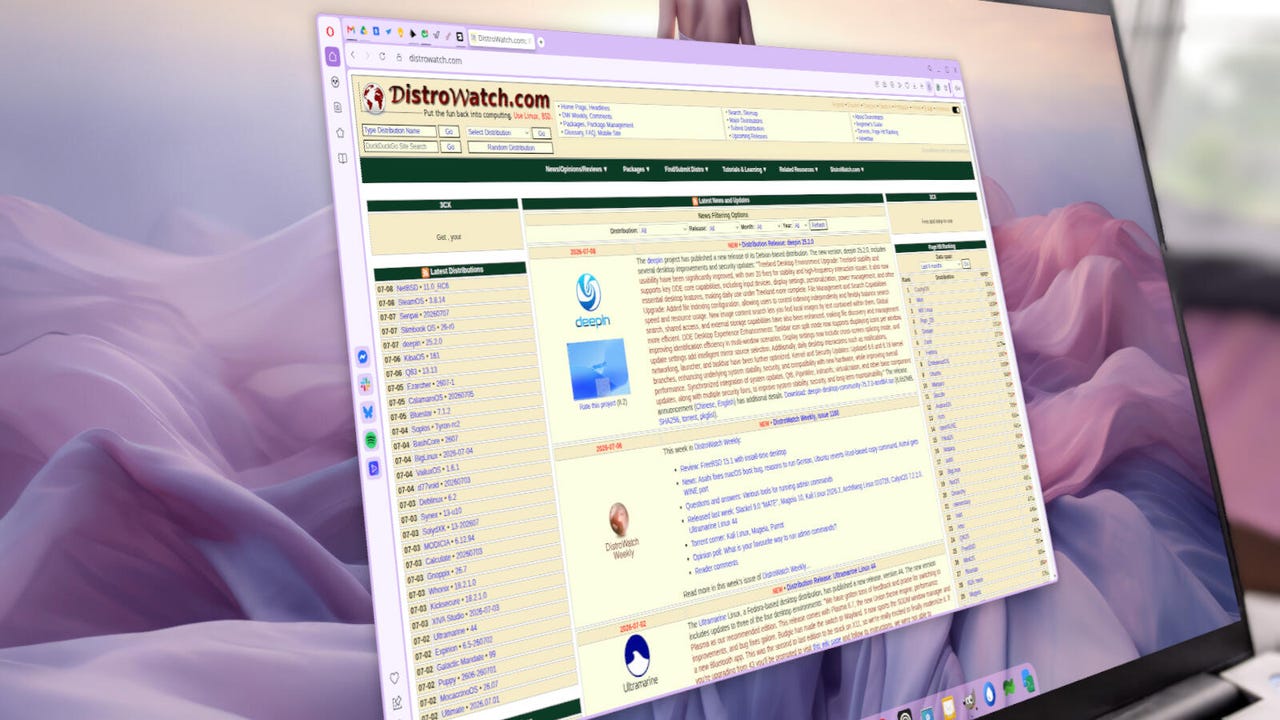
I visit DistroWatch every day. I find the site an invaluable resource for keeping up with what’s happening in the world of Linux distributions. Not only can I see what new releases are available and even view random distributions, but I can also check out which distributions are being viewed through the site’s ranking system.
Also: ‘I’m not a programmer’ anymore: Linus Torvalds on the only two tools he uses now
I’ve shared my take on what that ranking system really means, and even though I see those rankings differently than most, I still find it useful.
A few days ago, as I was looking at the list, I started reordering it according to my experience and opinion. As you probably expected, the ranking I came up with was quite different from the one on the page.
Today, the top 10 distributions on the DistroWatch ranking list are:
- CachyOS
- Linux Mint
- MX Linux
- Pop!_OS
- Debian
- Zorin OS
- Fedora
- EndeavourOS
- Ubuntu
- Manjaro
I want to order them according to my take on usability. After all, isn’t usability one of the most important metrics by which we should measure an operating system?
How I’d rank the top 10 Linux distributions
With that said, here’s how I would rank the current top 10 distributions on DistroWatch.
1. Zorin OS
I’ve been calling Zorin OS one of the most usable Linux distributions on the market for some time. Zorin OS is the ideal distro for anyone coming from MacOS and/or Windows. Zorin OS is exactly what an operating system should be, be it open-source or proprietary. One reason Zorin OS stands above the rest is the ability to easily choose (or change) the layout so the UI is perfectly familiar. Zero learning curve is always good for usability.
Also: After 30 years with Linux, here’s my way of convincing Windows users to switch
Another helpful feature comes by way of open-source app suggestions. If you download and attempt to install a Windows application, Zorin OS will suggest an open-source equivalent.
2. Linux Mint
If you check any given “best of” list for Linux distributions, you can be certain that Linux Mint will be in the top five (if not the very top). Linux Mint takes a rather old-school approach to the UI, so it’s instantly familiar to those who’ve used any given incarnation of Windows. Linux Mint is also fast, thanks to the lightweight Cinnamon desktop.
Also: 5 tiny Linux tools I can’t live or work without
Linux Mint also includes an outstanding Web Apps system, so you can easily add any web application you use to the desktop menu. I do not take this feature lightly, as I make use of quite a few web apps.
If you ask my esteemed colleague, Steven Vaughan-Nichols, he’ll happily tell you that Linux Mint is, hands down, the best operating system in the universe (even as it slows down its release pace).
3. Pop!_OS
Pop!_OS has been my go-to Linux distribution for years, and I don’t see that changing any time soon, especially now that COSMIC is the default desktop (it’s out of this world good).
When Pop!_OS first arrived on the scene, I was sure it would target developers and nothing more. Turns out that initial assumption was way off. Pop!_OS is a great desktop distribution for all types of users: developers, designers, gamers, content creators, and even average users. System76 has created something very special.
Also: Want to save your aging computer? Try these 5 Linux distributions
Since the COSMIC desktop is written in Rust, Pop!_OS is not only fast but also secure. And given this desktop is only on its first Epoch (currently at version 1.2), it’s impressively stable. On top of that, COSMIC is highly customizable, so you can make it exactly what you want.
4. Fedora
Some might call me crazy for placing Fedora this high on the list, but it’s becoming harder and harder to deny just how usable this distribution is. Over the past few years, Fedora has grown leaps and bounds not only in speed (it’s fast), but also in usability. This evolution is put on full display with the KDE Plasma spin of Fedora.
Also: Ubuntu 26.04 vs. Fedora 44: After years of testing both Linux distros, here’s my verdict
Although Fedora does tend to ship with newer software releases than the likes of Ubuntu, that no longer equates to instability. The software is well tested and very stable. From top to bottom, Fedora is as user-friendly as any distribution on the market.
5. Ubuntu
If you were to compare Kubuntu against Fedora KDE, those two distributions would easily stand side by side, which is why they are so close on my list. And even though the default spins of each use the GNOME desktop, you might think I’d place Ubuntu above Fedora because the former lays out GNOME in a more user-friendly way.
Also: Ubuntu 26.04 is the OS for the AI agentic era, says Canonical’s Mark Shuttleworth – here’s why
The reason why I place Ubuntu below Fedora is the choice of a universal package manager. While Ubuntu goes with Snap packages, Fedora opts for Flatpak, and (in my opinion) the latter is the hands-down winner. Flatpak apps start faster than Snaps, and Flatpak is also entirely open-source (whereas Snaps are only partially open-source).
Don’t get me wrong, Ubuntu is still very user-friendly, but with Fedora getting the nod in both speed and universal package management, it stands above Ubuntu.
6. Debian
Debian is the “mother of all distributions” because it serves as the base for so many distros. Debian is also one of the most stable Linux distributions on the market.
There are two reasons why Debian isn’t higher on this list: It defaults to the GNOME desktop, and standard users aren’t in the sudo group, which means you have to su to root to run any admin task (such as installing software from the command line).
Also: You can use Linux 7.0 on these 7 distros today – here’s what to expect
That’s not to say Debian isn’t usable — it is. But unlike Ubuntu (and the others above it), there is a slightly steeper learning curve.
7. Manjaro
And now we venture into the world of distributions that are not based on either Debian or Fedora. Manjaro is based on Arch Linux, which is not a user-friendly distribution. However, Manjaro was the first distribution to evolve Arch into a slightly more user-friendly, Arch-based distribution.
Also: I found a new Linux distro that’s a productivity powerhouse right out of the box
Manjaro has a well-designed GUI installer, ships with a graphical app store, and feels as rock solid as any OS. You’d be hard-pressed to find a more user-friendly Arch-based distribution on the market; that’s how good Manjaro is.
But Manjaro is still an Arch-based distribution, so it’s not going to beat out the others for usability.
8. CachyOS
CachyOS is another Arch-based Linux distribution. The thing that sets this distro apart from the others with a similar base is its speed. CachyOS is probably the fastest desktop operating system I’ve ever used. You also get KDE Plasma, the latest kernel, a kernel manager, and performance like you’ve never seen.
Also: I’ve used Linux for 30 years. Here are 5 reasons why I’ll never switch to Windows or MacOS
Yes, CachyOS places a rather high importance on speed, and it pays off. And because it ships with a GUI app store, it gets to sit right under the ruler of user-friendly Arch distros, Manjaro.
9. EndeavourOS
I really like EndeavourOS; it’s beautiful, and it makes setting up NVIDIA drivers as easy as it gets. That alone should put it at the top of the Arch-based distributions on this list, but because Manjaro has been around for much longer and was the first user-friendly Arch-based distribution, and CachyOS has all that speed and a GUI app store, EndeavourOS is going to have to settle for being a bridesmaid.
Also: EndeavorOS Titan is one of the most unique Arch-based Linux distros I’ve tried – here’s why
Like Manjaro and CachyOS, EndeavourOS defaults to the KDE Plasma desktop (which is becoming a common theme for highly usable Linux distributions), but the main reason why it ranks below Manjaro is the lack of a GUI app store. Yes, you can install Octopi, but you have to do it from the command line.
10. MX Linux
I like MX Linux a lot. I really do. It’s fast, it bucks trends to do what it wants, and it just works out of the box on both desktops and laptops.
The reason why MX Linux sits at number 10 on my list is that it defaults to the Xfce desktop. I’m not saying that there’s anything wrong with Xfce, but those who are new to Linux might have a panic attack at seeing all of the customizations within this desktop environment. There’s a lot. In fact, Xfce might be the most configurable desktop on the market.
Also: The best Linux distributions for beginners: Expert tested and reviewed
Another reason why I place it at the bottom of the list is that it does look a bit old-school. That’s entirely due to Xfce. Of course, if you really like the old-school look, you won’t have a problem with MX Linux. If, on the other hand, you equate modernity with ease of use, you’ll have a hard time with this distro.