Laurie Hertzel’s new memoir set in Duluth explores family stories


This story about Laurie Hertzel’s new memoir was originally published by KAXE.

DULUTH — Growing up in the same house doesn’t mean you lived the same story as your family. 

We all have our own stories to tell.

Minnesota author and journalist Laurie Hertzel was a recent guest on the KAXE Morning Show to talk about her new memoir Ghosts of Fourth Street: My Family, a Death, and the Hills of Duluth.

Hertzel writes from the point of view of her 9-year-old self. One of 10 children, she found herself smack dab in the middle.

“I was sort of all by myself in this crowd. And I was also a very shy, introverted, kind of observant kid. So I spent a lot of time just sort of spying on people.”

The book includes the sudden death of her older brother.

“This sounds goofy, but 9 was like a really good age to experience this kind of tragedy, because I was old enough to understand it and remember it, but I was not old enough to have fully developed emotions.”

Hertzel remembers the loss, but in a different way than older siblings or her parents. 

“I was not really enveloped in devastating grief.”

At its core, the memoir goes beyond the death of a sibling, exploring the stories we tell and how they come to define us.

“My father used to tell stories about growing up in the Great Depression and what that was like. And then the stories we told each other. Because there was so much tension in the household, we kind of looked out for each other.”

Hertzel’s mother took her to the Duluth Public Library and books became a refuge, foreshadowing her career in journalism as the Minnesota Star Tribune books editor as well as an author. She found herself drawn to all the orphan stories like Anne of Green Gables and The Boxcar Children.

“Maybe I’m an orphan and I’ll go find another place to live,” she said.

It wasn’t just the influence of library visits with her mother where she found solace in story. Hertzel said, “My father was an English professor and he had a room in the basement that he had fitted out with bookshelves.” 

She described the basement as creepy and unfinished with a large furnace. 

“And then you went into this little room and it was just like this beautiful place.” Hertzel found herself hiding there often, and reading for a sense of escape from the chaos of the family. 

“It was a way of, at an early age, understanding there’s a whole lot of different ways to live. And I think that’s important for a child.” 


Source link

Leave a Reply

Subscribe to Our Newsletter

Get our latest articles delivered straight to your inbox. No spam, we promise.

Recent Reviews


Payments are at the heart of any accounting and bookkeeping firm. But what happens when your clients don’t pay on time? The cost isn’t just financial. There’s often an emotional toll, a drain on time, and a real barrier to growth.

We surveyed 800 small-to-medium business (SMB) decision-makers across Australia and New Zealand to better understand the state of late payments today, and the findings are powerful.

The GoCardless Pursuing Payments 2025 report uncovers the true impact of late payments and what you can do to break the cycle.

1. The pursuit of payments is still a time drain for many businesses

Over a quarter of small businesses report spending up to an hour every single week just chasing down late payments.

Think about that – a full hour of every work week, gone. That’s an hour that could be spent onboarding new clients, innovating, or simply focusing on what you do best. Instead, it’s lost to the frustrating and awkward task of debt collection.

Unfortunately, the problem isn’t getting any better. Nearly half of SMBs are waiting longer for payments now than they were just 12 months ago (48% in Australia and 51% in New Zealand). And with rising living costs, it’s no surprise that 59% are worried this trend will only get worse.

2. Late payments take a financial and emotional toll

While the time sink is bad enough, the financial and emotional impact can be far-reaching.

41% of Australian SMBs and 35% of New Zealand SMBs report that their payments are, on average, more than 14 days overdue. And these delayed payments inflict a substantial financial hit with 15% of SMBs in both countries losing up to $1,000 every month.

Our research also showed the heavy emotional cost. Chasing money creates tension with customers, causes stress, and makes business owners feel anxious and frustrated. It’s a vicious cycle that can distract from your day-to-day business and core purpose.

3. Bad cash flow is bad for growth

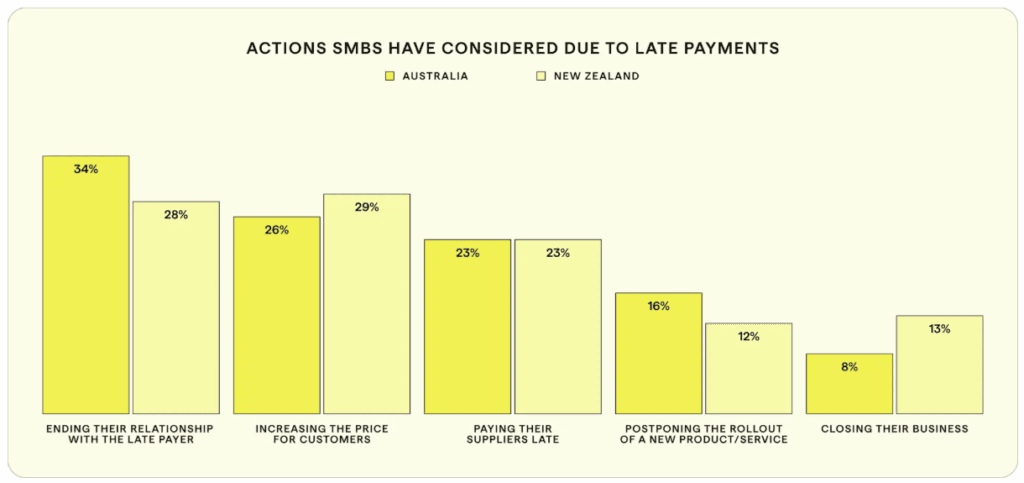
Delayed payments often mean poor cash flow and can result in businesses having to put a hold on future plans. Here are a few growth-stunting actions Australia and New Zealand SMBs have been forced to take due to late payments:

  • Ending their relationship with the late payer
  • Increasing the price for their customers
  • Being late paying their suppliers
  • Postponing the rollout of a new product or service
  • Closing their business

4. Late payments don’t have to be inevitable

So, what’s the solution? The good news is that SMBs are hungry for change. Two-thirds of the businesses we surveyed said they’re interested in using new technology to get a handle on late payments.

That’s where technology comes in. By adopting modern methods like bank payments with GoCardless (think, payments that are made from one bank account directly to another, including BECS Direct Debit and PayTo) you can create, schedule and collect payments for your client invoices on their due date – all from your existing Xero setup.

It’s time to put a stop to the endless admin, reduce costly payment failures, and get paid up to 47% faster. Connect GoCardless to Xero to automate invoice payments, and take back control of your business’s cash flow and growth. 

Was this article helpful?

YesNo


Source link