This summer’s World Cup hasn’t been without controversy, but at least the entertainment is sure to excite fans.
July’s FIFA World Cup Final will include its first-ever halftime show featuring Madonna, Shakira and BTS. The musical event will support the FIFA Global Citizen Education Fund and its work to expand access to quality education and football for children around the world.
Coldplay singer Chris Martin will curate the show, which will feature Sesame Street Muppets, as well as Muppets Kermit and Miss Piggy. A video posted to Instagram shows Martin and Elmo video calling BTS to join in and raise money for children’s education. Shakira said in an official statement, “Standing alongside Madonna and BTS, I’ll be performing ‘Dai Dai,’ the song I created for this FIFA World Cup and for the kids around the world we will reach with the FIFA Global Citizen Education Fund.”
The World Cup Final will take place at MetLife Stadium in East Rutherford, New Jersey, on July 19, starting at 3 p.m. ET. The halftime show will be broadcast live globally.
The 2026 FIFA World Cup has been facing scrutiny over soaring ticket prices and dynamic pricing strategies, with some tickets reportedly reaching thousands of dollars. There have also been major logistical and political concerns, as the White House has imposed bans and travel restrictions on some three dozen countries, including teams participating in the World Cup. FIFA has also imposed stricter discipline on its players’ behavior during matches.
One piece by The New York Times’ The Athletic captured some of this in an article with the headline: “The World Cup is supposed to inspire hope and unity. This one feels different.”
Google is downloading a 4GB file to the PCs of many Chrome users.
The file is harmless and is used for the Gemini Nano on-device LLM.
You’ll see it if you’ve opted into the on-device AI setting in Chrome.
Google is silently saving a Chrome-related file to many computers. That’s nothing earth-shaking. But this file is a hefty 4GB in size, which has caught the attention of some Google watchers. What is the file, why is it being installed, and how can you check for it?
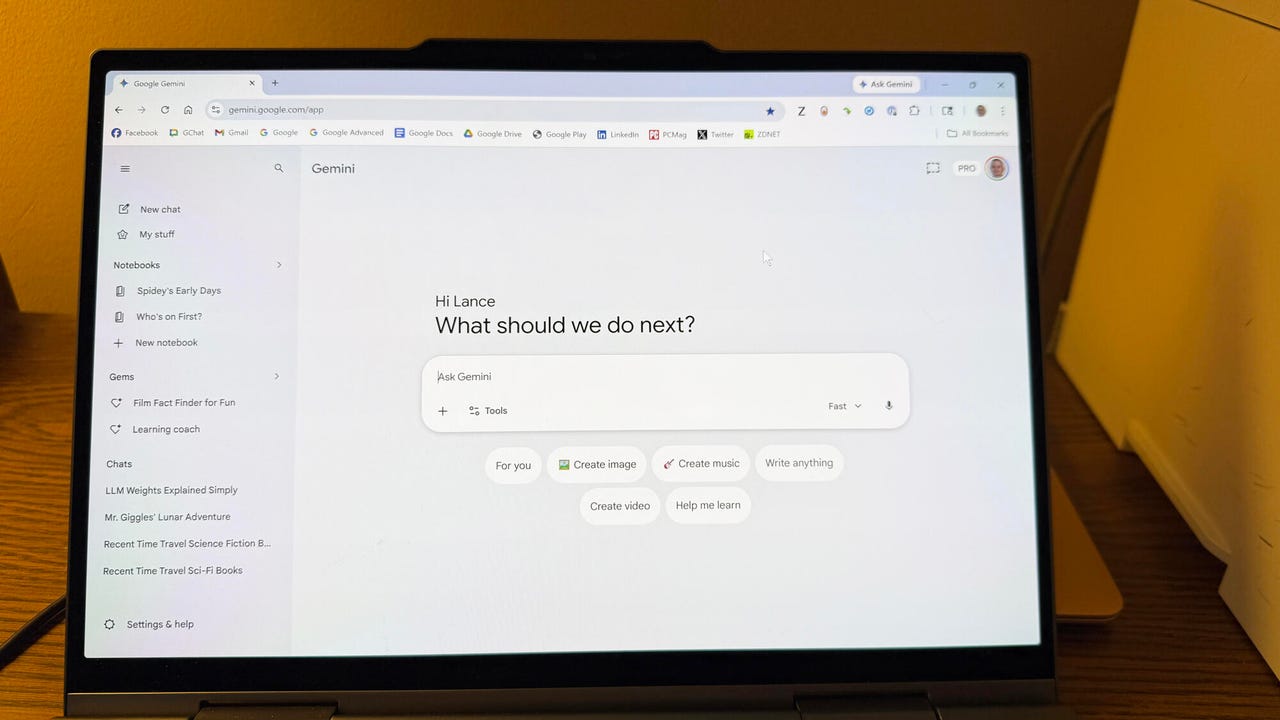
In a new blog post, computer scientist Alexander Hanff, aka the Privacy Guy, pulled back the curtain on this mysterious file. Named weights.bin, the file is being downloaded deep within the user data folder of many Chrome users. The file itself is related to Gemini Nano, which Google is using as the on-device AI model for Chrome users.
If you delete the file, it comes back
Though there’s nothing risky or dangerous about the file, Hanff and others have expressed concerns that it’s being downloaded without users’ knowledge or permission. And if you delete the file, it eventually comes back, Hanff said. That by itself is hardly alarming; that’s part of any software update. Rather, some of the criticism centers on the file’s size. If you have ample hard disk space, then 4GB is likely not a big deal. But if you’re running low, that big a file might chew up space you can’t spare.
Traditionally, AI models like Gemini use the cloud to interact with you. Submit a request, ask a question, or kick off a conversation, and the AI taps into its online data and resources to respond. But that method can be slow and naturally requires that you be connected. By traveling between your device and the cloud, your data can also be exposed.
A trend has emerged in which companies are experimenting with locally stored LLMs (large language models). That not only speeds up the process, but it also means you can use the AI offline and more securely. Gemini Nano has already been in play on Google’s own Pixel phones.
That explains why the file is so large; it has to pack in a lot of data. In this case, a weights file contains numbers that measure the level of importance an AI model assigns to your input. The AI uses these values to determine what should come next. For example, let’s say you start typing the phrase “Why did my new phone cost me an arm and a…” at the prompt. The AI assigns weights to your input to help it predict that the next word would be “leg.”
How can you tell if the file has been downloaded to your PC? First, open Chrome, go to Settings, and select System. On the System screen, check whether the On-device AI option is turned on. If so, then you probably have the file or will soon get it.
To double-check, you’ll have to navigate to the user folder on your PC. That location varies based on your operating system. On my Windows 11 PC, I ran a search in File Explorer for weights.bin. The search took a long journey through the following path: C:\Users\lance\AppData\Local\Google\Chrome\User Data\OptGuideOnDeviceModel\2025.8.8.1141. At that final location, the weights.bin file appeared, measuring 4GB.
Since the file is downloaded again if you simply delete it, you’ll have to take an extra step to get rid of it permanently. After you delete the file, go back to Settings in Chrome and select System. Then turn off the switch for On-device AI.
But as long as you have enough disk space (and if you can’t spare 4GB, then it’s time to clean up your drive), the file is little cause for concern. Just forget about it, especially if you’re keen to try on-device AI, and we’ll see what the future holds for Gemini Nano.
To provide the best experiences, we use technologies like cookies to store and/or access device information. Consenting to these technologies will allow us to process data such as browsing behavior or unique IDs on this site. Not consenting or withdrawing consent, may adversely affect certain features and functions.
Functional
Always active
The technical storage or access is strictly necessary for the legitimate purpose of enabling the use of a specific service explicitly requested by the subscriber or user, or for the sole purpose of carrying out the transmission of a communication over an electronic communications network.
Preferences
The technical storage or access is necessary for the legitimate purpose of storing preferences that are not requested by the subscriber or user.
Statistics
The technical storage or access that is used exclusively for statistical purposes.The technical storage or access that is used exclusively for anonymous statistical purposes. Without a subpoena, voluntary compliance on the part of your Internet Service Provider, or additional records from a third party, information stored or retrieved for this purpose alone cannot usually be used to identify you.
Marketing
The technical storage or access is required to create user profiles to send advertising, or to track the user on a website or across several websites for similar marketing purposes.