
Valves control how air and fuel get in and how exhaust gets out, and theoretically, more of them should translate to better airflow and more power. Before the 80s, two or three valves per cylinder was the norm. But since then, four valves per cylinder has become the gold standard, and today, they’re even found in most budget cars. Nobody, though, has ever tried cramming six valves into a single cylinder and actually put that into production. And there’s a good reason for that. It turns out there’s a point where adding more valves actually hurts airflow instead of helping it, and six is well past that point.
But back in 1985, Maserati — at the time owned by Argentinian-born entrepreneur Alejandro de Tomaso – thought it could pull it off. De Tomaso’s whole vision for Maserati was to build cars that could compete with BMW and Mercedes on price. In 1982, this led to the Biturbo, a V6 sports coupe powered by twin turbo technology. It sold well, too, with close to 40,000 units over its production run. But more importantly for this story, the engine inside it is what Maserati would eventually try to evolve into a six-valve design.
What Maserati built and why
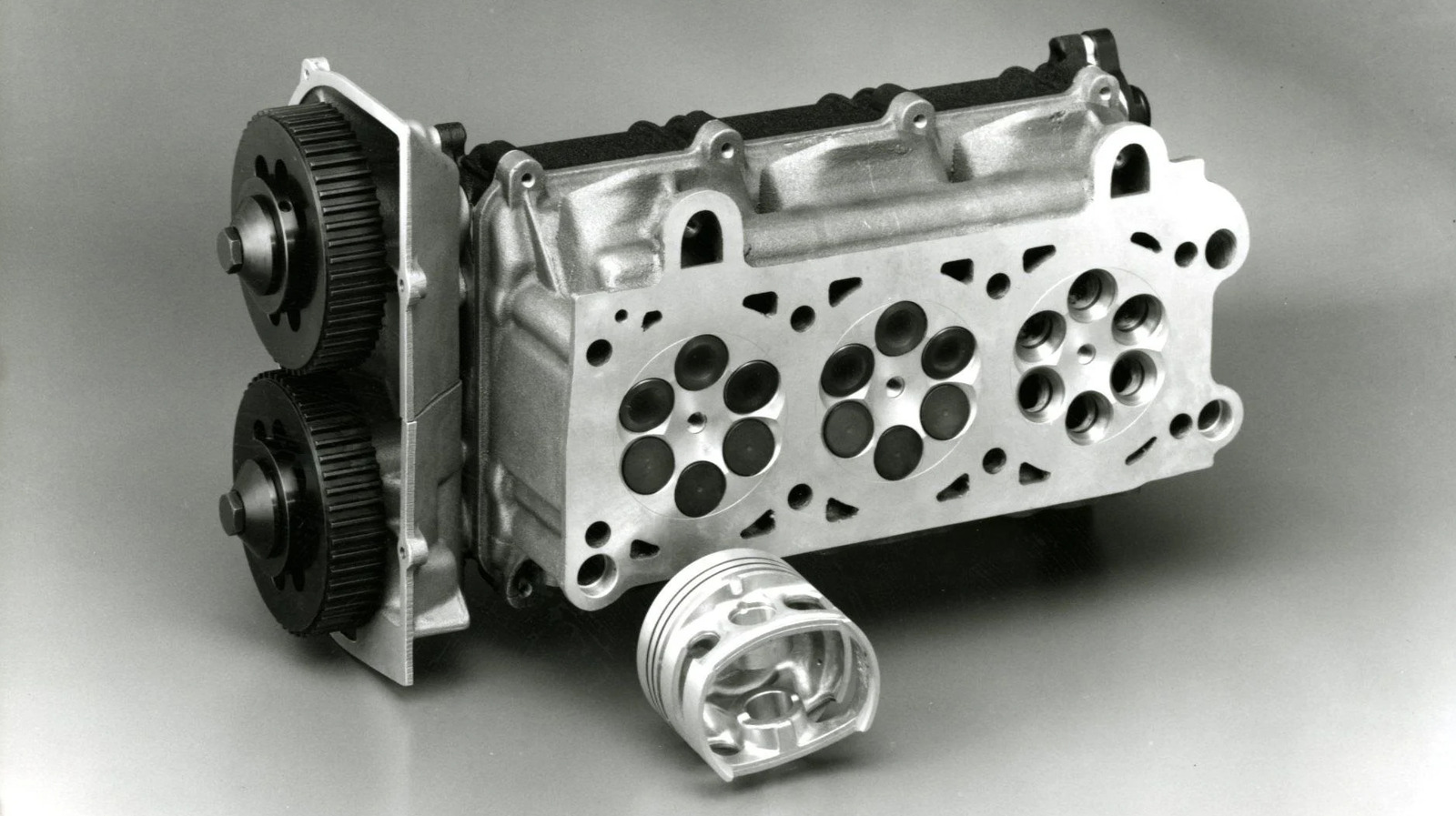
Italian tax law at the time applied a 38% VAT rate to any car with an engine over 2 liters, compared to just 19% below that threshold. So the Italian-market Biturbo was capped at 2.0 liters, and Maserati’s engineers had to get creative within those limits. The standard version still made 180 horsepower with a three-valve-per-cylinder setup, which was impressive for the early ’80s. But De Tomaso wanted more. He didn’t just want to go from three valves to four like everyone else. He wanted six. So he told his engineers to build it, and they did — at least as a prototype. Maserati called it the 6.36, a name that stood for its six cylinders and 36 total valves. And on paper, it looked like a winner.
The 6.36 was a 2.0-liter twin-turbocharged V6 with four overhead camshafts, which is double what the Biturbo’s engine had. Helping it all work was a patented “finger control” system – a single rocker arm that operated three valves at once. It kept the number of moving parts low despite all those valves. Maserati’s engineers also angled the center valves differently from the outer ones. That created a swirl effect inside the combustion chamber, which reportedly increased gas circulation area by 34% over a four-valve design.
Why nobody ever tried it again
Indeed, running just 0.8 bar of boost from its water-cooled turbochargers, the engine reportedly produced around 261 horsepower at 7,200 rpm. That works out to roughly 130 horsepower per liter. That was a huge deal in the mid-1980s. In fact, the only cars matching that kind of specific output at the time were exotics like the Ferrari 288 GTO — one of the most impressive V8 Ferraris ever built – which cost several times more and wasn’t exactly built for the road.
But unfortunately, as it turned out, more valves don’t always mean better results. Maserati wasn’t the only company experimenting with valve counts at the time. Yamaha was another, except it was doing it with motorcycles. Yamaha had already put a five-valve cylinder head on its 1984 FZ750, one of its highest horsepower motorcycles at the time. During that development process, it tested six and even seven-valve designs. What Yamaha found was that airflow actually got worse beyond five. That makes sense because if you pack more valves into the same space, each one has to shrink. Eventually, the total opening area starts decreasing instead of increasing.
Maserati likely ran into the same wall. On top of that, the added complexity and manufacturing cost of a six-valve head made the whole thing impractical for production. And so, it quietly decided to shelve the dream. By 1990, the automaker also introduced a more conventional four-valve-per-cylinder version of its 2.0-liter V6 that made 283 horsepower. That was more power than the 6.36 ever promised, that too with far fewer moving parts. The highly complex six-valve cylinder just didn’t make sense, and no one has attempted it since.

Stephan is the sports journalist for the Maple Grove Report.