Meta CEO Mark Zuckerberg used the company’s first-quarter earnings call on Wednesday to detail his plans to continue investing in AI, including integrating personal AI agents in Meta’s popular smart glasses.
Zuckerberg has long championed a future vision of “personal superintelligence,” which is the idea that AI will be used for “personal empowerment,” as Zuckerberg wrote in a blog post in July 2025.
“My view of AI is very different from many others in the industry,” Zuckerberg said during the earnings call, and repeated in a Facebook post Wednesday afternoon. “I hear a lot of people out there talk about how AI is going to replace people. Instead, I think that AI is going to amplify people’s ability to do what you want, whether that’s to improve your health, your learning, your relationships, your ability to achieve your personal career goals, and more.”
This is not dramatically different from other tech leaders’ view of AI, but it does highlight a key difference: AI from companies like Anthropic, Google and even Microsoft is for your work life. Meta — with social media platforms Facebook, Instagram and Threads — is for your personal life.
That would be fine, except the AI industry has been changing direction this year to focus on building tools for enterprise work and businesses, like Claude Code and Codex. So if Meta is going to primarily focus on the consumer side of AI (though not entirely, since developer tools are important, Zuckerberg acknowledged), there have to be other ways to use Meta AI.
That’s where products like smart glasses come into play.
“All of our glasses are designed to easily update to use our newest AI models and features,” Zuckerberg said. “I’m also really excited to see the glasses evolve from being able to answer questions to being able to be a personal agent that’s with you all day long, helping you remember things and achieve your goals beyond glasses.”
Meta’s focus on building agents comes as many AI companies are working on building autonomous AI tech.
Meta Muse Spark, the company’s latest model, is the first major product launch from its frontier AI lab led by Alexandr Wang and proves the company “is on track to build a leading lab,” Zuckerberg said. But competitors like Google, OpenAI and Anthropic already have those labs and have been growing their model capabilities and customer bases.
The Muse Spark model is the first step toward that future personal agent, the company said. And because it’s Meta, which has built its tech empire on e-commerce, shopping will be part of that vision.
“I don’t hear any other labs out there talking about how they’re building an AI that’s really good at shopping,” Zuckerberg said. Shopping isn’t the most important thing, he said, but it’s about a difference in philosophy around the purpose of AI.
Meta is about “empowering people to do the things that matter in their lives, whether understanding social context or shopping or personal health things, or understanding what’s going on around them visually…these are all elements of the personal super intelligence vision.”
For 2026, Meta increased its overall capital expenditure forecast to between $125 billion and $145 billion, up from the previous ceiling of $135 billion, which Zuckerberg partially attributed to “higher component costs, particularly memory pricing,” referencing the global RAM shortage caused by the high memory needs of AI datacenters.
Wall Street investors have had their eyes on Meta’s report, as analysts use the financial health of the so-called Magnificent Seven — the biggest tech companies — as a litmus test for AI spending and the health of the global economy. Also reporting its earnings on Wednesday afternoon were Amazon, Alphabet and Microsoft.
Struggling with infertility can be emotionally draining. It can leave you feeling isolated and alone. Many avoid talking about their struggles and may even avoid conversations with their physicians because of the stigma surrounding infertility. However, according to the World Health Organization (World Health Organization, 2023), infertility affects approximately 17.5% of the world’s population.
You are not alone – Arizona Gynecology Consultants is here to help you understand the impacts of infertility and share resources to help navigate the emotional and physical difficulties associated with it.
What Is Infertility?
Infertility is generally described as struggles with becoming pregnant within a year of beginning active efforts to conceive (i.e., vaginal sex without withdrawal, barrier, or medication-based birth control). With this definition, it’s easy to see how many individuals suffer from infertility, especially as they age. A woman’s fertility, for example, declines after age 35, and many women seek treatment for infertility if they have not become pregnant after six months of unprotected sex, according to the Centers for Disease Control (CDC, 2024).
Many other factors can contribute to infertility, including medical conditions, medications, new or existing trouble ovulating, differing reproductive organ structure, hormonal changes, and even lifestyle factors like weight, smoking and/or alcohol use, and stress. It’s also important to note that infertility does not just apply to women, but to men as well.
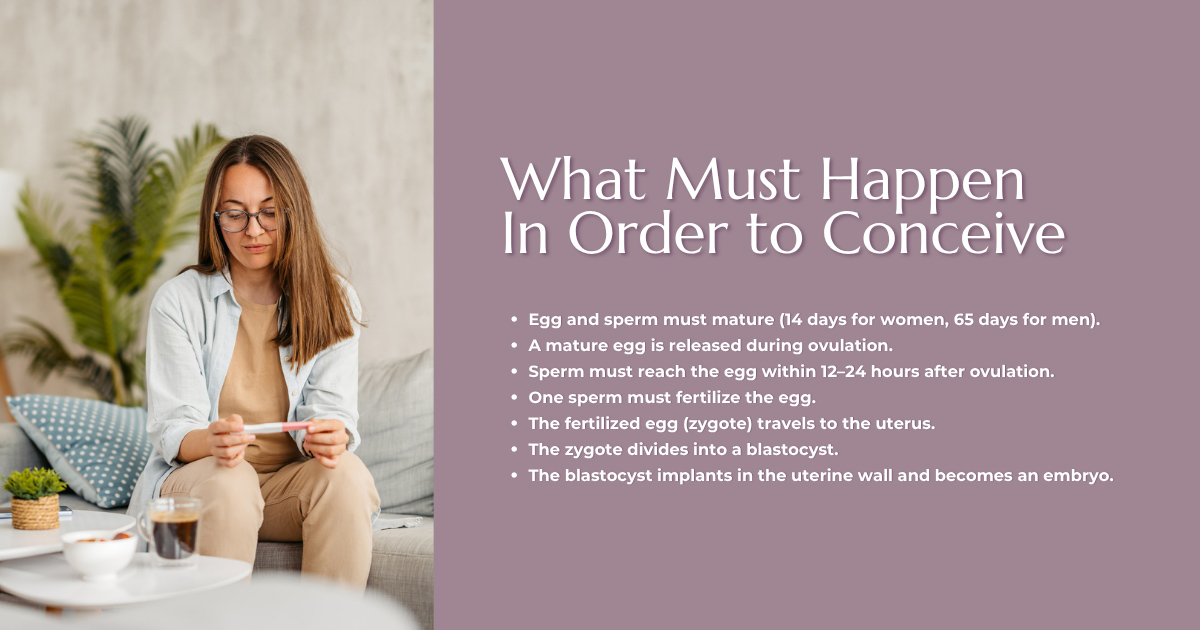
What Must Happen In Order to Conceive
Many women are able to become pregnant without any medical assistance, even those who have previously experienced infertility. However, it’s important to note that many events must occur under ideal conditions to make conception possible. When you’re amidst an ongoing struggle to conceive, though, it can seem like pregnancy happens quickly and easily for everyone else.
For a woman to become pregnant, several things must occur:
First, both egg and sperm must develop and mature, a process that begins at birth and takes about 14 days to complete for women and about 65 days for men.
A mature egg must be released from one of the woman’s ovaries, a process called ovulation.
Sperm must be released into the vaginal canal within 12-24 hours after ovulation and enter the fallopian tube; otherwise, the egg will be reabsorbed by the woman’s body.
At least one sperm must join with the egg to fertilize it.
The fertilized egg, now known as a zygote, must then travel through the fallopian tube and into the uterus.
The zygote must undergo cell division multiple times to become a blastocyst.
The blastocyst must implant itself within the uterine wall, where it will remain as an embryo as it begins to undergo more cell divisions.
From a medical standpoint, pregnancy officially begins at implantation, where the quickly dividing cells implant within the uterine wall and begin receiving nourishment.
Medical conditions, medications, organ structure differences, hormonal changes, and the other issues described earlier can affect the completion of one or more of these events. Even timing can impede pregnancy in many women. But, when these steps are interrupted repeatedly, regardless of the reason, despite active efforts to conceive for a year or more, a physician may diagnose infertility.
It’s important to note that in some cases, a woman may be able to get pregnant but may not be able to carry to term. When a woman miscarries multiple times, she may also be diagnosed with infertility.
What Are Common Reasons for Women to Experience Infertility?
As you can see, conditions must be ideal for both women and men in order for conception to occur. For women, any factors or medical conditions that impact the ovaries, uterus, or fallopian tubes can result in infertility.
Here are some common reasons women experience infertility:
Polycystic Ovary Syndrome
Polycystic Ovary Syndrome (PCOS) is a hormonal issue that impacts the ovaries, causing irregular periods as well as the development of cysts within the ovaries. Irregular periods make it difficult for women to track when they are ovulating, leading to difficulty conceiving. Other women with PCOS may not ovulate at all. PCOS is a permanent condition that makes it difficult to become pregnant, although women can manage symptoms with medications.
Endometriosis
Endometriosis is a condition that occurs when tissue similar to the uterus’ lining grows outside of the uterus. When this happens, scar tissue forms, which causes inflammation, hormonal changes, and pain. Pain during sexual intercourse can inhibit a couple’s efforts to conceive. Meanwhile, scar tissue can physically prevent fertilization or implantation, while both hormonal changes and inflammation can affect all stages of the conception process.
Fibroids
Uterine fibroids are benign tumors that form in or around the uterine wall. They consist of muscle cells or other kinds of tissues that may grow to various sizes. Typically, cysts do not cause pain, but can prevent fertilization and implantation, cause ongoing issues with the development of the fetus, or even result in pregnancy loss.
Other Ovulation and Structural Issues
Aside from the major causes of infertility listed above, women may experience other conditions that can inhibit conception, including:
Other hormonal imbalances that hamper ovulation, like thyroid disorders
Other delayed or inconsistent ovulation, often due to unknown causes
Fallopian tube damage caused by surgery or untreated sexually transmitted infections (STIs)
Genetic or chromosomal conditions that impact ovulation or reproductive organ structure
Certain autoimmune disorders, including lupus and rheumatoid arthritis
Lifestyle Factors
While lifestyle factors are often not the only causes of infertility, they can decrease the likelihood that a woman will become pregnant under otherwise normal circumstances. Substance use, including smoking, alcohol, and drug use, may reduce a woman’s chances of conception. Similarly, being significantly underweight or overweight can impact ovulation, fertilization, and conditions within the uterus.
What Are Common Reasons for Men to Experience Infertility?
It’s important to recognize that, although women frequently blame themselves for difficulty conceiving, infertility is not solely a woman’s issue. Conditions that impact a man’s testicular or ejaculatory function can also inhibit conception.
These conditions include:
Severe injury, birth defects, or genetic conditions that block the testicles or the tubes that carry sperm
Various conditions that raise the temperature of the testicles, inhibiting sperm production
Low sperm count due to hormonal imbalances or genetic factors
Abnormal sperm that cannot fertilize an egg, which can result from genetic or environmental factors
Sperm with poor motility that cannot reach the egg, also due to genetic or environmental factors
Chromosomal or genetic abnormalities that affect sperm quality or sperm production
Medications or medical conditions (like STIs) that cause issues with sperm production
Autoimmune disorders that can affect sperm production
Lifestyle and environmental factors that reduce or eliminate sperm production, such as smoking, heavy alcohol use, environmental toxins, and even weight problems
These conditions represent the most common, but certainly do not represent all the causes for infertility in men. It is vital for any individual experiencing infertility to examine the potential causes in both partners.
When to See A Doctor
While it can be frustrating to experience difficulty conceiving, due to the number of things that must go precisely right and in the correct order, it isn’t unusual to experience a wait of several months before conception occurs. Most couples wait to consult a fertility specialist until they’ve marked one year of trying to conceive.
Here are some groups of women who may want to consult with a physician for infertility as soon as – or even before – a year elapses:
Women Who Are Older
Women aged 35 and older should consult with a specialist after six months of trying to get pregnant. Fertility rates decline as women age, especially in the late 30s and into the 40s. Addressing fertility issues as soon as possible can help older women maximize their fertility before natural age-related changes further hamper conception.
Women Who Struggle with Reproductive Health Conditions
Women with diagnosed endometriosis, PCOS, and other conditions that affect the reproductive system can benefit from consulting with a physician when they decide to have children. Providers can give professional insight into the condition, help address factors that prevent pregnancy, and even provide potential techniques that can increase the chances of conception.
Women with Irregular Periods
Women with inconsistent or absent menstrual cycles often have inconsistent ovulation, as well. Learning more about the reasons behind this irregularity can help women address potential infertility issues. In addition, a physician may be able to help women reach a solution for timing and tracking ovulation for the best chances at conceiving.
Women with a History of STIs, Painful Periods, or Miscarriage
STIs and pelvic inflammatory disease can negatively impact fertility, and painful periods can be indicative of endometriosis or another condition that can cause infertility. Similarly, multiple miscarriages may be a symptom of a condition that has caused infertility. Women with these circumstances should consult with a physician once they decide to try to conceive.
Fortunately, advances in medical science have allowed for more treatment options to help couples conceive. Some of these options include intrauterine insemination (IUI) or in vitro fertilization (IVF). Although Arizona Gynecology Consultants does not provide fertility treatments like IUI or IVF, we play a critical role in diagnosing and treating issues that may affect fertility.
The Testing Process for Infertility
If a couple has had trouble conceiving or has experienced multiple miscarriages, a physician can conduct several tests to determine why they are experiencing infertility.
Tests for Men
Providers typically run a series of tests with the male partner first, as male infertility causes are usually easier to identify. When a man struggles with infertility, the problem is typically due to the production of sperm. This is why fertility tests for men involve an analysis of the semen to evaluate sperm count as well as sperm quality, shape, and motility.
Tests for Women
If men’s tests do not reveal any cause of infertility, the female partner will then undergo several tests. Physicians first determine whether the woman is ovulating and, if so, if she is ovulating regularly.
Testing for women often involves X-rays and ultrasounds. Physicians may also elect to conduct a hysterosalpingography, where dye is injected into the vagina and allowed to spread to other parts of the reproductive system. With these kinds of tests, any blood clots, blockages, or other issues can be identified.
In certain cases, women may need additional tests such as a laparoscopic inspection. This procedure involves a doctor using a laparoscopic tool that is placed through a small incision in the abdomen. From this perspective, the doctor can gain a better understanding of the woman’s reproductive system and any issues preventing conception.
Lifestyle Tips for Fertility Health
Whether you are exploring the root cause of ongoing infertility or simply want to ensure you are giving yourself the best chance at conceiving, it’s wise to address your lifestyle at the same time. Implementing a few healthier choices into your life can make a significant difference in your reproductive health.
Get Plenty of Omega-3 Fatty Acids
An article published in the Oxford University Press (Stanhiser et. al., 2020) states the importance of eating omega-3 fatty acids to boost fertility. Omega-3 can be found in various foods, including fatty fish, walnuts, chia seeds, and flax seeds.
Get Enough Fiber in Your Diet
Fiber intake can also impact fertility health, according to research published in The American Journal of Clinical Nutrition (Willis et al., 2020). Eating foods that are high in fiber but low in added sugars can help increase the chances of a woman becoming pregnant. Some examples of high fiber foods include beans, fruits, vegetables, and whole grains.
Take Prenatal Vitamins
Taking prenatal vitamins may also help you create ideal conditions for conception and fetal growth. The most crucial ingredients in prenatal vitamins are folic acid and B vitamins, but they are also a good source of vitamins A, C, D, and E, as well as calcium, iodine, and zinc. Before choosing a prenatal, consult with a medical professional to determine which prenatal may work best for you.
Maintain A Healthy Weight
Managing your weight is another crucial aspect of maintaining fertility health. Being overweight or underweight can affect your chances of getting pregnant. A 2020 study published by the Avicenna Research Institute (Bond et al., 2020) states that losing 5% of your body’s total weight, as well as lowering your body mass index (BMI), and maintaining healthy triglyceride levels, can help boost fertility.
Stay Away from Unhealthy Substances
Staying away from unhealthy habits, such as smoking or drinking too much alcohol, can also help increase a woman’s chances of becoming pregnant. One systematic review published in Scientific Reports (Fan et al., 2017) demonstrates that consuming alcohol can negatively impact fertility in women.
Evaluate Your Sexual Health
Past sexual activity can also play a part in infertility. STIs can cause a variety of issues to the reproductive system that may also cause problems with fertility. If you’re planning to try to get pregnant, you may want to undergo a screening to rule out lingering effects of STIs.
How Arizona Gynecology Consultants Supports Women Undergoing Fertility Treatments
Although Arizona Gynecology Consultants does not provide fertility treatments, we are still dedicated to helping you address the hormonal and physical issues that impact fertility. Our services are designed to support your health before conceiving, while you are undergoing fertility treatments, and after you give birth. We focus on many of the common issues associated with infertility.
Diagnoses
Diagnosing reproductive issues can help you answer many of the questions associated with infertility.
This includes health issues such as:
Tubal disorders, including fallopian tube blockages
Uterine disorders, such as endometriosis or uterine fibroids
Disorders that impact the ovaries, including PCOS
Disorders that affect the endocrine system, resulting in a hormonal imbalance
Preconception Care
We promote menstrual health, ensuring consistency so that you can track your cycle and identify when you are ovulating. Evaluating any potential medical issues, such as diabetes or high blood pressure, alongside reproductive health, can help you prepare for pregnancy. Arizona Gynecology Consultants can work with you to develop a plan to manage these conditions before they create infertility struggles or become a health risk to you or your child.
Other preconception care includes assistance with implementing healthy habits, such as exercising regularly, eating well, keeping stress levels down, and eliminating alcohol, drugs, or tobacco.
Hormone Management
Managing hormonal imbalances is another important part of treating infertility. When your hormones are not balanced, you may experience uncomfortable side effects as well as difficulty conceiving. Depending on your hormone levels, you may require medication, Hormone Replacement Therapy (HRT), or surgery.
Helping You Find Solutions
When needed, we will provide referrals to fertility specialists to support you on your infertility journey. This is why we partner with a large network of trusted medical providers who possess the necessary medical expertise to treat a wide range of infertility-related issues. If you’ve undergone testing, we can help you analyze your lab results, giving you a better understanding of your situation. We can then provide you with options and guide you through the next steps in your infertility journey.
Find Support for Infertility with Arizona Gynecology Consultants
If you’re struggling to conceive, Arizona Gynecology Consultants offers compassionate and comprehensive care to help identify the underlying issues and guide your next steps.
*Editor’s Note: This article was originally published July 9, 2017 and has been updated with additional information, and republished on August 7, 2025.
To provide the best experiences, we use technologies like cookies to store and/or access device information. Consenting to these technologies will allow us to process data such as browsing behavior or unique IDs on this site. Not consenting or withdrawing consent, may adversely affect certain features and functions.
Functional
Always active
The technical storage or access is strictly necessary for the legitimate purpose of enabling the use of a specific service explicitly requested by the subscriber or user, or for the sole purpose of carrying out the transmission of a communication over an electronic communications network.
Preferences
The technical storage or access is necessary for the legitimate purpose of storing preferences that are not requested by the subscriber or user.
Statistics
The technical storage or access that is used exclusively for statistical purposes.The technical storage or access that is used exclusively for anonymous statistical purposes. Without a subpoena, voluntary compliance on the part of your Internet Service Provider, or additional records from a third party, information stored or retrieved for this purpose alone cannot usually be used to identify you.
Marketing
The technical storage or access is required to create user profiles to send advertising, or to track the user on a website or across several websites for similar marketing purposes.