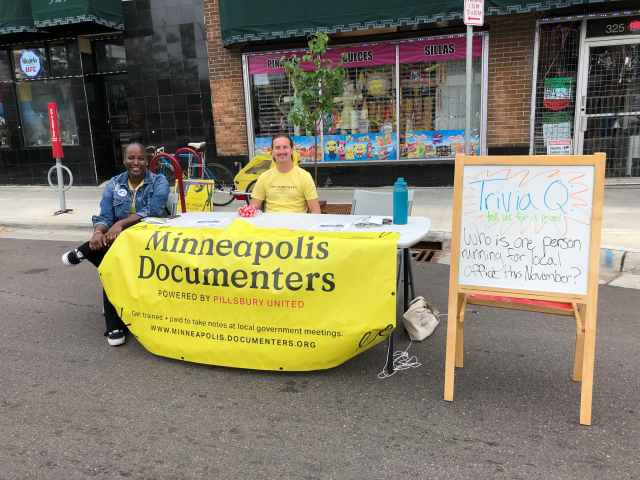
MinnPost is thrilled to share that we’re partnering with the national nonprofit City Bureau to reimagine its award-winning Documenters program for the Twin Cities.
Our program trains and pays community members to attend public meetings and take notes, which are published in collaboration with MinnPost journalists.
Journalists can’t be everywhere and cover everything, and we know you and your neighbors already fill important information gaps. We want to work with you to equip more Minnesotans with the information and skills needed to influence local decision making.
Documenters’ work is already strengthening our journalism: Notes from a recent Hennepin County Board meeting led to this story on pending SNAP cuts and supported this story on the financial pressure threatening Hennepin County Medical Center’s survival. These examples are just scratching the surface of what we think is possible when we bring community members’ diverse perspectives, observations and questions into our newsroom.
We’re building on the successful incubation of Minneapolis Documenters at Pillsbury United Communities, which trained over 100 people and created a comprehensive public record of more than 1,000 meetings from 2022-2025. We’re grateful for PUC’s continued partnership and support in rehoming the program to MinnPost earlier this year. Today, we’re excited to share what we’ve been working on and how you can join us in building a collaborative infrastructure for civic information.
With thanks to the McKnight Foundation, in January we joined City Bureau’s national Documenters Network, a collective of 20+ newsrooms and organizations committed to participatory journalism. We onboarded Minneapolis Documenters program manager Jackie Renzetti and resumed our Minneapolis coverage in February. Next, we’re working on outreach in St. Paul to inform how we can cover the other half of the Twin Cities.

We’re also thankful to be collaborating with North News Editor David Pierini and Southwest Voices Editor Melody Hoffmann, who have served as notes editors for more than a year. In exchange, they receive early access to all Documenters’ submissions to inform their reporting. We’re excited to build on this model, which is inspired by Detroit-based Outlier Media and their Detroit Documenters program. We believe when newsrooms work together to build collective knowledge around local government, journalists are better equipped to track policy and hold officials accountable.
Related: Twin Cities Documenters public meeting reports
Finally, we’re rethinking what it means to be a Documenter and are eager to work with our readers and the broader community to shape the program at MinnPost. Our events and online forum welcome anyone across the Twin Cities or Greater Minnesota looking for support monitoring their local government and sharing that information with their neighbors.
Here’s how you can help us build a more informed and connected Twin Cities:
- Share your questions and suggestions about Twin Cities local government coverage, including what meetings you’d like to see Documenters at.
- Partner with us. We want our program to be a force multiplier for newsrooms and organizations working to improve equitable access to civic information. We’re thankful to already be working with the Minnesota Journalism Center, Pillsbury United Communities, North News and Southwest Voices.
- Attend an orientation to learn more about our program and how to take paid assignments covering Minneapolis and St. Paul. Our free trainings and events are also open to anyone looking for support following their own local government and sharing that information with their communities.
- Follow us on Bluesky, Instagram and Facebook at @TwinCitiesDocs and share our announcement with your networks.
- Donate. We’re actively raising money to sustain and expand the program, including adding more meetings in St. Paul. You can help with a donation to MinnPost.
- Become a corporate sponsor. Your support directly expands coverage, creating a more informed public and healthier civic ecosystem. We’ll be rolling out news products and events with various customizable sponsorship opportunities. Let’s talk!
To get involved with our program, please make an account here. To connect with us as a partner, sponsor or funder, please submit this quick form.
We believe that more Minnesotans paying attention to local government will lead to better results and ensure that the people affected by local government decisions are equipped to influence them. Even if you don’t pursue formal public meeting assignments with us, we hope this program gives you the tools, the knowledge and the community to engage more deeply with your local government.
Related