New Poll Connects Social Media and Chatbots With Spread of Vaccine Misinformation


Vaccines have become an increasingly contentious public health topic, with some parents choosing not to vaccinate their children against certain diseases due to widespread misinformation. Among the most prevalent myths are that the measles, mumps and rubella vaccine causes autism in children and that COVID-19 vaccines have resulted in more deaths than the virus itself.

Many of these false claims are being spread online by anti-vaccine influencers. 

The latest tracking poll on health information and trust, conducted by the Kaiser Family Foundation, an independent source of health policy research, examined such claims. 

The poll, published on Tuesday, looked at four widespread anti-vaccine myths: MMR vaccines cause autism in children; MMR vaccines are more dangerous than being infected by the measles; more people died from the COVID-19 vaccines than the virus itself; and mRNA vaccines can change your DNA. 

A representative for the Kaiser Family Foundation did not immediately respond to a request for comment.

The poll surveyed 2,480 US adults and found that those who use social media for health information and advice at least weekly (26% of all adults) are more likely than those who never use social media for health to say each false vaccine claim is “probably” or “definitely true.” 

screenshot-2026-07-01-at-3-16-48pm.png

The relationship between belief in vaccine myths and the use of social media or AI for health information.

KFF Tracking Poll on Health Information and Trust (May 7-31, 2026)

The findings were similar when the survey looked at people who relied on AI chatbots for health advice. The results showed that 35% of adults who use AI chatbots at least weekly for health advice believe the measles and mRNA vaccine myths, compared to 20% of non-chatbot users. 

AI Atlas

Although only a small percentage of adults believe health myths shared by AI chatbots, the finding underscores broader concerns about trust in the US healthcare system.

The survey found that those most likely to not fall for vaccine myths tend to have a reliable healthcare provider they trust. When asked if more people died from the COVID-19 vaccines than the virus, 46% of adults who didn’t have a trusted healthcare provider agreed that it’s “probably” or “definitely true.” This is roughly double the share of people with a trusted healthcare provider (24%) who disagree with these claims.

screenshot-2026-07-01-at-3-17-07pm.png

Individuals with a trusted provider are less likely than those without one to endorse vaccine-related myths.

KFF Tracking Poll on Health Information and Trust (May 7-31, 2026)

These figures also extended to parents who skipped or delayed vaccinating their children. Parents who were against vaccinating their children were 25% more likely to say vaccine myths were “definitely” or “probably true,” compared to parents who vaccinate their kids. 

The poll also analyzed the data collectively and showed there’s an opportunity to regain trust in vaccines among those in the “malleable middle.” While some people were fully opposed to vaccines and others fully in support, at least half of the adults surveyed were unsure. The poll suggests this is the group that should be targeted to address vaccine hesitancy.

CNET previously reported that the spread of wellness misinformation online indicates a problem within our healthcare system. As access to primary care and diagnosis becomes more restricted and less affordable, many people turn to social media or AI for free answers they cannot get elsewhere.

Some are drawn to information — even when it’s false — from wellness influencers who appear to have the answers, because they share relatable, professional-looking content. With gaps in access to healthcare and the growing use of social media and AI chatbots, vaccine misinformation can spread more easily among vulnerable populations.


Source link

Leave a Reply

Subscribe to Our Newsletter

Get our latest articles delivered straight to your inbox. No spam, we promise.

Recent Reviews


angry-birds-android-auto

Artie Beaty/ZDNET

Follow ZDNET: Add us as a preferred source on Google.


ZDNET’s key takeaways

  • Several mobile games are compatible with Android Auto.
  • The games all have simple touch-screen controls.
  • These are slow-paced, short-burst games. 

If you spend downtime in your car waiting for school pickup or during a lunch break, there’s a good chance you pass the time with mobile games. Here’s what you probably didn’t know: You could be playing some of those games on your car’s screen instead. A handful of popular mobile games are compatible with Android Auto, meaning you can play them in your car.  

Also: 4 Android Auto developer settings that make driving so much easier – how to enable them

You might have browsed your Android Auto apps and already seen the Gamesnacks app, which hosts several dozen light games that are not unlike early internet flash games. However, these games are more robust; they’re the same games you’d play on your phone, just on a bigger screen.

The catalog of Android Auto-compatible games isn’t huge, but it’s worth a look. None of these titles has complex controls or a steep learning curve, and all are perfect for short sessions. 

How to get started

To play on your car’s screen, you will need to install these games on your phone and have your vehicle in park. The good thing is, though, when you’re connected to your car and open the app on Android Auto, you can still use your phone for other things. This is ideal when you have a child in the car with you and need to pass the time, but don’t want to hand over your phone. 

Also: 4 Android Auto apps I highly recommend for your next road trip – beyond Maps and Spotify

I tried a quick run-through of the available games; while they didn’t run as smoothly as on my phone, they’re enough to play comfortably. Here’s a rundown of my favorites.

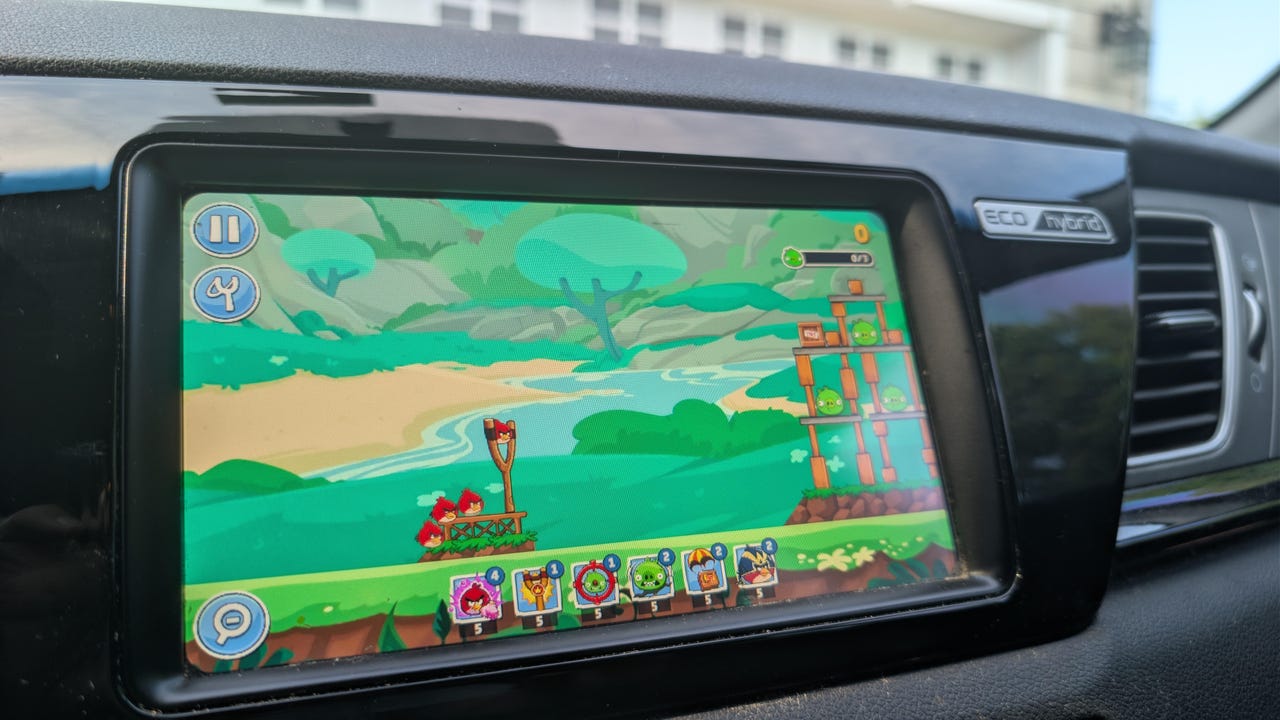
angry-birds-android-auto

Artie Beaty/ZDNET

Angry Birds Friends: I hadn’t played Angry Birds in years, but the slingshot-style gameplay was easy to pick back up. It works well on a car touchscreen, and the levels go by quickly. Since the game is actually on your phone, your progress saves, so you can keep going across multiple sessions. I enjoyed not just beating levels, but immediately replaying a level I had just beaten to get a higher score. 

beach-buggy-racing

Artie Beaty/ZDNET

Beach Buggy Racing (1 and 2): Both versions of this cart-racing game feature colorful racers with very simple controls, making them the perfect games to kill 5 or 10 minutes. The tracks are filled with powerups, shortcuts, and other racers to beat (computer players, not online). I feel like this game takes more advantage of the bigger screen than any other on this list, and it’s the one that feels most like a “real” video game.

candy-crush-android-auto

Artie Beaty/ZDNET

Candy Crush Soda Saga: I’ve never been a fan of Candy Crush or its many versions or clones, but this is probably the most popular game available for Android Auto. The match-three gameplay is easy to pick up and play in short bursts, and it is relaxing to just zone out for a few minutes. Since the action is slower, it’s easy to play on a car screen than are games that require more movement.

farm-heroes-android-auto

Artie Beaty/ZDNET

Also: I saw the future of Android Auto, and now Google has me dreading my own car

Farm Heroes Saga: This game is from the same developers as Candy Crush and functions the same way, you’re just matching fruit, vegetables, and water instead of candy. This game goes a bit beyond the standard match-three format, as it sometimes requires you to collect a specific number of a particular piece. I still enjoyed this game, I just gave the more popular name the nod first.


Source link