Earlier this year, people familiar with Hennepin County Medical Center’s (HCMC) dire finances started worrying publicly that the Minneapolis institution would be forced to shut down. In May, a massive legislative bailout bought time for the region’s largest safety-net hospital. But it didn’t fix the underlying causes of its troubles, high among them the skyrocketing cost of providing care to people who can’t afford it.
Take cancer treatment, for example. It’s notoriously expensive and can even send patients in stable financial situations, with comprehensive health insurance, into medical debt. Sometimes there are legal solutions, said Erin Hartung, director of legal services for Cancer Legal Care, a nonprofit providing assistance to Minnesota cancer patients with medical debt or other financial difficulties. But sometimes there aren’t. So, her clients often look to options like one-time health care grants, food and travel assistance, or even GoFundMe.
“It’s a lot to add on top of somebody’s medical treatments that they’re already trying to navigate,” Hartung told MinnPost.
Related: HCMC bailout offers life raft for a critical physician training program
When outside options can’t cover the costs, Hartung said some clients apply to the hospitals’ financial assistance programs. For patients who qualify – some whose lives hang in the balance – the money can be lifesaving.
But for HCMC, financial assistance has become an almost impossible burden. The cost to the hospital of what is called “charity care” not only has risen to unsustainable levels in recent years, but has far outpaced what other hospitals in the state have spent. And as the number of uninsured Minnesotans rises, the hospital finds itself in an increasingly untenable position with no simple solution in sight.
HCMC’s financial woes have been mounting for years, due in part to the shutdown of Minnesota-based health insurer UCare and changes to Medicaid eligibility brought on by the One Big Beautiful Bill Act. HCMC is set to face up to $50 million in operating losses this year alone, along with a staggering $1.7 billion in losses over the next decade, according to financial projections shared with the Hennepin County Board’s budget committee in March.
After weeks of intense discussions, Minnesota lawmakers passed an omnibus bill securing $205 million for HCMC from the state’s general fund in the final hours of the Legislative session. Starting next summer, the hospital will also have access until 2031 to a $500 million reserve account, drawn from the state’s rainy day fund.
“The stabilization funding does not resolve the long‑term impacts of HR1 or the structural deficits that uniquely challenge safety‑net hospital systems,” Hennepin County spokesperson Joshua Yetman said in an email to MinnPost. “But it does accomplish two essential things: it delivers historic support that prevents closure, and it gives us the time and stability to work with the state on durable, long‑term solutions.”
The cost to treat HCMC’s uninsured or publicly insured patients, who make up roughly 75% of Hennepin Healthcare’s patient base, according to a hospital fact sheet, are massive. Part of HCMC’s mission as a safety-net hospital is treating all patients regardless of their insurance status or ability to pay, which has led to a large share of unpaid bills.
This phenomenon falls under a broader umbrella term called “uncompensated care,” said Scott Hulver, senior policy analyst with KFF, a health policy research, polling and news organization.
There are two major types of uncompensated care, Hulver explained: charity care and bad debt. Charity care, also called financial assistance, is when a hospital deducts a patient’s medical bill because they were unable to pay but qualified for financial aid. Bad debt is when a patient does not pay their bill but does not qualify for charity care.
While virtually every hospital has some amount of uncompensated care costs, HCMC’s costs represent roughly 20% of total costs statewide, Yetman said in an email.
In recent years, uncompensated care costs have skyrocketed at HCMC, where the threshold to qualify for financial assistance is lower compared to similar hospitals.
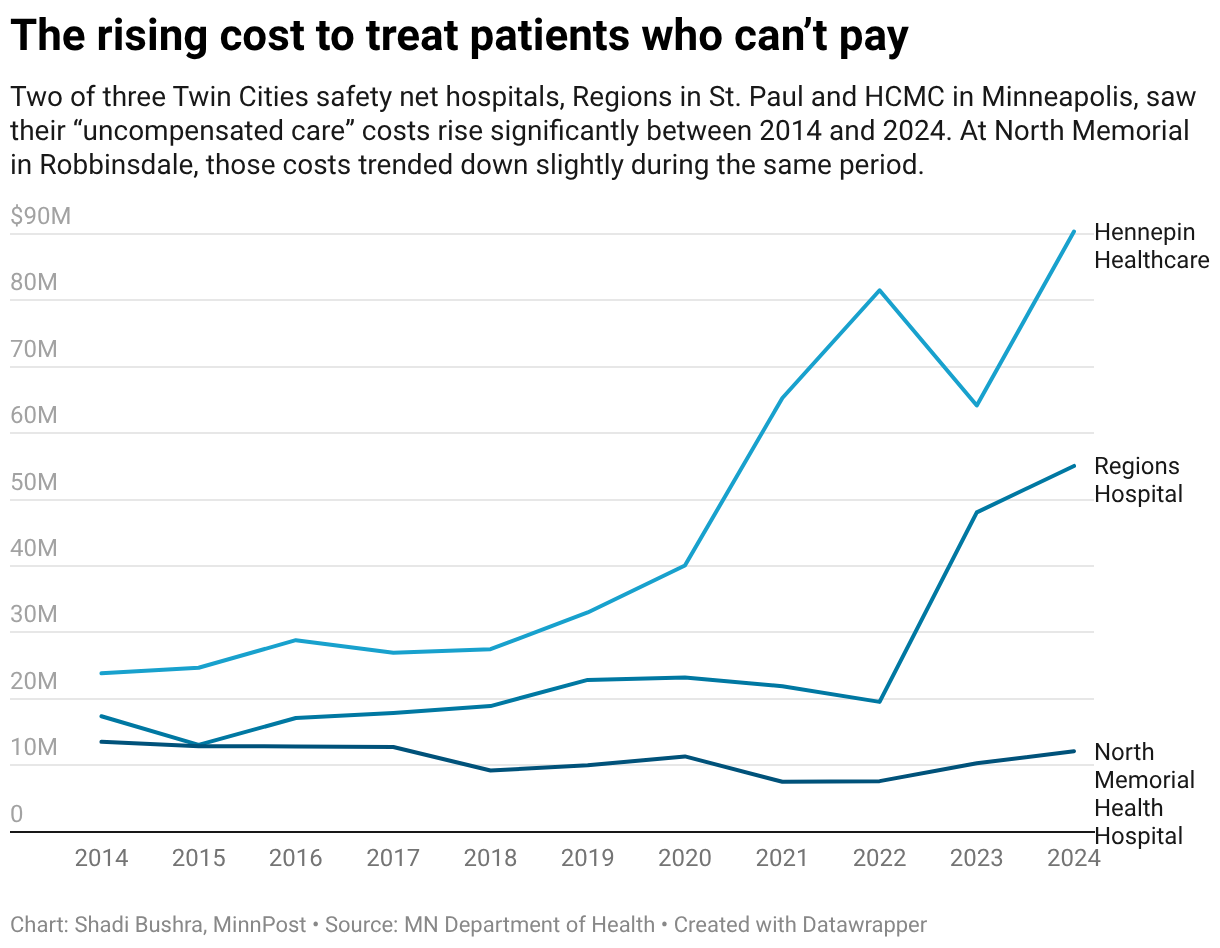
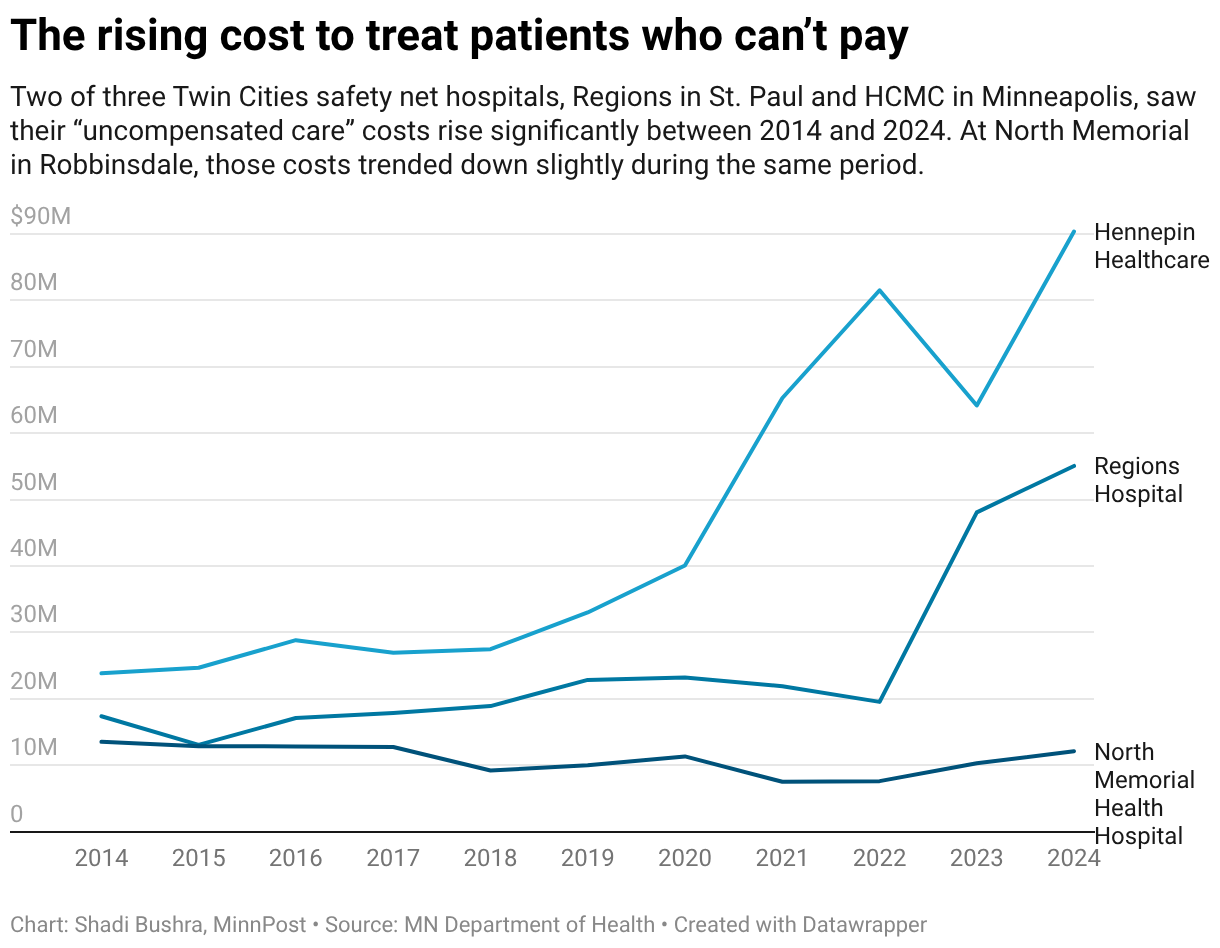
Data from the Minnesota Department of Health (MDH) shows that in 2014, the hospital had just under $24 million in uncompensated care costs. A decade later, that figure jumped to more than $90 million – an increase of almost 280%. Additionally, more than $88 million of HCMC’s $90.3 million uncompensated care price tag in 2024 was for charity care, a 47.5% increase from 2023. The remainder – about $2 million – covered bad debt.
Regions Hospital in St. Paul, another Level 1 trauma center, had $55 million in uncompensated care costs in 2024, $25 million of which was charity care. Regions did not grant an interview to MinnPost, but Jimmy Bellamy, senior communications consultant with HealthPartners, said in an email that the hospital provides the “most charity care to underserved patients in the East Metro as a safety net hospital.” Bellamy added that in recent years, Regions has seen a decline in patients on Medicaid and a rise in uninsured individuals.
North Memorial in Robbinsdale, the other hospital in the metro area’s trifecta of Level 1 trauma centers, only spent about $2.6 million on charity care that same year. North Memorial did not respond to MinnPost’s repeated requests for comment.
Yetman attributes the rise in uncompensated and charity care costs at HCMC to several factors, including an increase in uninsured or underinsured patients, post-pandemic hikes in clinic visits and more intensive inpatient stays, which increases the overall cost of delivered care – including treatment that goes unpaid.
Beth Feldpush, senior vice president of advocacy and policy at America’s Essential Hospitals, representing safety-net hospitals across the country, including HCMC, said hospitals nationwide have experienced rises in patient volumes post-COVID due to individuals opting to delay treatment during the pandemic. Now, patients are coming in with more urgent needs and hospitals like HCMC are dealing with the backlog.
An additional 10 million people nationwide are projected to lose health insurance coverage due to federal changes to Medicaid, part of the One Big Beautiful Bill Act, Feldpush said, citing estimates from the Congressional Budget Office. In coming years, she predicts more increases in charity care costs that will disproportionately affect HCMC and other safety-net hospitals.
“We’re going to see a lot more folks needing charity care, and at the same time that bill also cuts support for hospital funding,” Feldpush said. “Hospitals are really looking at this double whammy, where they’re going to see more people needing charity care coming in through their doors, but also they’re going to have less ability and less financial support to provide that charity care.”
HCMC also devotes more of its operating budget to charity care compared to other metro hospitals.
A KFF Health News and Minnesota Star Tribune investigation published in May found that 80% of Minnesota hospitals spent less than 1% of operating expenses on charity care, with only 24 hospitals in the state spending more than 1%. HCMC is one of them, spending 3.62% of its operating budget, the highest percentage of any hospital in the state. Charity care accounts for just over 2% of Regions’ operating budget and only 0.38% at North Memorial.
The reason may lie, in part, in HCMC’s willingness to provide financial assistance. Compared to the other Level 1 trauma centers in the metro, HCMC is much less strict with its application requirements, meaning a wider range of patients qualify. Unlike some states, Minnesota does not have standardized eligibility criteria for who qualifies for charity care.
“Hospitals vary a lot in terms of what income thresholds they allow for financial assistance, whether the hospital provides some sort of discount to the care or whether they will cover 100% of a patient’s bills,” Hulver said.
Related: Charity care: As ranks of uninsured grow, Minnesota’s hospitals are among least charitable in nation
For starters, HCMC offers free care to those at or below 300% of the federal poverty level, meaning an individual making just over $45,000 a year qualifies. This is a higher income threshold than Regions and North Memorial, both of which offer free care to those at or below 200% of the FPL, meaning some patients would qualify for charity care at HCMC, but not at the other two hospitals.
Additionally, HCMC doesn’t have as many requirements to apply for charity care. The KFF/Star Tribune investigation noted the hospital only requires applicants to provide their income totals, while Regions and North Memorial require income, bank accounts and financial assets estimates.
For now, HCMC has secured funding from the Legislature that will keep it running in the short-term, but long-term stability and the ability to absorb growing uncompensated care costs remain a looming challenge.
Rep. Esther Agbaje, DFL-Minneapolis, a major player in House HCMC negotiations, told MinnPost at the Capitol in the final days of the session that the passed legislation also calls for the creation of a task force to help develop sustainable solutions for the hospital, including a new governance structure.
“I really want people to be encouraged at the fact that we want (HCMC) to be here for the long haul, and I hope they will stay here too,” Agbaje said.
Related