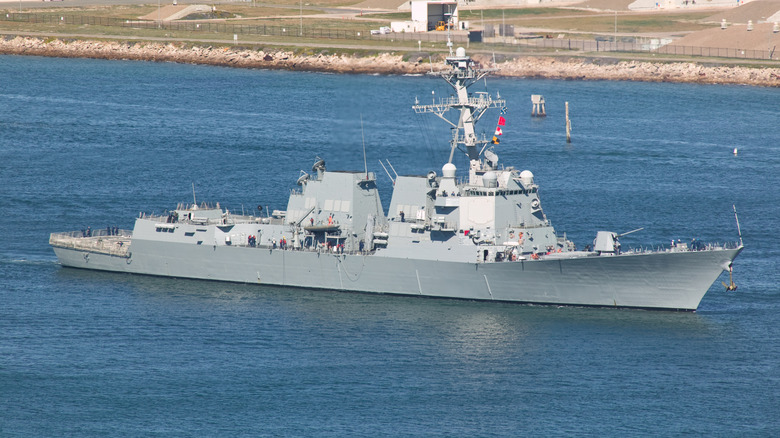

The U.S. Navy, which possesses the largest and most advanced fleet of missile destroyers on the planet, is undertaking a major modernization and expansion with several new ships set to be commissioned in the years to come. One of the newest ships in this lineup is the USS Ted Stevens, an Arleigh Burke-class guided missile destroyer, widely considered one of the world’s most powerful destroyer class vessels. This particular vessel was manufactured at the Ingalls Shipbuilding division in Pascagoula, Mississippi. After undergoing mandatory sea trials in 2025, the vessel has finally departed the shipbuilding yard, towards its homeport in Norfolk, Virginia.
This trip to Norfolk is significant in that it will be one of its last trips as an uncommissioned vessel. As per current plans, the USS Ted Stevens is expected to be officially commissioned in the fall of 2026 at Whittier, Alaska. The location in Alaska was chosen because the ship is named in honor of Ted Stevens, who served as a U.S. Senator for Alaska for over four decades. The commissioning of the USS Ted Stevens in Alaska is a rare event in itself, given that the last U.S. Navy vessel to be commissioned here was the USS Anchorage back in 2013.
The USS Ted Stevens is one of the latest Arleigh Burke-class destroyers delivered to the U.S. Navy. The vessel belongs to the “Flight III” category, which indicates that it is the newest generation of its class. Several newer Arleigh Burke-class destroyers are already in the works, with two shipbuilding companies, Huntington Ingalls Industries (HII) and Bath Iron Works (BIW), involved in the manufacturing of these new ships.
Everything to know about the USS Ted Stevens
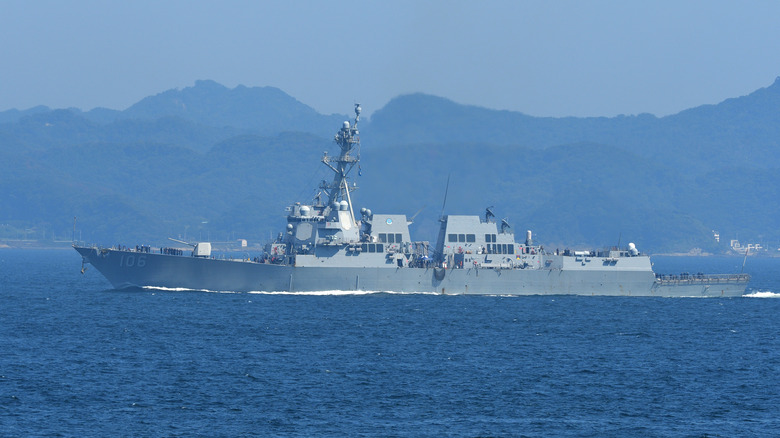
The USS Ted Stevens is set to become the second Flight III-grade Arleigh Burke-class vessel to be commissioned by the U.S. Navy. The first vessel of this class is the USS Jack H. Lucas (DDG 125), which was commissioned in October 2023. Its successors, the USS Louis H. Wilson Jr. (DDG-126) and the USS Patrick Gallagher (DDG-127), are still under construction by Bath Iron Works, a separate shipbuilding company. Other Flight III grade vessels that are currently under construction include the Jeremiah Denton (DDG 129), the USS William Charette (DDG-130), and the George M. Neal (DDG 131).
The USS Ted Stevens, like other members of the Flight III grade vessels, will have a displacement of 9,496 long tons when fully laden. It has a length of 309.5 feet, a beam width of 66 feet, and a 31-meter draft. It is propelled using four separate General Electric (GE Vernova) LM2500 gas turbines. Each of these turbines is rated at 35,000 hp, and together, they can propel the vessel to speeds of up to 31 knots. As expected of a destroyer, the USS Ted Stevens will be armed with an array of weapons, including several machine guns, a wide selection of missiles, and twin torpedoes.
One of the most significant feature additions to the USS Ted Stevens is the all-new AN/SPY-6(V)1 Air and Missile Defense Radar (AMDR). It is touted as the most powerful radar ever fielded on a U.S. Navy surface warship and enables the ship to track and detect threats of various types over longer ranges.

Stephan is the sports journalist for the Maple Grove Report.