Parking lots aren’t eco-friendly. What are the alternatives?


At the Hampton Roads Planning District Commission headquarters in Virginia, staff knew their crumbling asphalt parking lot was in desperate need of repair. But instead of replacing the lot with more dark blacktop, the group chose an alternative.

The new parking lot, completed last year, includes porous concrete panels and areas with native plants and recycled materials to make the lot cooler and less prone to flooding.

With the new panels, “the rain infiltrates faster than it can puddle and stop on the surface,” said Jill Sunderland, the commission’s senior water resources planner.

“You notice too, that it’s cooler,” Sunderland added. “You really can tell a difference out there … not to mention it’s just more inviting.”

The project is one example of how dozens of cities and other groups around the U.S. are using alternatives to traditional asphalt lots in order beat the heat and curb water runoff — especially as climate change worsens.

The City of New Orleans has required its Department of Public Works to use permeable paving in lots and other spaces where practical. In Indianapolis, the Newfields art museum transformed one parking lot to include bioretention rain gardens and another with a permeable grid instead of traditional blacktop. Denver’s dePaving a Greener Denver initiative is looking to slash the city’s cover of parking lots and other impervious surfaces.

Another way cities are cutting back on pavement is by dropping regulations that require a minimum number of parking spaces for new residential or commercial buildings. Buffalo, New York; Austin, Texas; and Minneapolis are among the cities that have changed these policies in recent years.

Asphalt industry representatives, meanwhile, are touting advances in that material while also cautioning that parking lot owners should carefully consider the durability of any non-asphalt alternative.

Here’s a look at a variety of alternatives to traditional lots.

Cooling technologies and shading

In some downtowns, parking takes up a quarter or more of the land, and studies show that more than a third of parking spaces can sit empty at any given time, according to Adam Millard-Ball, a professor of urban planning at UCLA. Many lots see infrequent use at sporting arenas, malls or offices. So some entities offer grants for cities and businesses to replace or transform these hardscape parking areas, which have traditionally been made from asphalt.

Reflective surface coatings or treatments, as used in Los Angeles’ Pacoima neighborhood, function like paint to keep the ground from absorbing as much heat.

Incorporating vegetation also helps regulate temperature by absorbing energy and releasing moisture.

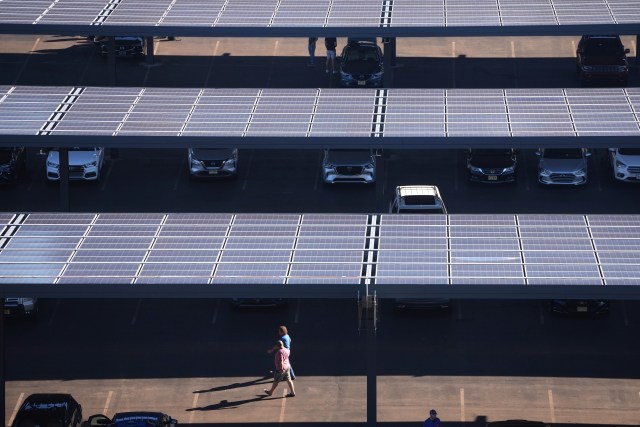
Solar panels covering a parking lot.
FILE – People walk though a parking lot with solar panels near Lincoln Financial Field, Sept. 8, 2025, in Philadelphia. Credit: AP Photo/Matt Slocum

Sacramento, California, requires parking lot developers to plant enough trees to shade half the lot within 15 years of its construction. Washington, D.C., and Seattle have green area requirements for landscaping, particularly for new development. Some cities leverage solar panel installations as shade structures.

Without these fixes, dark paved surfaces can trap heat and drive temperatures up by as much as 20 degrees. That heat typically builds up during the day.

The heat spreads, contributing to what’s known as the urban heat island effect, said Vincent Cotrone, extension educator of urban forestry at Pennsylvania State University. Warmer neighborhoods often lead to high energy use, as people rely more on air conditioning to stay cool. Those AC units push hot air back outside.

Stormwater runoff solutions

Other alternatives aim to solve problems that occur when impervious pavement prevents rainwater from soaking into the ground. When water runs off paved surfaces, it can carry pollutants like oil and heavy metals into nearby waterways, said Cotrone.

More advanced than gravel, lattice pavers allow for grass to grow. These, as well as interlocking pavers that create spaces between individual units, allow for rainwater to filter through. Other permeable substances used for runoff control include stone beds, brick pavers or honeycomb-style structures.

The Hampton Roads Planning District Commission uses a stamped, grooved concrete border, so that when stormwater runoff flows from traditional concrete to the porous concrete, sediment gets trapped instead of clogging up and needing maintenance.

Long channels of plants known as bioswales and recessed sections known as rain gardens both use sand, soil and plants to filter pollutants before stormwater reaches streams or sewers.

At the Newfields museum in Indianapolis, one parking lot features rain gardens, while the overflow parking lot is made of recycled plastic grid pavers.

“It has worked really well for us because we don’t park on that lot every single day,” said Jonathan Wright, director of the garden. “Why should it be asphalt and not breathing and not permeable when you only need to use it 10% of the time?”

The cost of alternative materials

Alternative materials may cost more up front, so experts said that it’s important for owners to do a cost analysis that factors in other benefits over a parking lot lifetime.

“If we were going to just repave it with asphalt, we could have done it significantly cheaper,” said Sunderland, of the Virginia project. “It’s more expensive initially, but you get so much more life out of it.”

A person using a long pant brush to paint a parking lot yellow.
FILE – Ronnie Jefferies paints the parking lot at Science, Arts and Entrepreneurship School to help cool it by making it more reflective, Sept. 4, 2024, in Mableton, Ga. Credit: AP Photo/Mike Stewart

Buzz Powell, technical director at the Asphalt Pavement Alliance, a coalition of national industry groups, said asphalt is more versatile and designed to handle heavy traffic better than some of the newer alternatives, and that any new pavement may need repairs eventually.

“I just think we need to be really, really careful when we put alternative systems in to make sure that we have a good understanding of what the life cycle impact is gonna be,” Powell said. “Some things can be really sexy on the front end and look good on paper, but then when you run a trash truck over it, it can’t handle the stresses and strains.”

Asphalt can be installed at different thicknesses for different needs, and porous asphalt is becoming more popular. He said it may repair more easily — and all options are going to have tradeoffs as far as environmental impact, longevity and maintenance, depending on use.

“My focus is 100% to make asphalt better,” he added. “If we do better asphalt, that means better mixing materials, better structural pavement design, and better pavement preservation.”

Some experts who favor alternatives also worry that budget-constrained cities interested in redoing parking lots won’t be able to find the funding.

“We are headed in the right direction, but at the same time, we’ve got acres and acres of nothing but blacktop parking lots that sit there and age and again, heat up,” said Cotrone. “And we just don’t have the dollars to go retrofit those.”

But ultimately, improving how parking lots are built, or reducing how much space they take up altogether, can help address multiple challenges at once, from heat to water quality to related inequality issues.

“The reality is, one city changing their surfaces is just not by itself not going to have a big impact,” said Greg Kats, founder of the Smart Surfaces Coalition. “But once cities are able to understand in a rigorous way the scale of the benefits… it’s kind of intuitive.”

___

Read more of AP’s climate coverage.

___

The Associated Press’ climate and environmental coverage receives financial support from multiple private foundations. AP is solely responsible for all content. Find AP’s standards for working with philanthropies, a list of supporters and funded coverage areas at AP.org.


Source link

Leave a Reply

Subscribe to Our Newsletter

Get our latest articles delivered straight to your inbox. No spam, we promise.

Recent Reviews


There are places in the world where everything feels accounted for. The roads are smooth, the signs are clear, and the experience has been carefully arranged long before you arrive. Adventure exists, technically, but only within boundaries that make it predictable. Nothing unexpected happens. Nothing pushes back.

And then there are places that still feel wild.

Not reckless. Not uncomfortable. Just untamed enough that you feel like a guest rather than a consumer. Places where the land doesn’t bend to human schedules, where weather sets the tone for the day, and where nature isn’t something you observe from a distance — it’s something you move through, adapt to, and occasionally surrender to. Traveling somewhere that still feels wild changes you in quiet, persistent ways. It slows your thinking. Sharpens your senses. Reminds you how small you are — and how good that can feel.

Alaska is the clearest example we know. But the feeling itself, the pull toward the wild, extends far beyond one place on the map.

The Absence of Predictability Is the Point

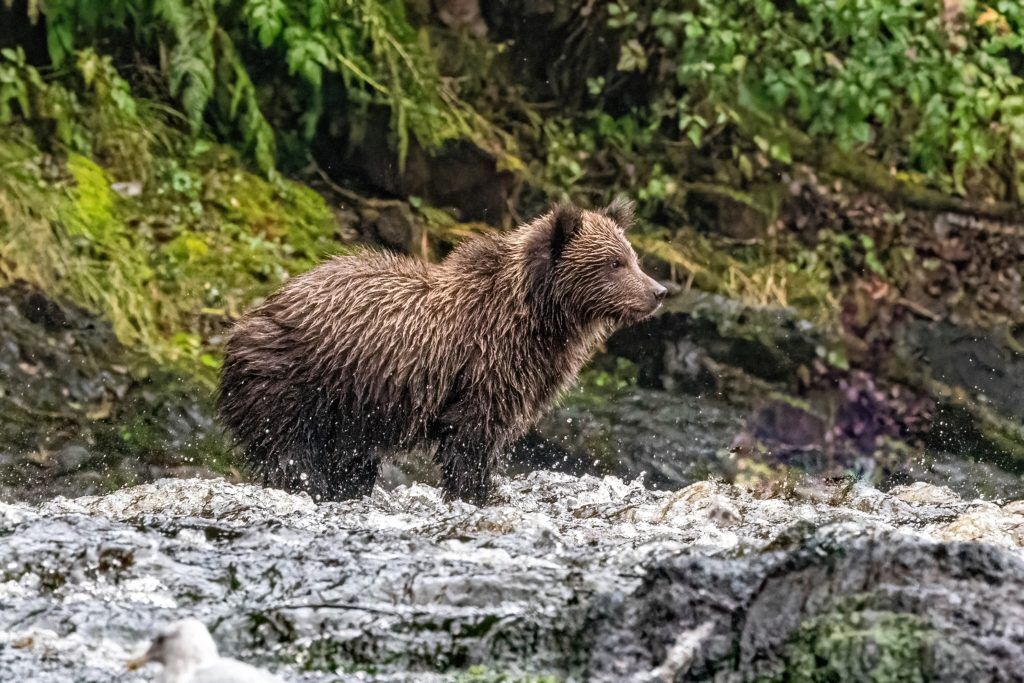
Baby bear Pavlovs Bay Alaska
Photo Credit: Jenn Coleman.

When you travel somewhere wild, certainty disappears almost immediately. Plans turn into loose outlines. Timelines soften. The assumption that you’re fully in control starts to fade — and that’s exactly where the experience opens up.

In Alaska, weather doesn’t politely cooperate. Flights wait. Boats adjust for tides. Trails change overnight. Wildlife appears on its own terms, not when you’re ready with a camera in hand. At first, this unsettles people. We’re trained to optimize travel, to squeeze value from every hour, to move efficiently from one highlight to the next.

Wild places resist that mindset. They force you to slow down and pay attention instead.

Instead of rushing, you find yourself watching clouds crawl across a mountain range or listening for the distant crack of shifting ice. You wait because someone has spotted a bear across the river, and suddenly waiting doesn’t feel like lost time — it feels like the entire point. In wild places, patience isn’t a virtue. It’s a requirement.

Nature Isn’t a Backdrop — It’s the Main Character

Endless Adventures Await-Moose - Alaska Glacier Lodge Palmer Alaska
Photo Credit: Jenn Coleman.

In many destinations, nature plays a supporting role. It’s something you admire between meals and museum visits, a scenic pause before moving on to the next activity.

In wild places, nature is the storyline.

In Alaska, the scale alone recalibrates your perspective. Mountains don’t rise politely in the distance; they loom. Glaciers don’t shimmer passively; they groan, fracture, and move. Rivers aren’t decorative — they’re powerful, cold, and very much alive. Wildlife isn’t something you visit. It’s something you encounter, often unexpectedly, and always on its own terms.

That reality changes how you move through the world. You speak more quietly. You scan the horizon. You learn to read the land not just for beauty, but for meaning — wind direction, cloud movement, water levels. You stop expecting nature to perform for you and start allowing it to lead.

Comfort Looks Different in the Wild

View from my room Homer Inn and Spa
Photo Credit: Jenn Coleman.

Traveling somewhere wild doesn’t mean giving up comfort, but it does redefine what comfort actually means. Luxury here isn’t about excess or polish. It’s about warmth after cold. Shelter after exposure. A solid meal after a long day outside.

Some of our most memorable places to stay in Alaska weren’t remarkable because of opulence, but because of where they were. Remote enough that silence felt complete. Close enough to the land that stepping outside meant being fully immersed — weather, wildlife, and all. Comfort in wild places is practical and intentional, and because of that, it feels deeply satisfying.

You notice and appreciate the basics more. Dry socks. Hot coffee. A sturdy roof during a storm. These aren’t assumed; they’re earned. And because you’re more present, they land differently. They feel grounding in a way that polished luxury sometimes doesn’t.

Your Senses Wake Up

Matanuska Glacier, Alaska
Photo Credit: Deposit Photos.

One of the quieter gifts of wild travel is how it reactivates your senses. In daily life, we filter relentlessly just to get through the day — noise, movement, light, information. Wild places strip that filter away.

You smell rain before it arrives. You hear ice shifting miles off. You notice how light changes minute by minute. In Alaska, even the air feels sharper, cleaner, alive. You become aware of your body in space — where you step, how fast you move, what’s happening around you.

This heightened awareness isn’t stressful. It’s calming. It pulls you into the present without effort or instruction. It’s mindfulness without the app, presence without performance.

You Remember What Adventure Actually Means

Hatcher Pass - Gold Cord Lake Trail Alaska
Photo Credit: Jenn Coleman.

Somewhere along the way, adventure became a marketing word. But real adventure, especially in wild places, isn’t about adrenaline or bragging rights. It’s about curiosity, humility, and uncertainty.

Adventure means not knowing exactly how the day will unfold. It means trusting guides and locals. It means adapting instead of controlling. In Alaska, that might look like hiking through mist, unsure if the clouds will lift. Kayaking through ice-dotted water where seals surface nearby. Boarding a small plane knowing weather could change everything.

And when things don’t go according to plan, that doesn’t diminish the experience — it becomes the story. Wild places remind you that the goal isn’t perfection. It’s participation.

Time Feels Different Out Here

Yllas Ski Resort Finland
Photo Credit: Jenn Coleman.

Wild destinations stretch time in ways that are hard to explain until you experience them. Days feel full without feeling rushed. Hours pass unnoticed when you’re fully engaged. Evenings arrive gently, not abruptly.

Without constant stimulation or packed schedules, your nervous system settles. You sleep more deeply. Wake earlier. Feel less urgency to check your phone. In Alaska, the light itself reshapes time, lingering late into the evening in summer, quietly reminding you that clocks are human inventions, not natural laws.

That shift doesn’t disappear when you leave. You return home more aware of how often urgency is manufactured — and more protective of your time because of it.

You Feel Like You’ve Earned the Experience

Kayaking Glacier Bay Alaska
Photo Credit: Jenn Coleman.

There’s a quiet satisfaction that comes from traveling somewhere that isn’t effortless. Wild places often require extra steps — small planes, ferries, long drives, patience. But effort creates investment.

When you arrive, you don’t feel like you stumbled into the experience. You chose it. And that choice creates respect — for the land, for the people who live there, and for the experience itself. In Alaska, simply reaching some destinations comes with stories before the stay even begins.

Wild travel doesn’t hand itself to you. It asks something in return.

Why We’re Drawn to the Wild Now More Than Ever

Waterfall Cove Alaska
Photo Credit: Jenn Coleman.

The pull toward wild places isn’t accidental. After years of constant connectivity, crowded destinations, and carefully curated experiences, many travelers are craving something real. Something grounding. Something that doesn’t ask them to perform.

Wild places offer perspective. They remind us that the world is bigger than our inboxes, that discomfort isn’t dangerous, and that awe still exists — no explanation required. Alaska sits at the heart of this longing, but it isn’t alone. You feel it in remote coastlines, high deserts, northern forests, and far-flung mountain towns around the world.

What unites them isn’t geography. It’s restraint. These places haven’t been overly softened or simplified. They still ask you to meet them where they are.

What You Take Home From a Wild Place

Hikers hiking, enjoying the view of Famous Patagonia Mount Fitz
Photo Credit: Deposit Photos.

You don’t return with just photos. You come back quieter, more observant, and more comfortable with uncertainty. You gain a clearer sense of what you actually need — and what you don’t.

Traveling somewhere that still feels wild recalibrates your sense of scale and self. It reminds you that not everything needs improvement, explanation, or monetization. Some things are powerful simply because they exist.

And once you’ve felt that — once you’ve stood somewhere that didn’t care whether you were there or not — it changes how you travel going forward. You start seeking places that ask something of you. Places that feel alive. Places that leave room for surprise.

Because wildness, in the end, isn’t something you conquer.

It’s something you experience — and carry with you long after you’ve left.

Hi! We are Jenn and Ed Coleman aka Coleman Concierge. In a nutshell, we are a Huntsville-based Gen X couple sharing our stories of amazing adventures through activity-driven transformational and experiential travel.


Source link