

Pros
- Best performance we’ve seen to date in a Windows gaming handheld
- Windows devices support a wider library of games than competitors such as the Steam Deck and Nintendo Switch
- Bumpers and buttons feel clicky and responsive, joysticks have reasonable tension
Cons
- Slightly too big for my hands (size 7 women’s glove) and grip texture is a bit too rough
- Performance can be inconsistent from run to run because AI is a black box
- Screen doesn’t support HDR
- Expensive, especially since it doesn’t include a case
- Would be nice if it had trigger stops
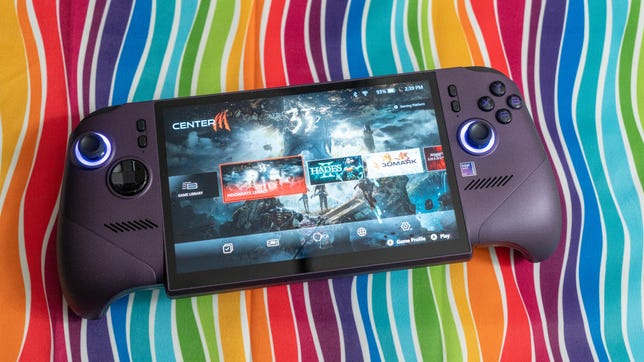
There are three intertwined stories in the MSI Claw 8 EX AI Plus: one about a solid, smartly redesigned Windows gaming handheld; one about the new Intel Arc G3 Extreme processor, which drives it to class-leading performance; and a sadly oft-repeated one about how the Windows implementation still makes me bonkers.
The Claw 8 EX AI Plus joins models such as the Lenovo Legion Go series and Asus’ ROG Xbox Ally X, which let you play games from any game store that runs on a PC — Steam, Epic, GOG and so on. Along with most other computing devices, their prices have gotten pretty painful, thanks to a supply crunch in memory, solid-state storage and processors driven by rich-on-paper AI buyers competing with less profitable consumer uses.
The Claw 8 AI Plus launched in December 2024 starting at $799; the Claw 8 EX AI Plus, which has a new design and new Intel Arc G3 Extreme chip but otherwise similar specs, is $1,800. Ouch. And there’s no end in sight.
MSI Claw 8 EX AI Plus (CG3EM)
| Price as reviewed | $1,800 |
|---|---|
| Display | 8-inch, 1,920×1,200-pixel, IPS, touchscreen, 120Hz, 500 nits, 100% sRGB |
| CPU | Intel Arc G3 Extreme |
| Memory | 32GB LPDDR5x-8533 (soldered) |
| Graphics | Intel Arc B390 |
| Storage | 1TB M.2 2280 SSD, micro SD slot |
| Audio | Mic, 3.5mm combo jack, 2x2W speakers, Dolby DTS, Hi-Res |
| Ports | 2 x USB-C (2 x TB4 w/ DP 1.4, PD 3.0) |
| Networking | Intel Wi-Fi 7 R2 BE213, Bluetooth 6.0 |
| Operating system | Microsoft Windows 11 Home 25H2 |
| Size | 12.6 x 5.1 x 1.9 in (321 x 130 x 48mm) |
| Weight | 1.7 pounds (785 grams) |
| Battery | 80Wh |
| Available | June 2026 |
At the moment, there’s only one model of the Claw 8 EX AI Plus, but Asus plans a version based on the lower-end Arc G3, with an Arc B370 GPU equipped with two fewer graphics cores. It hasn’t yet revealed the price or ship date. It’s likely to be less expensive.
Pretty in purple
MSI reworked the design from the older models. For one, it’s a snazzy dark purple in the front and black in the back. Most notably, MSI extended the grips a bit a la ROG Xbox Ally X for a more comfortable feel.
The grips now extend below the body and have a raised texture.
The texture feels a bit too pronounced to me, but I tend to prefer a rubberized grip. When in use, either the grips get a little warm from inside or they warm from my hands pretty fast; in either case, my palms start sweating shortly after I start holding it.
They’re just a hair too big for me; I have to scooch them up to reach the bumpers or hold them in a slightly unnatural spot. (I wear women’s size 7 gloves for reference.) Your mileage, of course, will vary, but they’re quite big.
On the top edge are two Thunderbolt 4 connectors, a microSD card slot, a 3.5mm combo audio jack, volume switches and the power button. I like that there are no connections on the bottom; I get tired of cables poking me in the stomach.
There are the usual controls, plus two bindable back buttons. You can also remap everything for desktop mode, which is nice.
The RGB lighting also illuminates the ABXY buttons.
The sticks and triggers use magnetic Hall Effect technology, which is considered more durable and consistent than mechanical versions and feels a lot smoother. With the MSI Center M control center, you can remap buttons, calibrate and set stick dead zones, trigger actuation, vibration intensity and calibrate the gyro — all capabilities we typically see. The buttons and bumpers are clicky and responsive.
The triggers have a really deep pull, though, and I wish there were physical trigger stops like those found on higher-end controllers. Even if you set them to register at a fairly shallow depth, trigger stops make them feel shallower and faster.
It is compatible with the old dock if you need to prop it up while connecting to other devices.
Fast, but not always fast enough
While it’s the best performing Windows gaming handheld I’ve tested thus far, that’s kind of a low bar to jump. It also depends on what you consider a sufficient frame rate and where you’re willing to make tradeoffs. Games that don’t stress the GPU — ones that don’t rely heavily on 3D rendering, such as 2D games like Hades 2 — fare pretty well (more than 100 fps) on all the current-generation devices.
For older 3D games, which were written to run on far less capable hardware, such as Shadow of the Tomb Raider, the Arc can cross from “playable at lower quality” to “playable at reasonable quality or faster at lower quality” with the Arc. For example, Shadow of the Tomb Raider hit 66 fps at highest quality with the Intel chip but only 43 fps on the next-fastest device, the ROG Xbox Ally X.
And if you like ray-traced graphics, avoid the AMD Ryzen Z2 processors altogether. In general, ray tracing is pretty heavy for these devices, but AMD’s GPUs are already weak at it (on 3DMark Solar Bay they lagged the MSI by over 60%).
In addition to the set of connections — two Thunderbolt 4 and one combo audio — hot air vents out of the top of the Claw.
They’re weakest for newer, GPU-heavy AAA games such as Assassin’s Creed Shadows. The Arc is generally the fastest (though the Ally X beat it at low quality), but “fastest” is relative. If you’re okay with 38 fps at low quality, then you won’t have an issue.
Intel and MSI throw a lot of technology to boost frame rates and battery life. The Claw has several different power settings, which are exposed by MSI’s control center software: AI automatically balances power based on what’s needed to run a given program. Endurance caps frame rates at 30 fps and disables the P-cores to extend battery life. Manual lets you adjust PL1 and PL2 (base and maximum power levels) as well as fan speeds to tailor performance to your needs. You can even configure Manual right in the quick action menu, which is nice.
The maximum total power available for the Claw with the G3 Extreme is 45W (35W for the chip), and I got it pretty close to that, though I didn’t spend a lot of time trying to optimize. But based on most of my test results, it was pulling close to that in AI mode, so you could probably get away with ignoring it. It did seem to boost CPU performance more than GPU.
On the flip side, performance on battery in AI mode seems to be the same as plugged in, and looks like it draws the same amount of power when gaming, which is good.
Intel’s very clear about the point of Endurance mode and that it requires tradeoffs, but I found it hit and miss. For one, I don’t think it consistently kicks in. For instance, it drew the same amount of power in Hogwarts Legacy as the other modes but still capped the frame rate at 30 fps, even as I watched the battery drain by about 1% every 10 minutes of play. (My battery testing ran into some glitches, so it’s still in progress, but I never once thought, “Gee, this is lasting a long time!” These generally last about three hours, unless you apply aggressive power saving.)
The grips have a nice contour.
I experimented a bit with Intel’s upscaling an optimization technology, XeSS, which recently added multiframe generation to its bag of tricks and is supported by the Arc G3 chips and their latest Xe3 GPU cores. In contrast, AMD’s Z2’s use older Radeon RDNA 3-generation GPUs. But in Hogwarts — which supports XeSS 3 MFG — I only gained a few extra frames per second in exchange for obviously poorer quality (skin textures looked too smooth and it reduced mouth movement so that they seemed out of sync and far less expressive).
There are too many variables to play with, though, both within the games and in Intel’s graphics utility. It wouldn’t be as much of a pain if accessing the Intel settings didn’t require jumping out to the Windows desktop, and if nearly every change didn’t prompt a device restart before switching back to Xbox full-screen mode.
The Arc B390 integrated graphics in the G3 Extreme is the same as that in the Intel Core Ultra X7 358H laptop chip and delivers roughly the same performance. The CPU is also similar, so single-core performance is comparable as well, but the core makeup of the X7 is different — notably, it’s got two more performance cores. So it’s unsurprising that the X7 has faster multicore processing than the G3 Extreme.
Display tests
| Gamut coverage | 100% sRGB |
|---|---|
| White point | 7300K |
| Gamma | 2.2 |
| Peak full screen brightness (nits) | 517 |
| Accuracy (DE2K average/max) | 2.2/5.11 |
| Contrast | 1500:1 |
The screen is a bit disappointing, especially given the price. It’s a decent 120Hz IPS display, but only has a smallish sRGB gamut, and while the contrast is numerically good, it just can’t compare with some of the better screen technologies such as OLED or even IPS Black. The whites are pretty cool (relative to 6500K), which can happen when the display is driven to higher brightness levels than it can comfortably support while still targeting 6500K.
A mixed bag
I still yearn for the day when I can stop complaining about Windows on these devices. Looking back at my issues with the Xbox Ally X, I couldn’t find one that I didn’t run into again with the Claw. Oh — the setup no longer tries to get you to enable Recall. That’s one for the win column.
I’ll summarize the key points here. If you want the full rant, go visit the Xbox Ally X review.
- Confusing and annoying inconsistencies in the various interfaces that don’t have the Xbox Full Screen Experience grafted onto them, which is most.
- Glitchy behavior, such as the Xbox app losing focus and disabling controller input until I switched away and back, as well as random app switching while a game was loading.
- Games frequently get confused as to whether there is a controller or keyboard attached.
- Memory management issues cause apps to glitch. (The MSI utility even puts “free memory” right in its quick access menu, and I used it quite a bit.)
- The popup keyboard in desktop mode frequently and unavoidably blocks the text field you’re using it for.
I’ll add a new one: It’s absurdly bad at switching between desktop and full-screen modes. The Xbox app often windows itself in the process, forcing you to manually tell it to go back to full screen.
Windows’ primary advantage for handheld gaming is its ability to play games from any PC game store. But these handhelds continue to feel like gaming is only a part of what they’re intended for, rather than their main purpose. It’s not MSI or Intel’s fault, so it’s hard to pin the software shortcomings on the particular device.
I like being able to play PC games in bed rather than my desk without having to stream them, and I think the power mode issues I ran into are just a case of “the early bird gets the bugs.” Some may be user stupidity, but I lay those at the feet of the confusion of interfaces. (A group of interfaces is called a “confusion” in my brainspace.)
But if I were spending upwards of $1500, I’d want OLED. Dark blacks, HDR and colors that pop mean more to me — at least for the games I play much of the time — than performance that just tips over into okay. I like the color and overall design of the MSI Claw 8 AI Plus and it performs better than the rest of the field, but it still falls a little short.
Performance charts
Assassin’s Creed Shadows (1080p, High)
Lenovo Legion Go 2 13Lenovo Legion Go 2 (battery) 18ROG Xbox Ally X (on battery) 19Lenovo Legion Go 2 (low preset) 23ROG Xbox Ally X 24Dell XPS 14 (2026) 24Acer Swift 16 AI (2026) 25MSI Prestige 14 Flip AI Plus 27MSI Claw 8 EX AI Plus 28MSI Claw 8 EX AI Plus (on battery) 28MSI Claw 8 EX AI Plus (max power) 30MSI Claw 8 EX AI Plus (low preset) 38ROG Xbox Ally X (low preset) 43
Shadow of the Tomb Raider gaming test (1080p, Highest)
ASUS ROG Ally 24Asus ROG Ally X (battery) 29Lenovo Legion Go 2 35ROG Xbox Ally X (<span class=”scribe-editor-marker” style=”display: none;”></span>battery) 37Lenovo Legion Go 2 (battery) 38ROG Xbox Ally X 43MSI Claw 8 EX AI Plus 65MSI Claw 8 EX AI Plus (battery) 66MSI Claw 8 EX AI Plus (max power) 66
3DMark Solar Bay
Lenovo Legion Go 2 15,188Xbox ROG Ally X 16,535MSI Claw 8 EX AI Plus 26,714
3DMark Steel Nomad
Lenovo Legion Go 2 400Lenovo Legion Go 2 (on battery) 577ROG Xbox Ally X 587ROG Xbox Ally X (on battery) 593MSI Claw 8 EX AI Plus (endurance) 1,176Dell XPS 14 (2026) 1,286Acer Swift 16 AI (2026) 1,440MSI Claw 8 EX AI Plus (max power) 1,510MSI Claw 8 EX AI Plus 1,520MSI Claw 8 EX AI Plus (on battery) 1,527MSI Prestige 14 Flip AI Plus 1,527
Geekbench 6 CPU (single-core)
MSI Claw 8 EX AI Plus (Endurance) 1,181MSI Claw 8 EX AI Plus 2,698Lenovo Legion Go 2 2,753Dell XPS 14 (2026) 2,813MSI Claw 8 EX AI Plus (max power) 2,829Acer Swift 16 AI (2026) 2,850MSI Prestige 14 Flip AI Plus 2,896
Configurations
| Acer Swift 16 AI (2026) | Windows 11 Home; Intel Core Ultra X7 358H; 32GB DDR5 RAM; Intel Arc B390 Graphics; 1TB SSD |
|---|---|
| Asus ROG Ally | Microsoft Windows 11 Home (23H2); 3.3GHz AMD Ryzen Z1 Extreme; 16GB LPDDR5X-6400; integrated Radeon 780M; 512GB SSD |
| Asus ROG Ally X | Microsoft Windows 11 Home (23H2); 3.3GHz AMD Ryzen Z1 Extreme; 24GB LPDDR5X-7600 (8GB dedicated to GPU); integrated Radeon 780M; 1TB SSD |
| Dell XPS 14 (2026) | Windows 11 Home; Intel Core Ultra X7 358H; 32GB DDR5 RAM; Intel Arc B390 Graphics; 1TB SSD |
| Lenovo Legion Go 2 | Microsoft Windows 11 Home (24H2); 2GHz AMD Ryzen Z2 Extreme; 32GB LPDDR5X-8533; integrated Radeon 890M; 1TB SSD |
| MSI Claw 8 EX AI Plus | Microsoft Windows 11 Home (25H2); 1.9GHz Intel Arc G3 Extreme; 32GB LPDDR5X-8533; integrated Arc B390; 1TB SSD |
| MSI Prestige 14 Flip AI Plus | Windows 11 Home; Intel Core Ultra X7 358H; 32GB DDR5 RAM; Intel Arc B390 Graphics; 1TB SSD |
| ROG Xbox Ally X | Microsoft Windows 11 Home (24H2); 2GHz AMD Ryzen Z2 Extreme; 24GB LPDDR5X-8000 (8GB dedicated to GPU); integrated Radeon 890M; 1TB SSD |

Stephan is the sports journalist for the Maple Grove Report.