
Verdict
Shokz’ updated clip-on earbuds now offer punchier open-ear sound for the same premium price
-
Comfortable to wear for long periods
-
Improved open-ear sound performance from OpenDots One
-
Both buds and case offer water resistance rating
-
Controls aren’t spotless in all listening scenarios
-
Price still high for open-ear earbuds
-
Call quality doesn’t seem vastly improved
Key Features
-
Dolby Audio
More immersive sound with Dolby audio
-
Shokz Bassphere™ 2.0
Bigger bass, less distortion
-
Battery
40 hours with charging case
Introduction
The OpenDots 2 sees Shokz update its clip-on, open-ear earbuds for those that like a more discreet and elegant route to safer listening.
After launching the first generation OpenDots One in 2025, the OpenDots 2 arrives alongside the cheaper OpenDots Air. While both the OpenDots 2 and Air promise a similar clip-on look, it’s the former that gives you the best Shokz has to offer the form factor.
That includes the promise of improved overall sound quality, two open-ear sound technologies and a now tougher design to protect those dainty buds.
The first version of the OpenDots was a strong clip-on debut. I’ve been wearing the latest for three weeks to find out if you should be clipping them to your ears.
Price
The Shokz OpenDots 2 arrives as one of Shokz’ most expensive earbuds.
At £179, they do at least stick to the same price as the first OpenDots. The OpenDots Air has a launch price of £129, so that’s a substantial jump between the two buds. That does make them the same price as the Shokz OpenFit 2+ (£179) with the OpenFit Pro remaining the most expensive option in the Shokz family at £219.
Outside of the Shokz family, the OpenDots 2 does at least come in cheaper than the Bose Ultra Open Earbuds (£250), the buds mainly responsible for this surge in clip-on buds. There are more affordable options out there including the Soundcore AeroClip (£129), Skullcandy Push 720 Open (£99.99), Baseus Bowie MC2 (£79.99), EarFun Clip (£79.99) and Amazfit Up (£49.90).
Design
- Same clip-on design as OpenDots One
- Improved durability for buds and case
- New pearl white version
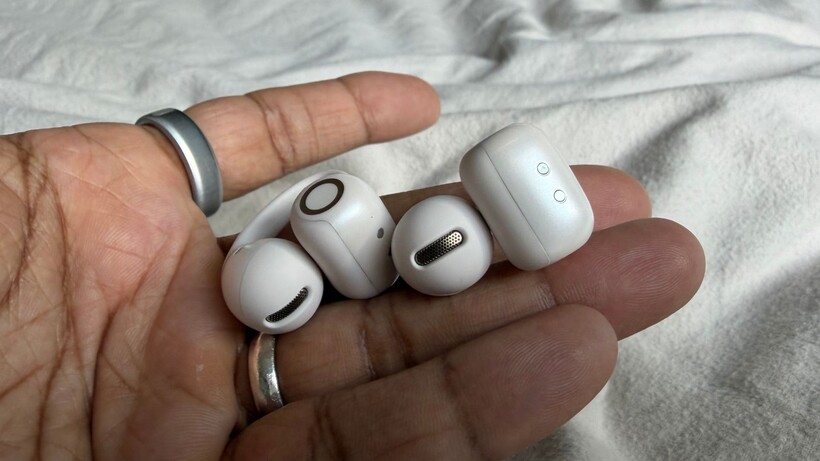
Shokz didn’t need to make sweeping changes with the OpenDots design. Instead it’s tweaked elements, added new colours and upgraded things on the durability front.
The way they clip to your ears is the same. The two main bud parts are held together by a flexible stem. Shokz has slightly dropped the weight of each bud from 6.5g to 6.4g. There’s been countless times where I’ve forgotten I was still wearing the buds after using them, just to emphasize how light they are.

Colours-wise, you have the same black and grey options as the OpenDots One, plus a new pearl white model, which I had to try out. This new shade is designed to provide a more elegant look and can even be paired up with an additional clip-on earring to further disguise the buds.
The secureness of the fit has been good as well. I’ve used them for working, travelling and wandering down to the shops and they’ve stayed put. Shokz shied away from saying the original OpenDots were a good fit for all exercise. I found these did a solid job in terms of fit across a range of workouts. I don’t think that’s out of the question to wear them in the gym or for runs.

I’m still not massively convinced by the controls, which are built both into the stem and the back of the buds. These let you squeeze, tap and hold to perform functions like skipping a track, adjusting volume or handling a call. I think they’re challenging to use on the move and aren’t the best example of controls I’ve seen built into clip-on earbuds. It is good to see that Shokz offers the ability to adjust the pinch control sensitivity in the companion app to improve matters.
An invisible upgrade is its durability. Previously, Shokz offered the OpenDots One with an IP54 sweat and water resistant rating. Now you get buds with an IP57 rating against dust and water. The compact charging case they sit inside of also carries an IP54 rating providing some resistance to dust and water.
Features
- Additional sounds modes in Shokz app
- Up to 10 hours battery life
Delve into the companion app and you’ll find a custom EQ, smart EQ and EQ presets to tailor the buds to your preferred audio. The Dolby Audio mode included with the first buds has now been upgraded to up the immersion.
Shokz says it’s using a newer version of its Basssphere technology to kick things up a notch on the bass front as well. To improve call quality, Shokz has added a bone conduction microphone to work alongside the dual air conduction ones included.

Battery performance actually hasn’t improved from the OpenDots One, but they are still capable of hitting that stated 10-hour battery life. An hour’s listening using a mixture of EQ modes and the Dolby Audio mode typically saw battery drop by 10%. That pretty much works out to the 10 hours promised. It does seem that using the EQ and Dolby Audio modes as well as louder listening volumes does dent the battery life quicker.
The quick charge mode has been improved. So now a 5-minute charge instead of a 10-minute one gives you up to 2 hours of playtime. A fully charged charging case tops the battery up to 40 hours and now Shokz offers Qi-certified wireless charging for that more convenient way to power them back up.

Sound Quality
- Now uses both bone and air conduction technology
While the OpenDots 2 remain still very much about open-ear sound, the way they deliver that has been tweaked. Air conduction does most of the heavy lifting as far as sound is concerned.
If you want that bassier sound, it’s not out of the OpenDots 2’s remit to deliver something pretty enjoyable. Bob Marley’s Africa Unite and Burial’s Archangel showcased the kind of punch of bass you don’t typically associate with open-ear earbuds.

I felt the original OpenDots could’ve benefited from a bit more roar. That’s certainly been delivered on the OpenDots 2. It makes a big difference with the open-ear experience in louder, outdoor environments.
Power boost aside, the new Dolby Audio mode gives the OpenDots 2 some added depth and is one of the biggest differences in sound profile compared to the OpenDots Air. You can’t however use that mode while bringing EQ modes into play.
Using the standard EQ mode on tracks like New Order’s Regret and Van Morrison’s Into the Mystic produce a pretty pleasant warm sound profile. There’s grainy trebles, smooth mids and a bass profile that doesn’t dominate proceedings.
What I’m less convinced by is the promise of significantly improved call quality. The added bone conduction headphones are there to bring those upgrades. While I found calls came out nice and loud, the clarity isn’t the best I’ve experienced on Shokz open-ear headphones.

Should you buy it?
You want great open-ear sound from a lightweight and comfortable clip-on design
The Shokz OpenDots 2 are comfortably the best-sounding clip-on earbuds you can buy
You want clip-on earbuds with great onboard controls
While Shokz promises improved controls from the first OpenDots, they’re still not the easiest to use in all scenarios.
Final Thoughts
The Shokz OpenDots was a great clip-on earbud debut for Shokz. For the latest generation, Shokz has addressed most of the problematic areas. Most notably, that uptick in sound quality, which helps to make these another set of standout clip-on buds from Shokz and a step up on most others in this category.
You do of course now have the cheaper OpenDots Air, which I’ve also tested and sound great. I think these sound better and if you care particularly about having the best-sounding clip-on buds and that more rugged design, those are key reasons to spend more on the OpenDots 2.
How We Test
We test every pair of headphones we review thoroughly over an extended period of time. We use industry-standard tests to compare features properly. We’ll always tell you what we find.
We never, ever, accept money to review a product.
Find out more about how we test in our ethics policy.
- Tested for three weeks
- Tested with real world use
FAQs
The OpenDots 2 most notably includes additional bone conduction technology, slightly longer battery life along with a more rugged overall design. That does also include the charging case.
Full Specs
| Shokz OpenDots 2 Review | |
|---|---|
| UK RRP | £179.99 |
| USA RRP | $199.99 |
| Manufacturer | Shokz |
| IP rating | IP57 |
| Battery Hours | 40 |
| Wireless charging | Yes |
| Fast Charging | Yes |
| Weight | 51.6 G |
| Release Date | 2026 |
| Audio Resolution | SBC, AAC |
| Driver (s) | Air conduction transducer |
| Connectivity | Bluetooth 6.1 |
| Colours | Pearl White, Grey and Black |
| Frequency Range | 100 20000 – Hz |
| Headphone Type | On-ear (Open) |

Stephan is the sports journalist for the Maple Grove Report.