
Follow ZDNET: Add us as a preferred source on Google.
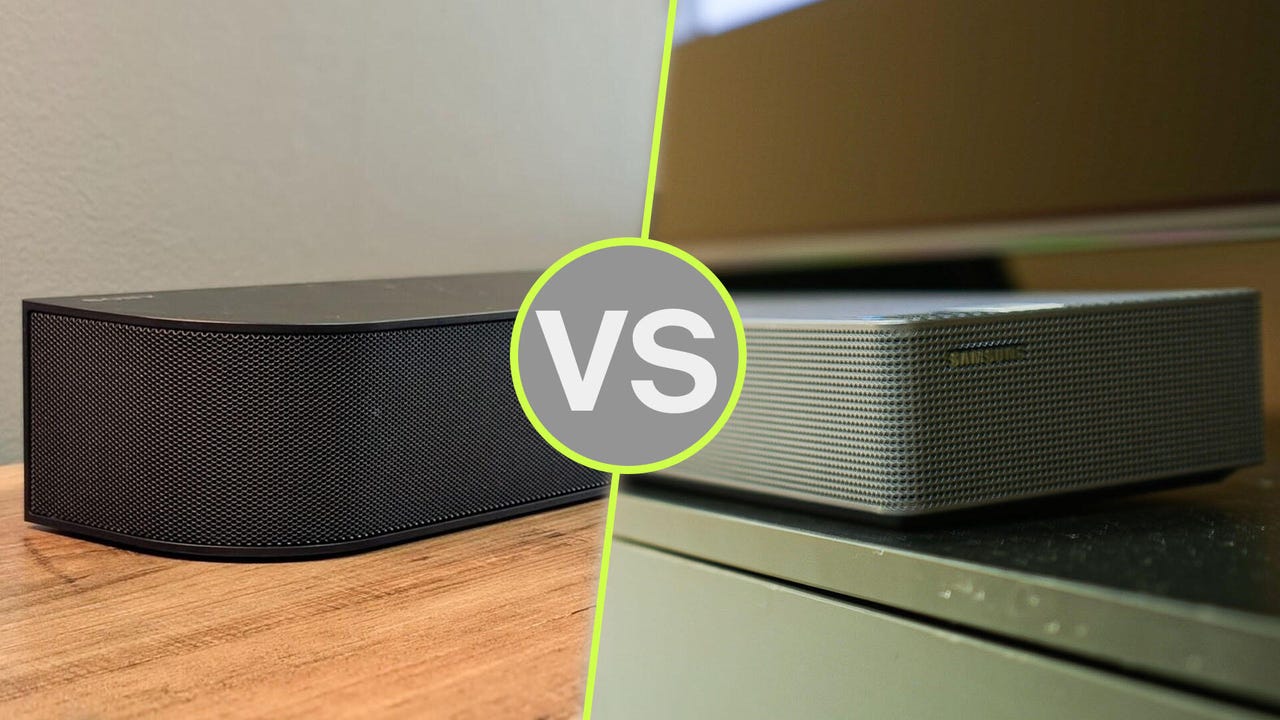
When building a home theater, you’ll likely consider Samsung or Sony. Both companies offer immersive home theater solutions to upgrade your watching experience. Before choosing a company’s home theater products, consider which company’s TVs you prefer. A TV from either of these companies serves as an anchor device, and your home theater will revolve around it.
Each company’s home theater products integrate with their TVs, and some features will be locked behind ecosystem walls if you mix and match manufacturers.
Also: Forget the soundbar: How I upgraded my TV audio with spare Bluetooth speakers
Generally, Sony offers modular options to build over time, with a focus on a cinematic experience and tight integration with PlayStation. On the other hand, Samsung is ideal for people who have a one-and-done approach to home theater, preferring to buy one complete system and stick with it for years. Samsung is also best for people with several Samsung smart appliances in their house, as your TV can act as a hub to monitor and control SmartThings-connected devices.
Which home theater solution best fits your needs? Let’s compare.
You should build a Sony home theater if…
1. You game on PlayStation 5
Sony is the home of PlayStation, and its home theater products are optimized for its latest-gen gaming console. Compatible Sony TVs and soundbars work together to automatically reduce picture and audio latency and improve picture quality when gaming on the PlayStation 5.
Compatible Sony TVs also support variable refresh rate, adjusting the refresh rate while gaming on the PlayStation 5 to reduce latency. Sony’s upper-midrange and premium soundbars promise Sony 360 Spatial Sound Mapping to create phantom speakers throughout your room, creating the illusion of a surround sound system.
Both Sony’s and Samsung’s premium soundbars promise 4K/120Hz pass-through via HDMI 2.1, but Sony’s top TV and home theater products are specifically optimized for PlayStation.
2. You want to build over time
Sony’s Bravia home theater lineup includes several modular options, allowing you to build a system over time based on your space and budget. Sony offers six soundbars compatible with its modular product line, priced from $600 to $1,500. Four pairs of rear speakers are compatible with those six soundbars, along with five subwoofers that are compatible with the same six soundbars, in addition to the Bravia Theater Quad.
Also: I traded my Sonos Era 300 for Denon’s new home speaker – and see no reason to go back
On the other hand, Samsung’s home theater systems are typically sold in a single box, meaning its flagship soundbar, rear speakers, and subwoofer come together in one purchase. Though Samsung’s method may be more cost-effective than Sony’s, you don’t have nearly as much control over tailoring home theater systems specifically to your liking.
3. You want to bring the cinema home
Sony’s home theater products focus on delivering a cinematic feel in your living room. Purchasing individual products reinforces this idea, allowing for sonic accuracy and precision. Additionally, Sony’s home theater products are typically compatible with Dolby Atmos and DST:X, which is the spatial audio format used in IMAX Enhanced content for at-home viewing.
While Dolby Atmos is more accessible within hardware and is more frequently used on streaming services, DTS:X is encoded at a higher bitrate and is commonly found on Blu-ray discs. Some of Samsung’s older and upper-midrange soundbars have DTS:X, but its newer, premium soundbars have dropped the spatial audio format in favor of Samsung and Google’s proprietary Eclipsa Audio.
You should build a Samsung home theater if…
1. You want a connected smart home
A compatible Samsung TV can behave as a SmartThings hub, allowing you to view and manage the devices on your SmartThings network. If you have Samsung smart appliances or Matter home automation products, your Samsung TV can keep you up to speed on your home’s smart statuses.
Also: 60Hz vs. 120Hz vs. 165Hz: I’ve tested dozens of TVs, and here’s what’s best for your home
Samsung’s home automation platform, SmartThings, serves as the hub for all your connected devices. Here, you can access compatible doorbell cameras, view the status of your compatible Samsung washing machine, track your pet’s Galaxy Tag, or look into your compatible refrigerator.
If you want your living room to be connected to the rest of your home’s compatible devices, rather than be an isolated area strictly for watching, then consider Samsung.
2. You’re a one-and-done person
Samsung’s premium and upper-midrange soundbars are sold in bundles: premium models include the soundbar, two rear speakers, and a subwoofer, while upper-midrange models include the soundbar and a subwoofer.
If you’re not interested in curating a system over time, you’ll appreciate that Samsung offers great home theater-in-a-box options. You can purchase a system once, have everything you need, and stick with it for several years.
Also: Why the ‘Subwoofer Crawl’ is the only way I found the bass sweet spot in my living room
If you have a Samsung TV, Samsung’s soundbars will work better with it, especially with Q-Symphony. Q-Symphony is a feature that enables your compatible Samsung TV to simultaneously deliver audio through its TV speakers and your soundbar. Otherwise, as long as your TV has HDMI eARC, you can access all the other features Samsung’s soundbars offer.
Writer’s choice
Though both Sony and Samsung deliver great home theater products, each company serves different consumer profiles. I don’t have an expansive smart home network, so I prefer Sony’s products over Samsung’s. Sony often leverages its involvement in the audio recording, motion picture, and gaming industries to incorporate more advanced technologies into its home theater products. As a result, Sony’s products tend to sound more balanced than Samsung’s.