Star Fox on Switch 2, Reviewed: Nintendo’s Remake Nostalgia Works. Is It a Trend?


Games come out, and time goes by. Movies age. Books age. We all age. 

But Star Fox is back on the Nintendo Switch 2, and it’s a loving remake. Definitely not a new Star Fox, though. The $50 game is a gorgeous graphic overhaul, with new cutscenes, new challenge modes, new multiplayer modes…and the same beat-for-beat level design as 1997’s Star Fox 64, included for “free” with the subscription-based Nintendo 64 Classics app on the Switch already.

After playing it for an hour or two a few weeks ago, I’ve been playing even more at home, and on the go, on the Switch 2. I love it, and it’s the perfect way to play Star Fox, but also, you’ve likely played this game before. Just not as nicely as this version.

Star Fox 64 on Nintendo 64 only came out four years after the original flat-polygon Super NES Star Fox, which feels amazing now. The graphics leap between those two games feels like 10 years or more have passed. 

It’s been another 19 years since Star Fox 64, and no surprise, the graphics in this new version make Star Fox 64 look primitive. But there’s still a lot of charm in that old game. I do prefer the new Star Fox, simply because, to me, this game was always about kinetic movie-like space battling. On the Switch 2, this game shines and looks better than any Switch 2 game that I’ve played before. It’s also wonderfully responsive.

A new cockpit first-person mode can be swapped into at any time by laying one of the Joy-Con controllers down flat into mouse mode. Control schemes shift a bit, and now aiming is mouse-based. It’s almost like playing a whole new game, but I still prefer the original third-person, behind-the-ship controls. Co-op games can let one person steer and the other shoot, a clever idea.

I got an extra kick of playing Star Fox on the Viture Beast display glasses connected to a Switch 2 battery dock, and it put me into an almost VR-like state of mind as I hovered my massive virtual displays in front of me and piloted my Arwing fighter. Next to Donkey Kong Bananza and Kirby Air Riders, Star Fox is the most visceral and kinetic game in Nintendo’s Switch 2 library.

A battle screen from the new StarFox game on Nintendo Switch 2

This game gives me all sorts of good Star Wars feelings.

Nintendo

Challenge modes give a little extra replay to this Star Fox, with achievements for hitting specific tasks on the challenge mode checklist. There are ramped-up difficulty settings for this mode, too. Star Fox is also a branching-path game, so there are ways to explore new planets to a degree. Still, all the levels are on-rails, just like before. There’s a limit to your freedom. Star Fox is, at heart, an arcade-type experience. Each level doesn’t take that long to play through.

What I haven’t played at home yet is the multiplayer mode, something I tried at a Nintendo demo event. It was a blast, and having a connected USB camera enables AR-like overlays of character face filters that move in video chat as you play, which feels exactly like how pop-up comms with your Star Fox copilots already feel in the solo campaign mode. The free-movement chaos of multiplayer is going to be the meat that keeps me interested in this one long after I wear out the campaign and challenge modes.

Four player avatars from StarFox chatting below a battle screen from the game StarFox on Nintendo Switch 2

I want to play more multiplayer: and yes those avatars mapping to your camera facial movements is unsettling.

Nintendo

I’d have loved more levels here, new worlds, more Star Fox. Would that have been too much to ask? I guess so. It’s a shame that Star Fox isn’t a real sequel, but I’d love to think that, perhaps, that could still come depending on how well this one does.

It also makes me wonder if remakes are Nintendo’s new strategy. A remake of the N64 Legend of Zelda: Ocarina of Time is next on deck this fall. Again, it’s a game that you can already play on the N64 app, a game that doesn’t “need” a new version. Metroid Prime Remastered returned a few years ago. Legend of Zelda: Link’s Awakening appeared before that.

Or, as games age over time and we lose ways to play them, maybe remasters and remakes are the future for everything. Remakes lose the history of what the original game actually felt like, and it’s a slippery slope for how games should be preserved and remembered. In the case of Star Fox, though, it’s a fantastic match and a perfect upgrade, even if $50 is a steep cost for nostalgia.

If you want a cheaper ride, there’s a free demo you can check out on the eShop, too.


Source link

Leave a Reply

Subscribe to Our Newsletter

Get our latest articles delivered straight to your inbox. No spam, we promise.

Recent Reviews


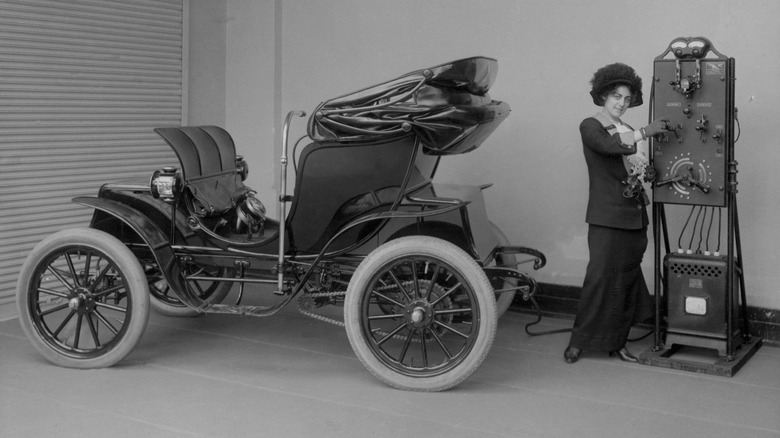
It’s easy to assume that vehicles all had internal combustion engines until very recently. Gasoline and petrol engines were the standard for decades, after all, so why would early vehicles be any different? In reality, the early days of the automobile era were more varied than you might expect, and even featured a range of electric cars. Yes, despite electric vehicles not truly taking off until the 21st century, the first electric vehicles are much older than you think; drivers in the 1900s were going around town in electric vehicles — and where there are EVs, there are charging stations.

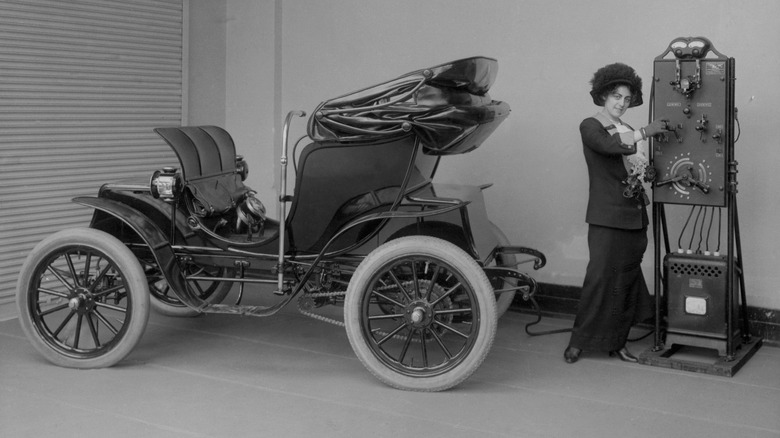
One such station, visible in the image above, was the creation of General Electric. Formally called the mercury arc rectifier, it took alternating current and sent it through vaporized mercury in a glass tube. This converted it into direct current, which powered up the EV’s battery. The woman in the image, who’s charging a Columbia Mark 68 Victrola, is standing at the control panel, which allowed a user to adjust power levels. 

These chargers could be installed everywhere, including homes, businesses, and public parking garages, supporting the electric vehicle boom of the early 20th century. While 21st-century EV chargers have come a long way from where they were, the basic building blocks are all still there, and it’s fascinating to see.

How EV chargers have evolved since the early 20th century

EV charging has changed a lot in some ways — but not in others. At the core of it all is the aforementioned conversion from AC to DC, which still happens when you charge modern EVs at standard charging stations. The difference is that your vehicle’s on-board charger performs the conversion, not the charger. Old EV chargers took between several hours and a day to charge, and current-day units can similarly take a few hours to well over a day from empty, depending on the charger’s speed. Fast chargers, which provide DC directly, can cut this down to around an hour or less.

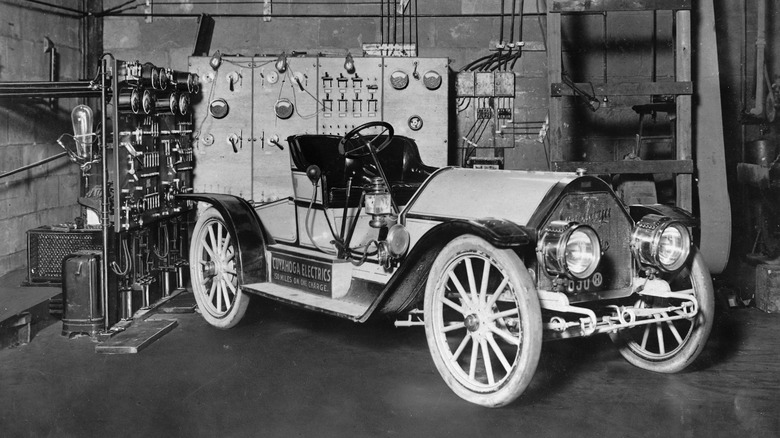
Old-school and modern EV chargers also differ in how they provide power to the vehicle. Mercury arc rectifiers connected directly to the negative terminal of the lead-acid battery that needed charging. Nowadays, EVs use dedicated charging ports. Battery swapping was also commonplace in the early 1900s, and companies like General Electric tried to cash in by offering to replace drivers’ old, run-down batteries with new ones for a fee. That’s not yet possible with most mainstream EVs, although companies like Stellantis have tried to introduce EV battery swapping with moderate success.

Even if they were unrefined compared to today’s models, early EVs seemed to be on to something. Why, then, did electric cars fail, and how did gasoline end up becoming the predominant power source for vehicles?

What led to the downfall of the original wave of electric cars

EVs were no mere fad in the 1900s and 1910s. According to the 1900 United States census, 1,575 of the 4,192 vehicles sold that year were electric, with the value of these early EVs — $2,873,464 — accounting for more than half of the total market value of $4,899,443. It wasn’t just EVs, either; other sources of propulsion, like steam, were also vying for a foothold in the automobile market. By the 1920s and 1930s, though, these had all been superseded by the internal combustion engine.

One of the major drawbacks of early EVs was the fact that electricity was not yet widely available. Electrical hookups were a rarity outside of major cities, limiting the use of these vehicles. The lead-acid batteries they used also had their fair share of issues. They needed to be inspected, cleaned, and repaired every few days, making them more of an inconvenience than anything. Worse yet, they had poor mileage, and, with chargers possibly out of reach, many likely didn’t want to risk being stranded while out for a drive.

Eventually, price reductions for gas cars and improvements such as electric starters and better reliability prompted buyers and automakers alike to move away from electric rides. Thus, while the best-selling EVs of 2026 show that it’s a good time for EVs, this electric boom plainly isn’t the first of its kind. Early EVs eventually fizzled out, but they still set the stage for our current fascination with electric vehicles.


Source link