MANKATO, Minn. — An hour before her paper’s print deadline Monday, Anahi Zuniga isn’t panicking.
The editor in chief at The Reporter, a student newspaper at Minnesota State University in Mankato, said she’ll feel her blood start pumping as the seconds tick closer to 9 p.m. But it’s been smooth sailing so far.
“Everyone should be done hopefully in the next half hour,” she said. “It’s sometimes a close call.”
Articles and photos have been filed, copy is being edited and the final pages are being placed on pages.
Once the final pieces land in Zuniga’s file folder, she’ll send all of it over to the press. Wheels kick into motion from there, bringing the paper from a printing press downtown to newsstands around campus Tuesday.
Students will pick up copies and see a story on a possible 7% tuition increase at the top of the front page. Zuniga always grabs a copy to see how pages on her computer translate to the physical form.
“It’s a satisfying feeling,” she said of holding a copy. “It keeps history alive.”
The Reporter has a century of history, recently marking its 100th year of publication. It is an example of how student newspapers are holding on as hallmarks of campus life at Minnesota colleges and universities.
They give students hands-on journalistic training, places to learn all that goes into writing, editing and publishing news. In Zuniga’s case, the student newspaper also helped her find her voice.
“I wasn’t very confident with who I was when I first enrolled here,” she said. “I feel so sure of myself now and who I want to be after graduation. I can use my words as a way to express what I feel and think is necessary.”
Student newspapers hold on
Despite declining readership in the newspaper industry, many student-run publications remain up and running in Minnesota. Some campuses, though, have no papers, or have publications that have faded with time or moved from print to online or magazine formats.
Bemidji State University’s Northern Student transitioned from a newspaper to a magazine printed four years each year. Minneapolis College currently has no paper, although the student government is in talks to start one.
The Reporter is unique in having a twice-weekly print product to go with a digital presence. This frequency is maintained even though the university no longer has a mass communication department, traditionally where students interested in journalism can be found.
On another campus within the Minnesota State system, a group of public colleges and universities, The Winonan publishes every other week. Doug Westerman, who serves as an advisor to reporters at Winona State University, said the paper is doing what so many college papers do: keep chugging along.
Every college paper has natural attrition, he said. Through graduations and new students stepping in, the paper has been fortunate to have good student leaders over the years.
Westerman gives good recommendations when employers call, and sometimes has a joke ready when they ask if he’d hire them back.
“Well they graduated. I don’t think they’d want to come back,” he said with a laugh.
In all seriousness, Westerman said learning the principles of journalism is as important as ever in the digital age. He’s glad students still have opportunities at student newspapers.
“You still have to check sources, you still need to do research, whether it’s going on a printed page or going on a post,” he said.
Among the other college papers in the state, the University of Minnesota system has the Minnesota Daily in the Twin Cities. Once a print product, it is now digital with a website updated, as the name denotes, on a daily basis. The Bark, at the University of Minnesota-Duluth, also posts content online daily in addition to a monthly print magazine. A print-only paper known as the University Register runs every other week at the University of Minnesota-Morris.
The Minnesota Private College Council, meanwhile, has active papers on most or all campuses. The University of St. Thomas has The Crest News, Gustavus Adolphus College has the Gustavian Weekly, Macalester College has The Mac Weekly and Bethel University has The Clarion, to name four more.
Back to school
On March 24, alumni met on Minnesota State University’s campus to celebrate The Reporter’s 100th year. Many of them went on from the student newsroom to careers in journalism, working at the Mankato Free Press or other publications.
Myron Medcalf, a senior college basketball writer at ESPN and Star Tribune columnist, became the college paper’s first African-American editor in chief in 2003. During a keynote speech at the century celebration, he said The Reporter was where he learned how to be a journalist.
“I learned the ins and outs of actually being on deadline, the accuracy that’s necessary in your reporting, the fact that you are communicating to an audience that’s much bigger than you are,” he said. “It’s not about you. It’s about the people who are going to pick up your story and read it.”
Journalists, even in an era where information floods in, still have a responsibility to report what is happening and how we got to that point, he said. Student reporters just go about that work on campuses.
“One-hundred years from now, all of us are gone and what we will have left is what we contributed to this world,” Medcalf said. “A big part of that, no matter what anyone tells you, will be the written word. It’ll be the archives from the MSU Reporter and all of these publications.”

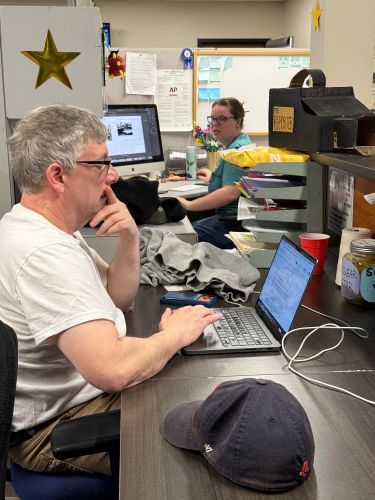
About a week later, editors Addie Larson, Alexis Darkow, Isaac Rozwadowski and Logan Schlosser are in the newsroom working ahead of the deadline. Zuniga is nearby in her office waiting for final pages.
Together, they exercise editorial independence over what makes it in the paper. Students also work on the advertising side with business manager Jane Tastad, one of two full-time university staff at the paper. The other is Dana Clark, an advertising design manager and production coordinator. The only other non-student regularly part of the operation is Robb Murray, editor at the Free Press, who comes in and proofs copy.
The students met the deadline Monday, but they can’t revel for long. This is journalism, after all, so they immediately pack into Zuniga’s office to plan out the next edition.
Everyone leaves for the night knowing their next assignments. The next part, going out and learning about what’s happening on campus, is the most rewarding part of being a student reporter, Zuniga said.
“We get to have all these very meaningful conversations with classmates and see their thoughts,” she said. “I think, overall, working at a college newspaper just opens up a completely different lens on how you view the world.”
Related