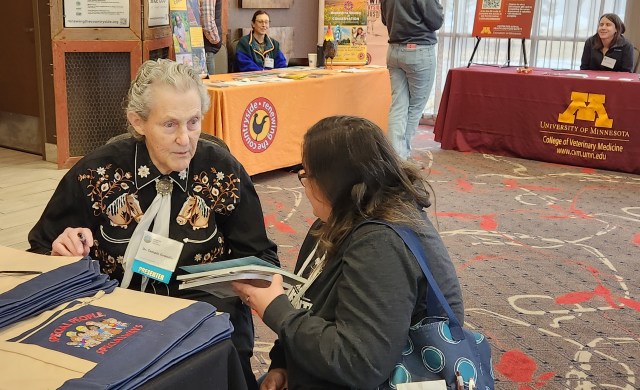
In 1988, in the wake of the era’s farm crisis, a group of farmers in Minnesota organized the Sustainable Farming Association with a mission of “transforming agriculture one farm at a time.” Around that time, Temple Grandin was finishing her doctoral work in animal science at the University of Illinois Urbana–Champaign.
Their unique approaches to agriculture connected earlier this month when Grandin — known for her innovative work with livestock as well as the autism she experienced that led her to unconventional thinking about farming — headlined SFA’s Midwest Soil Health and Grazing Summit in Willmar.
As she told the audience: “Grazing cattle, sheep and goats is an important part of a sustainable agriculture future.”
SFA President Lucinda Winter said she hopes agriculture can continue to undergo the paradigm shift championed by Grandin, from its heavy focus on monocropping to more sustainable systems that can support both the environment and the communities that surround farming.
“She saw a system that she felt she could have a role in transforming,” Winter said. “She was working against the tide, and I guess you could call that unconventional.”
On the road, again

A prolific author and speaker, Grandin landed at No. 105 on Forbes’ 2026 list of America’s 250 “Greatest Innovators.” The magazine cited her for “improved efficiency — and humanity — of livestock handling systems.” She currently is a professor in animal science at the University of Colorado.
Claire Danes portrayed her in a 2010 movie, “Temple Grandin.” A March 3 screening of “An Open Door,” a 2025 documentary about Grandin, who is 78, drew a full house to Willmar Senior High School. Many waited in a long line at her book-signing table that displayed many of the 16 books she has written on both livestock and autism, including “Visual Thinking – The Hidden Gifts of People Who Think in Pictures, Patterns, and Abstractions.”
Related: Getting down to earth about the health of the soil
“I’m really happy about the things you’re doing,” Grandin said in her keynote speech. “I also really like your slogan: One Farm at a Time. That’s how I started out, with information about cattle handling. We got one place to start doing things better, and then I wrote about it.”
Grandin’s journey from autistic child to national icon in the cattle industry enthralled the audience, many of whom raise cattle and other livestock on small farms. While her place on the autism spectrum presented many social challenges, she said, her “visual thinking” enabled her to understand livestock and improve handling systems.
“I looked at what cattle were seeing,” she said. “I designed the front end of every Cargill plant in North America. That’s pretty good for someone who can’t do algebra.” Her consulting client list includes other major meat packers and restaurants such as McDonald’s and Burger King.
Grandin grew up in Massachusetts and did not speak until she was nearly 4 years old. While doctors recommended that she be institutionalized, her mother refused and continued to work with her daughter. Grandin struggled in school. “I had a terrible time in high school — bullied, teased, called all kinds of names,” she said.
She was sent to a boarding school, where her connection with animals grew while she worked with horses.
Her association with cattle developed when she went to live with an aunt and uncle in Arizona. Writing articles for a cattle magazine helped her gain credibility in an industry unwelcoming to women in the 1970s.
In praise of different thinkers
Today, Grandin’s message extends far beyond livestock and her personal experience. Her various books promote an understanding of people who are “visual thinkers” — those who think in pictures and not words.
“We need the skills of different kinds of thinkers,” she said. “We’re screening out object visualizers, who are going to be some of the best people on crop rotation and new methods of farming.”
Related: Task force wades into the complexity of water stewardship in the Land of 10,000 Lakes
Grandin decries the decline of hands-on learning in contemporary education. Working with animals helped her offset her limits in verbal thinking and learning. “I don’t even know if I could graduate today because I can’t remember abstract math.”
More than 200 people attended the summit, which included breakout sessions on sustainable and regenerative agriculture topics. About 40 women attended, with scholarships provided by “Renewing the Countryside,” said Katie Feterl, SFA’s communications director.
SFA grew from a Land Stewardship Project chapter in southeast Minnesota. While LSP leans toward advocacy, “this group of farmers wanted a nonpartisan educational and mutual support organization,” Winter said. “They were supporting each other on how they could more successfully respect the soil and work with the land.”
Related