The US Just Found Enough Lithium To Rival China


Lithium is an important metal used to manufacture the batteries that power everything from mobile phones and laptops to EVs, power tools, and much more. It also has a variety of industrial and medical applications, and it’s a substance that many Americans benefit from every day. The U.S. is not one of the world’s major lithium producers, trailing behind nations like Chile, Australia, and China. A discovery in the Appalachian Mountains, however, has revealed that the nation’s lithium reserves are larger than previously thought. But that’s not quite the end of the story.

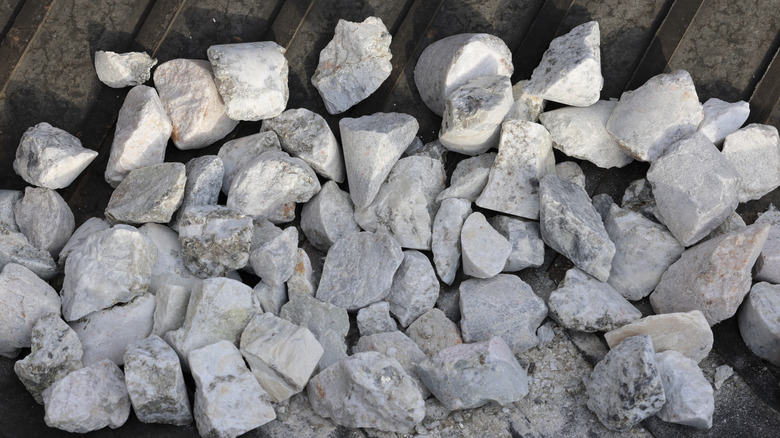
According to estimates from the U.S. Geological Survey, around 2.3 million metric tons of lithium oxide deposits are present across parts of Maine, New Hampshire, and North Carolina. But the problem is that this lithium lies within hard rock formations known as pegmatites, which aren’t easily accessible. As of this writing, those rocks are not being mined, and quite a bit of work would need to be done before the lithium could be extracted and put to good use.

In contrast, China’s dominant lithium-ion battery industry puts it far ahead of the U.S., at least for now. But even if America’s newfound lithium deposits can be developed, establishing a secure domestic supply chain would require rebuilding much of the existing infrastructure. So this discovery, while potentially a positive for the U.S. moving forward, doesn’t do much to change the current imbalance that exists between America and other countries.

America’s current lithium production and future plans
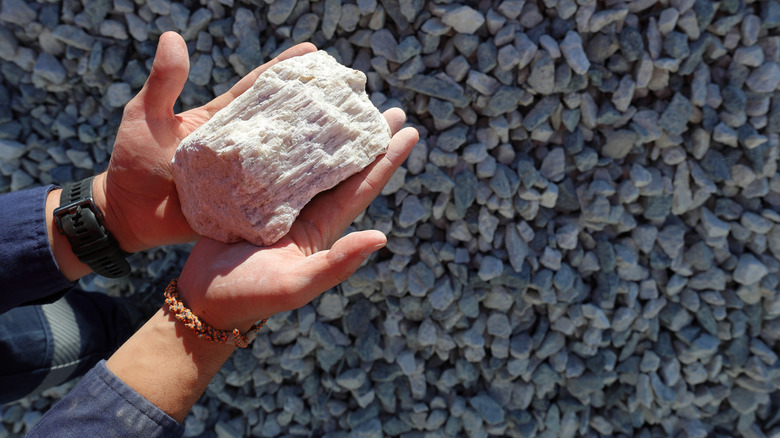
The recent discovery of lithium oxide deposits across several states seems to bode well for the U.S., which depends on rare earth elements for electric cars. Extraction issues aside, the U.S. Geological Survey’s 2.3 million metric ton estimate is also based on a 50% confidence level. This means there’s an equal chance of there being more or less lithium than estimated. The only way to confirm the total is through further development and analysis. Even then, the USGS’ projection does not account for how much of the lithium can actually be extracted.

Currently, the U.S. has a limited lithium production base despite holding 4.4 million metric tons in reserve. As of 2026, the nation only has one active lithium mine in Silver Peak, Nevada, which produced around 1,000 metric tons of lithium in 2025. That output is extremely small compared to China, which produced 62,000 metric tons of lithium in 2025. China also has a slightly larger reserve of 4.6 million metric tons.

However, there is a second mine under construction in Nevada as of mid-2025. The Thacker Pass Lithium Mine received its permits in 2022 after years of review, public forums, and revisions to the original applications. The mine is scheduled to begin operations in 2028, with an expected annual output of around 40,000 metric tons of lithium.


Source link

Leave a Reply

Subscribe to Our Newsletter

Get our latest articles delivered straight to your inbox. No spam, we promise.

Recent Reviews


Researchers in South Korea developed a wearable system that uses seven smart rings to read finger and hand motions to translate American Sign Language and International Sign Language into text. The purpose is to make communicating easier between those who sign and nonsigners without needing a separate human interpreter. 

AI Atlas

According to the study, published Friday in the journal Science Advances, the system reliably recognized 100 ASL and ISL words during testing. It also performed well with users the system had not seen before, and it didn’t require recalibration for each person. Because the system detects words in sequence, it can produce sentence-level translations without extra training on grammar. 

ASL and ISL are the everyday languages of more than 72 million deaf and hard-of-hearing people. However, most hearing people do not know any words in these languages or have a very basic understanding. That gap makes certain tasks, like ordering at a restaurant or asking for help, much more difficult. 

A graphic shows two illustrated people talking in sign language, ASL and ISL. The graphic also shows the different components of the ring as well as pictures of hands modeling the rings.

A concept of how the rings work in the real world. 

American Association for the Advancement of Science (AAAS)

Existing sign language translator prototypes often rely on bulky gloves that can distract from or block natural hand movement or feel uncomfortable for the wearer, which limits real word adaption. Camera-based technologies can work well in controlled environments but are often limited to those places where a camera can be set up with a clear line of sight, the researchers wrote. 

To solve these problems, the researchers designed sensing rings for each finger that can capture precise motion and finger position while letting the hands move naturally. The rings can detect both signs that involve movement, like the words for “dance,” “fly” and “sun,” and signs that are held still, like “I” and “you.”

“These advances suggest that [the device could enable] barrier-free public translation systems for unseen users and unrestricted daily assistive interfaces,” the authors wrote in the study. 

The authors are affiliated with Yonsei University, Hankuk University of Foreign Studies and the Korea Institute of Science and Technology, among others. While the technology is still experimental, the authors wrote that the technology has the potential to ease communication difficulties. The underlying idea could also help improve controls for other systems, like virtual or augmented reality.

“Beyond sign language translation, the ring-type, wireless, and modular architecture of (wirelessly connected, ring-type sign language translators) may also be extended to other gesture-driven applications such as virtual or augmented reality control, touchless device interfaces, or rehabilitation monitoring systems where fine-grained hand movement tracking is essential,” they wrote.


Source link




