
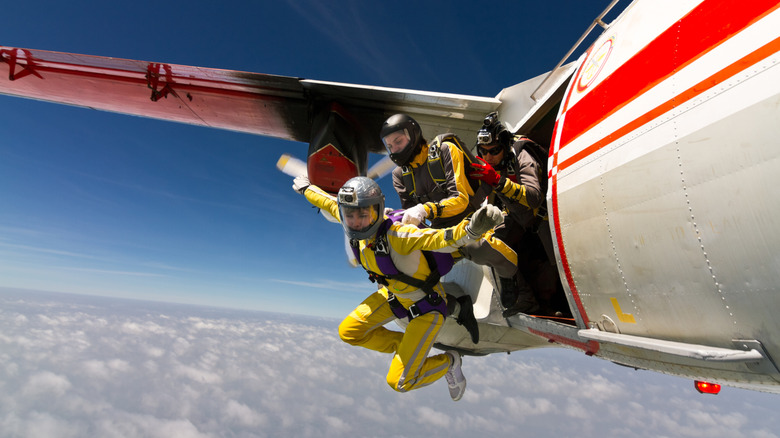
The safety briefing at the start of any flight explains to passengers what they need to do in the event of an in-flight emergency. It will tell you things like where to find the emergency exits and where the life jackets are stored. One thing it won’t explain is where to find your parachute.
This might seem strange, as parachutes have been saving fliers since the 1910s, a few short years after the Wright Brothers’ historic 1903 flight. In fact, the first successful use of a parachute happened in the 18th century, when André-Jacques Garnerin successfully parachuted from a hot-air balloon. But there are very good reasons why we’re not all issued with parachutes upon boarding a commercial flight.
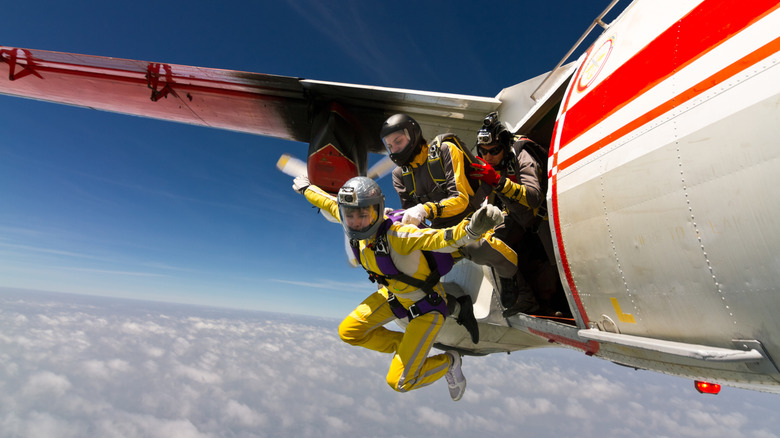
One of the biggest problems is altitude. Commercial jets typically fly at altitudes of about 35,000 feet or more, with some long-haul flights exceeding 40,000 feet. And while it’s easy to forget when you’re sipping a coffee at 37,000 feet, there are only a few inches of airplane separating you from freezing temperatures and air that’s too thin to breathe. Commercial planes also fly at incredible speeds, up to 575 mph in some instances. The fact that most passengers won’t have parachute training is another issue. Put simply, hundreds of flip-flopped holidaymakers exiting an aircraft into a minus 50-degree Celsius, 500-mph airstream without a clue how to skydive is not a scenario that’s likely to end well.
Why passengers are safer staying onboard
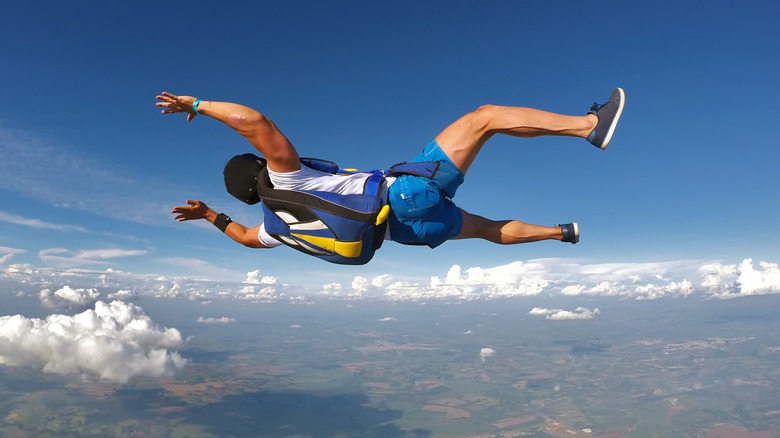
To illustrate why passengers are better off without parachutes, let’s look at an incident that took place on June 24, 1982, when a British Airways 747-200 unknowingly flew through a volcanic ash cloud. The ash caused the engines to fail, and the plane dropped 25,000 feet before the pilot managed to restart them and perform a successful emergency landing. Had passenger parachutes been available and the captain made the call to use them, the result would have been hundreds of passengers widely dispersed over the ocean.
There are no circumstances where turning off the seatbelt light and illuminating a hypothetical prepare-to-parachute light is viable. Even in instances where the altitude is survivable and the cabin doors can be opened (which can only happen if the plane is depressurized and below 10,000 feet), the idea of startled passengers with no parachute training forming an orderly queue, leaping into the airstream, and landing on the ground unscathed is unrealistic.
Modern airliners are incredibly safe, and flying remains the safest form of transportation. Issuing parachutes to passengers is unlikely to improve these stats. Parachutes only work when conditions allow them to, circumstances that commercial flights never satisfy. This is not a new realization either; as far back as 1931, airline operators maintained that the time element in crashes made passenger parachutes pointless. Perhaps slightly more plausible is a system like the whole-airframe parachutes fitted to Cirrus aircraft. However, weight, size, cost, and doubts about its effectiveness mean we probably won’t see such systems on commercial flights anytime soon.

Stephan is the sports journalist for the Maple Grove Report.