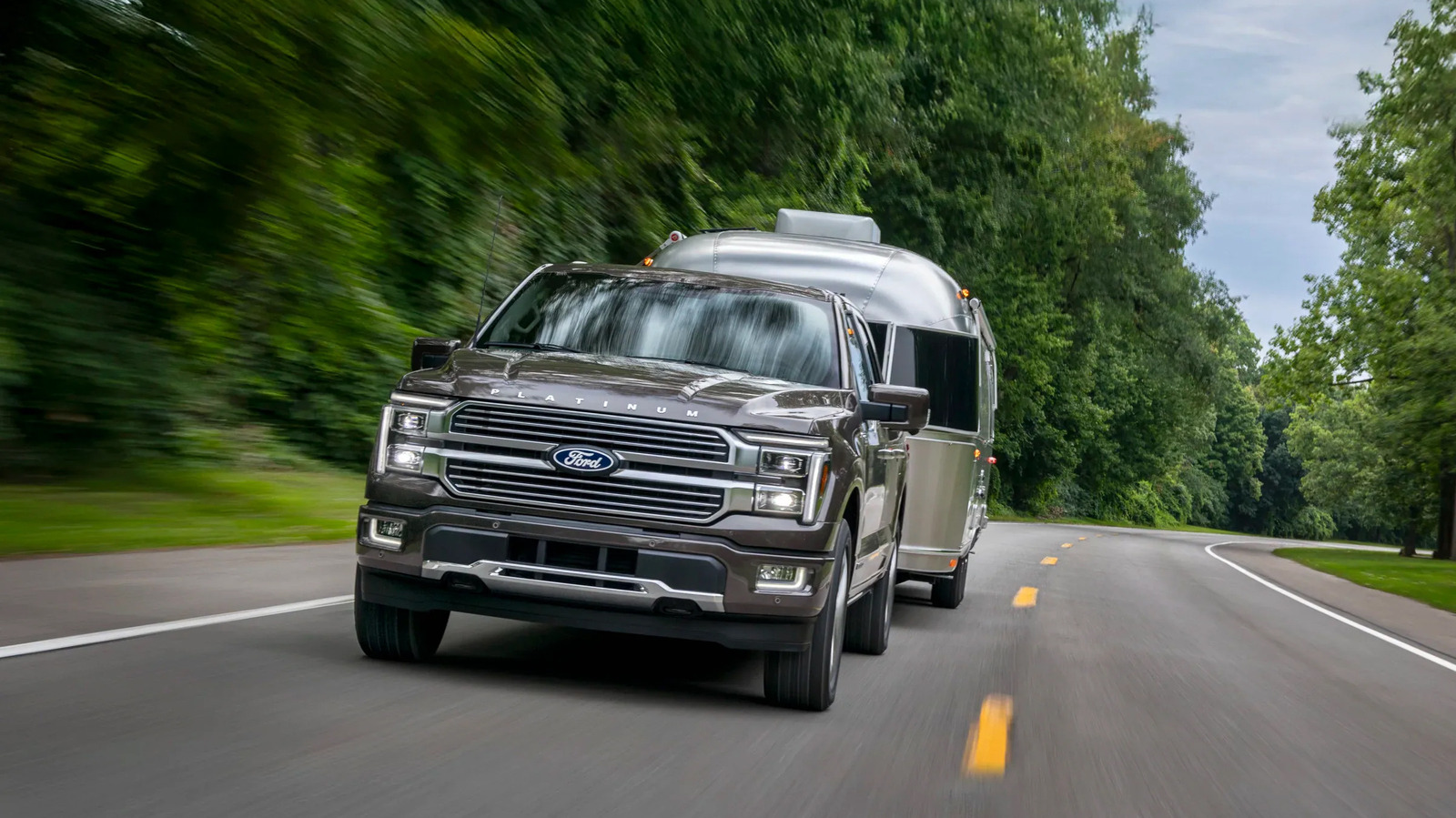

For decades, the Ford F-150 has found itself toward the top end of the sales sheets, consistently being the nation’s favorite truck by some margin despite the competition being incredibly fierce. Being marketed as the go-to full-size pickup if you’re looking for a blend of outright practicality and cutting-edge technology, the flagship of the F-Series lineup rarely puts a foot wrong in simply doing what a truck is supposed to do, and then some.
Another main reason why so many people love the F-150 is reliability. If you’re in the market for a new truck, you’re most likely wanting something you can trust to handle plenty of strain, with the latest 2026 model’s great reliability score of 86/100 from J.D. Power helping to continue the reputation the truck has built up over the years. However, it’s not quite on top of the pickup truck segment as a whole, with some recent model years slipping according to the data. Here’s a look at five pickups that come with higher reliability scores from trusted outlets such as J.D. Power and RepairPal, whether it’s new 2026 trucks or previous model years that beat the corresponding F-150. Not all of these trucks directly rival the Ford, with some falling into the mid-size segment. But if reliability is the crucial factor, they should still certainly be considered.
Chevrolet Silverado (2023 model year)
Out of all the full-size trucks competing with the F-150, the Chevrolet Silverado has managed to hold its own for the longest. In its latest guises, the two are unsurprisingly very close on paper, with either truck edging ahead to appeal to slightly different buyers. As standard, the F-150’s 2.7L V6 offers 325 horsepower, compared to the Silverado’s 310 horsepower, but the latter tops the base torque rating at 430 pound-feet compared to the Ford’s 400. Go for the standard 3.5L V6 in the F-150, though, and you get the 13,500-pound maximum towing capacity, which just beats the Silverado’s 13,300-pound rating.
As for reliability, the newer models are also pretty much neck and neck. As per J.D. Power, both the 2026 models achieve a score of 86/100, putting them toward the top end of the full-size segment in this area. Based on data collected by RepairPal, though, the two are actually tied, each earning a 3.5/5 score. If you look at some used models like those released in 2023, the Chevy comes out ahead in J.D. Power’s overview, getting a lower score of 80/100 compared to the 2025/26 years, but still above the 2023 F-150’s score of 78/100.
Nissan Frontier (third generation)
Nissan was competing directly with the F-150 for quite a few years with the Titan, but the Japanese brand decided to pull the truck from the lineup in 2024. While the Titan was a solid truck mechanically, it began to fall behind as rivals constantly introduced new technology, with sales numbers not really justifying investing more money into reaching the same level. Now, only the Frontier keeps Nissan in the pickup segment, which actually follows suit with the Titan in not being as advanced when it comes to modern technology throughout. However, it’s got one of the best reputations for reliability within the mid-size scene.
Under the hood of the 2026 Frontier is a 310-horsepower 3.8L V6 that was introduced all the way back in 2020. However, the truck entered its current generation in 2022, replacing what was one of the most dated trucks on the market. For the newest 2025 and 2026 models, the Frontier edges out the F-150 with a score of 87/100 on J.D. Power, with older 2023 models also getting a better score of 84/100. The same consistency is shared with RepairPal, which gives the truck an overall rating of 4/5 for dependability.
Jeep Gladiator (2023-2026 model years)
The F-150 puts a strong emphasis on practicality and functionality, but when it comes to how well it drives off the tarmac, it’s very hard to beat the Jeep Gladiator. This is another truck on this list to fall into the mid-size segment, sharing its platform with the Wrangler. The two models are basically the same vehicle, but with one having a bed on the back. The 285 horsepower from the standard V6 is enough for the size, but the tried and tested leading link and trailing arm setup is where the Gladiator earns its $53,215 starting price.
For a truck built for the trails, you need to have the confidence that it won’t let you down when you least need it to. According to J.D. Power, though, this should not be the case, achieving a strong score of 88/100 for the latest 2026 model. Even going back to the 2023 model, the score remains strong at 87/100.
Ram 1500 (2024 model year)
If you want a full-size truck that leans further toward luxury than the F-150, the Ram 1500 has long been the top choice in the segment for the money. On the capability side of things, as standard, the Ford currently has the slight edge in the crucial areas that make up for the Ram’s elevated luxury, most notably in its towing capacity. As mentioned, the F-150 in its newest guise can tow 13,500 pounds when properly equipped, with the 1500 managing a lower 11,610 pounds when fitted with the twin-turbo 3.0L inline-six.
For the 2026 model, the F-150 does have the Ram 1500 beat on reliability, at least according to J.D. Power’s ratings. The 1500 comes in with a score of 77/100, with the newer Hurricane engines being a common culprit for the drop in quality. But if you go back a couple of years to 2024, before the facelift, the Ram 1500 gets an outstanding 89/100 score for reliability. As per RepairPal, the Ram truck equals the F-150 with a 3.5/5 score, which is still above average for the segment. The base 3.6L V6 was also used in the 2024 model, alongside the two HEMI options. With the 5.7L HEMI V8, the towing capacity reached a more competitive 12,750 pounds.
Chevrolet Colorado (2022 model year)
The Silverado keeps Chevrolet well within the full-size segment, but the Colorado makes the same impact in the mid-size segment to keep all bases covered. Entering its current generation in 2023, the Colorado got all the features needed to remain one of the best trucks on the road, with new engines on top of an entirely rebuilt platform. However, while reliability ratings for the latest models are still strong at 83/100, it’s the previous second-gen models that come out ahead of the F-150 in the same years.
While the newer models come with more standard power and technology compared to the 2022 model (the last of the second-gens), having the 3.6L V6 under the hood brings the horsepower to 308 — bringing it up to modern standards. For reliability, though, its score of 84/100 from J.D. Power puts it ahead of the Ford quite comfortably, bolstered by its 4/5 rating from RepairPal.
Methodology
To select the trucks on this list, we looked at various sources, such as J.D. Power and RepairPal, to gather information on their reliability. To judge whether they’re more reliable than the F-150, we focused on specific model years to find which ones receive better scores than the F-150 of the same model year.

Stephan is the sports journalist for the Maple Grove Report.