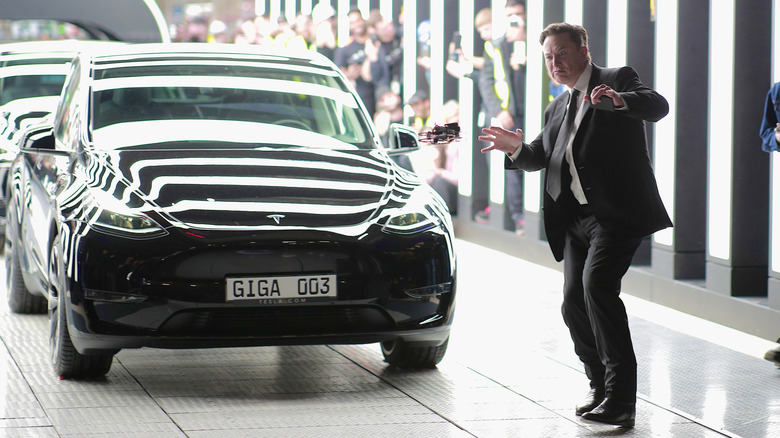

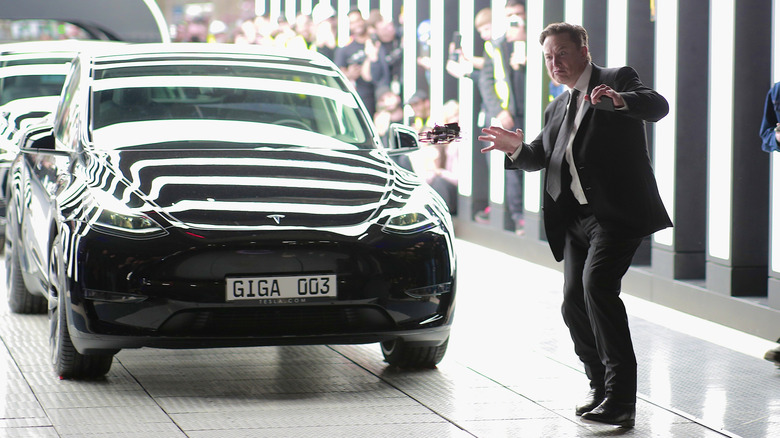
Elon Musk is many things — a billionaire, a rocket builder, a social media provocateur — but first, he’s a car guy. Long before he was running Tesla, he was spending his first big paycheck on a McLaren F1, which he believes is the best car in the world. Since then, his relationship with cars has only grown more complicated and mysterious.
Tesla, the company he joined in 2004 and has led since 2008, has grown from a single-model electric car startup into one of the most influential automakers on the planet. Its lineup has spanned the Model S, Model 3 Model X, Model Y, and the Cybertruck, though Tesla has since discontinued the Model S and the Model X. Regardless, Musk has driven, tested, or been spotted in most of them at one point or another.
So which Tesla vehicles does the CEO actually drive? Back in 2019, Musk revealed on X that his day-to-day rotation included the Model S Performance — equipped with the then-new Raven motor — along with the Model 3 Performance, and the Model X when he had his kids in tow. Since then, he’s been spotted in newer models, including a Cybertruck prototype in Austin.
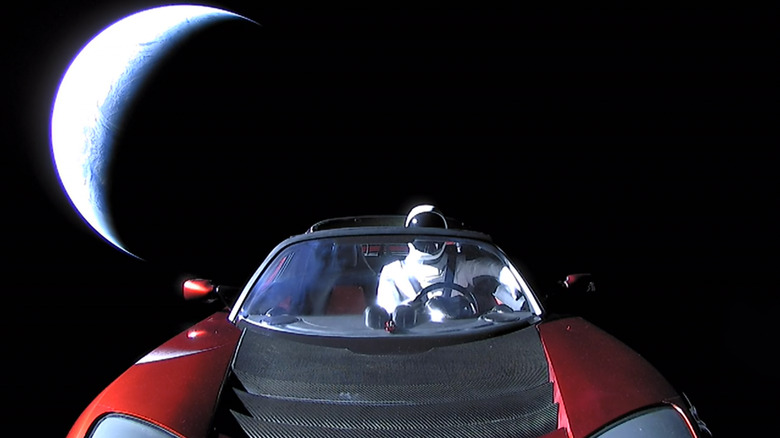
While Musk rarely updates the public on his garage, the Model S remains the Tesla most closely associated with him, alongside more recent appearances in the Cybertruck. His most famous Tesla, however, is still the original Roadster that SpaceX launched into orbit aboard Falcon Heavy in 2018. These are the Tesla models Elon Musk actually drives or has driven.
A closer look at Elon’s Teslas
Musk’s relationship with the Model S goes back further than most people realize. As early as 2015, Time Magazine reported he said at Tesla’s annual shareholder meeting that “I’m testing the latest version of autopilot every week. Typically, two or three builds per week that I’m testing on my car.” By 2018, when he appeared on The Joe Rogan Experience #1169, he confirmed the Model S was still his go-to, saying directly: “Model S P100D. That’s the car that I drive.”
By 2019, he had upgraded. In the aforementioned 2019 post on X, Musk revealed his Model S had been fitted with an adaptive damping suspension in addition to the Raven motor, along with a development version of the FSD computer that had not yet been made available to the public. The Model X is also the Tesla with a most personal backstory behind it. During a 2012 interview with Autoblog, Musk criticized the Audi Q7 he owned at the time for its notoriously difficult third-row access, saying that “you need to be dwarf mountain climber to get into the back seat.”
That frustration directly shaped the Model X. Musk said in the same interview that the Falcon wing doors were his idea, born out of a need for a door that could open in tight spaces while still allowing access to the third row without moving the second-row seat. Although these Falcon doors have proven to be quite problematic, In his 2019 X post, he confirmed the Model X remains his go-to when driving with his kids.
Elon Musk’s car collection
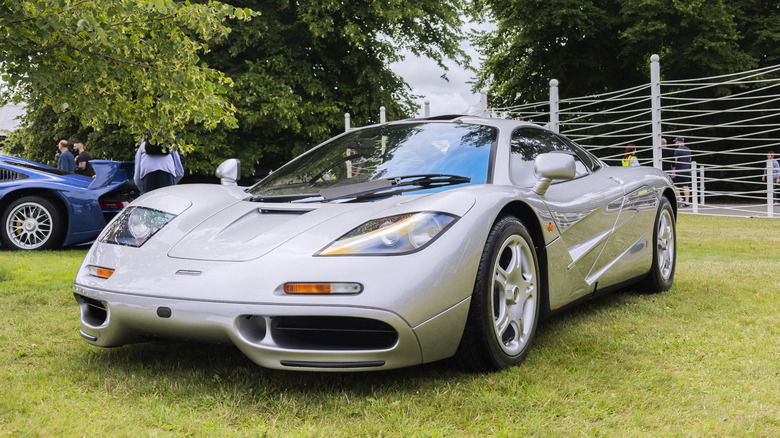
Although information on the Tesla models Elon owns and drives is somewhat limited, his broader car collection is more publicized. Likely the most expensive car in Elon Musk’s collection was the McLaren F1 — and we say “was” deliberately, since Musk no longer owns it. After crashing it while uninsured, watching it catch fire, and having it undergo a complete rebuild by McLaren Special Operations, he sold the car in 2007.
One of the oldest cars in Musk’s collection was the 1920 Ford Model T reportedly gifted to him by one of his friends as a symbol of how it changed the automotive industry and how Musk does the same. A well-known vintage also owned by Musk is the 1967 Jaguar E-Type roadster. Likely one of the coolest cars in his collection is the 1976 Lotus Esprit “Wet Nellie,” a car used in the 1976 “The Spy Who Loved Me” James Bond movie.
Musk’s collection also included a few older German luxury cars like the 1974 BMW 320i (his first car), a Hamman-modified 2005 BMW M5, and the 2010 Audi Q7 he criticized when talking about Model X Falcon doors. Musk’s 2012 Porsche 911 Turbo was actually directly tied with his connection with Tesla. When Musk offered AC Propulsion’s Alan Cocconi $250,000 to convert his Porsche 911 Turbo to electric, Cocconi refused.
It was then that AC Propulsion’s CEO Tom Gage suggested Musk speak with Martin Eberhard, who had just launched a small electric car startup called Tesla. In the same Joe Rogan podcast we mentioned above, Elon noted that the Jag and the Ford are the only two gasoline cars he owned at the time, meaning that the majority of the collection is no longer his.

Stephan is the sports journalist for the Maple Grove Report.