

Follow ZDNET: Add us as a preferred source on Google.
XR glasses aren’t just for gamers; they’re also great at simulating a big-screen for your laptop or tablet
XR glasses are fantastic for watching movies on a plane or playing Nintendo Switch games on a virtual big screen, but they also have some pretty incredible utility for mirroring your laptop or tablet display.
For a limited time, the Xreal One Pro glasses are on sale for $599, down from the regular price of $769. This is one of the most notable smart glasses deals we’ve seen so far this year, and matches their discount during last Black Friday.
Also: I tried an AR smart glasses prototype by the makers of Meta Ray-Ban Display, and it was wild
ZDNET’s Matt Miller tested the Xreal One Pro smart glasses and praised their performance in getting work done on his Surface Pro and MacBook Pro computers in ultra-wide mode. Powered by Xreal’s X1 spatial computing chip for augmented reality applications, he said the Xreal glasses left him feeling spoiled.
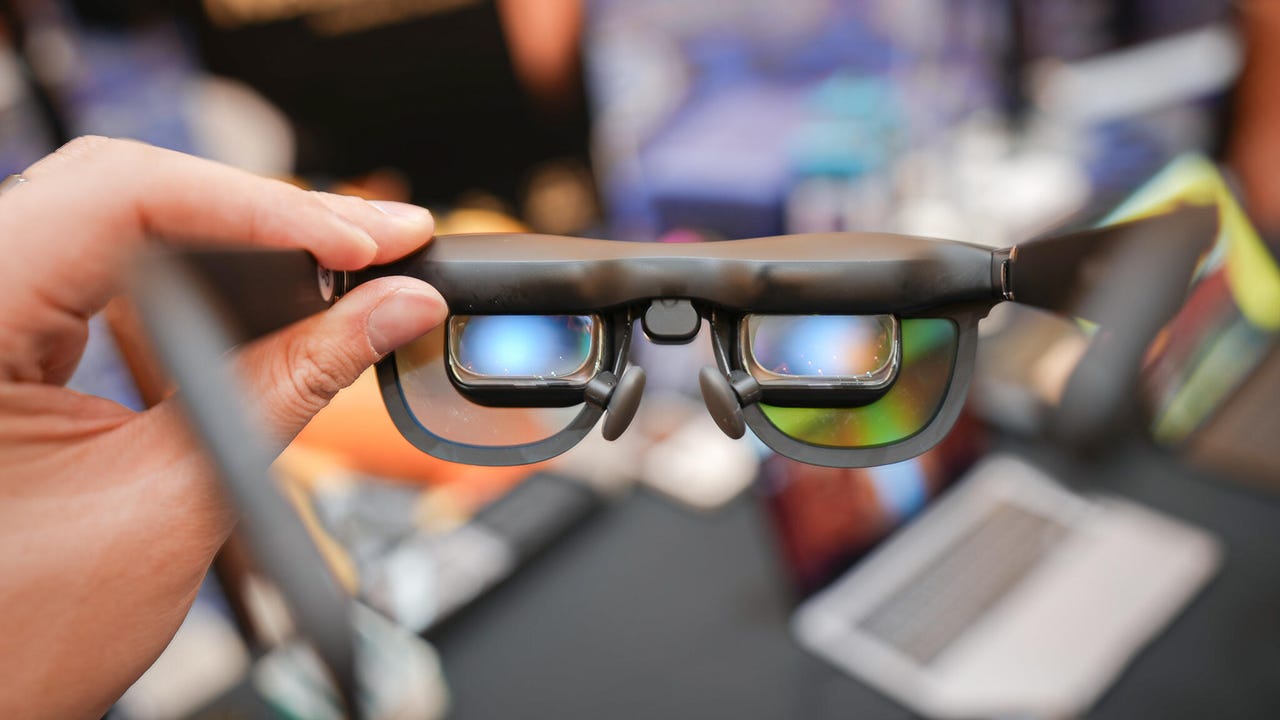
The Xreal One Pro delivers an impressive visual experience, thanks to its new flat prism optics. While the design adds some bulk and weight, it enables a 57-degree field of view — currently the widest available in any consumer AR device.
For anyone who likes bringing tech onto a plane, or just daily commuters on the train or subway, XR glasses like these offer one of the most immersive ways to watch content or play mobile games on the go.
Read the review: Xreal One Pro AR smart glasses
What about the audio, though? These were developed in partnership with Bose, which provides enjoyable sound even though the speakers aren’t directly in your ears like traditional earbuds and headphones.
It’s really all about the visual experience, though. The Xreal One Pro has a built-in ultra-wide screen, and when paired with the Xreal Eye accessory, adds 6DoF support — letting you anchor your virtual workspace much like you can with the Apple Vision Pro or Meta Quest 3.
When ultra-wide mode is enabled, all previously arranged apps, tabs, and windows reappear exactly where you left them, making for a remarkably fluid multitasking experience.
For frequent travelers who rely on a single laptop screen, XR glasses like these offer a compelling productivity boost — at a fraction of the cost of multiple physical monitors.
Also: CES 2026: These 7 smart glasses caught our eye – and you can buy this pair now
The glasses are compatible with iPhone 16 and up, Steam Deck, iMac, PC, and Android devices, and come in two sizes: medium (57-66mm), and large (66-75mm).
How I rated this deal
I gave this deal a 3/5 stars, since the sale price is very good (22% off), but still might be on the high end for consumers looking for affordable XR smart glasses.
Deals are subject to sell out or expire anytime, though ZDNET remains committed to finding, sharing, and updating the best product deals for you to score the best savings. Our team of experts regularly checks in on the deals we share to ensure they are still live and obtainable. We’re sorry if you’ve missed out on this deal, but don’t fret — we’re constantly finding new chances to save and sharing them with you at ZDNET.com.
We aim to deliver the most accurate advice to help you shop smarter. ZDNET offers 33 years of experience, 30 hands-on product reviewers, and 10,000 square feet of lab space to ensure we bring you the best of tech.
In 2025, we refined our approach to deals, developing a measurable system for sharing savings with readers like you. Our editor’s deal rating badges are affixed to most of our deal content, making it easy to interpret our expertise to help you make the best purchase decision.
At the core of this approach is a percentage-off-based system to classify savings offered on top-tech products, combined with a sliding-scale system based on our team members’ expertise and several factors like frequency, brand or product recognition, and more. The result? Hand-crafted deals chosen specifically for ZDNET readers like you, fully backed by our experts.





