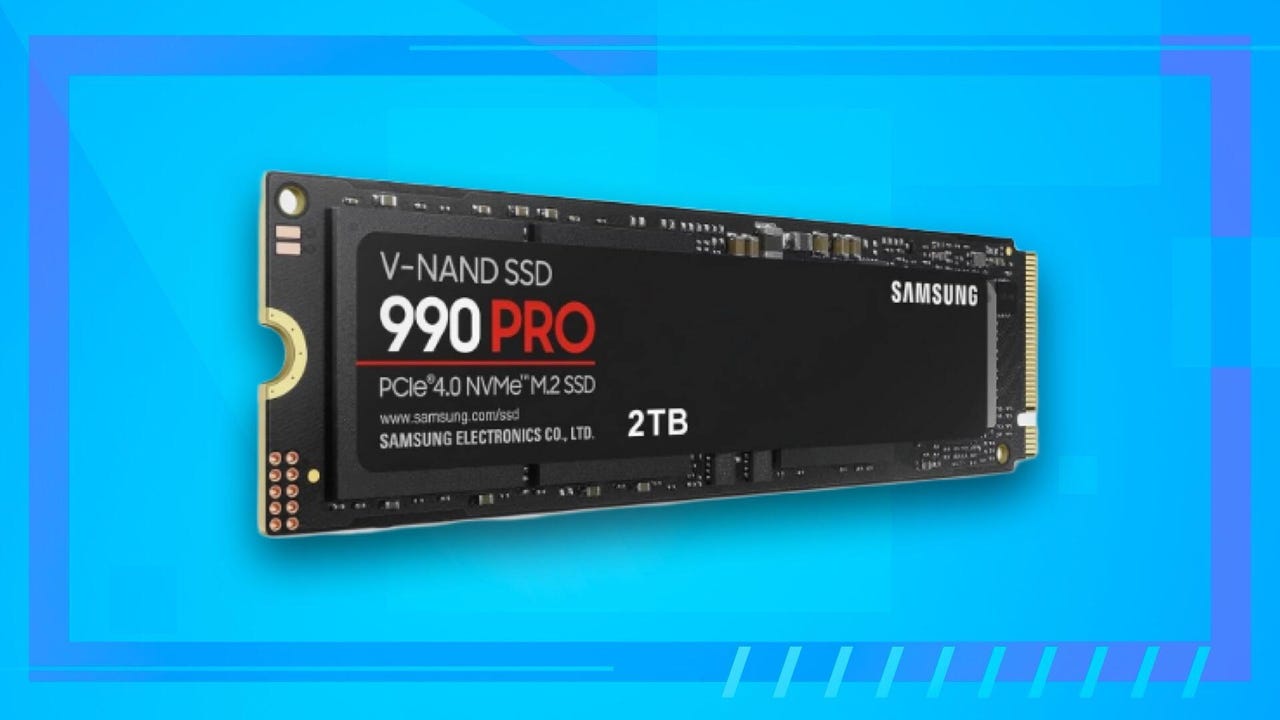
This 2TB SSD bucks the expensive memory trend with a $270 discount for Prime Day


samsung-990-pro-ssd-2

The Samsung 990 Pro pushes the limits of the PCIe 4.0 protocol.

Amazon/ZDNET

The cost of memory hardware has been skyrocketing lately, and it’s not only RAM that’s impacted — prices of solid-state drives and hard drives have been rising dramatically too.  

That’s why this Amazon Prime Day discount on Samsung’s 990 Pro SSD instantly caught my attention.  

Also: June Prime Day live blog 2026: We’re tracking Amazon deals on SSDs, TVs, laptops and more

Several capacities are on sale, but the standout deal is the 2TB option, which has dropped from $640 to $370, a 42% discount. The 1TB model is also worth considering, falling from $320 to $220. Power users looking for the most storage can save 20% on the 4TB SSD. We don’t expect these prices to drop further.

There’s also an alternative version of the 990 Pro that comes with a heatsink. 2TB SSD with said heatsink is available for $480, or 28% off.

If your PC, laptop, or video game console is running low on space, I recommend taking advantage of this deal. The Samsung 990 Pro is one of the better PCIe 4.0 SSDs available, delivering sequential read speeds of up to 7,450 MB/s and write speeds of up to 6,900 MB/s. At those speeds, you’ll be approaching the near-limit of what PCIe 4.0 can offer. You’ll be able to load AAA games and transfer large files in almost no time.

Compared to the previous generation, the 990 Pro offers improved power efficiency, providing “up to 50% improved performance per watt over the 980 Pro.” In plain English, that means it delivers those fast speeds while drawing less power. The drive also incorporates a nickel-coated controller to help keep temperatures under control and maintain a high level of performance.

Security is another highlight. The Samsung 990 Pro supports AES-256-bit hardware encryption, providing a strong layer of protection for sensitive files and data.

Also: I found the best SSD and storage deals ahead of Amazon Prime Day – including Lexar and Seagate

How I rated this deal 

As per ZDNET’s rating system, I give this deal a strong 4/5. The other discounted SSDs are solid, but the 2TB model offers the best overall value. Storage prices remain higher than many shoppers would like, and there’s no guarantee they’ll plummet anytime soon. If you’ve been waiting for the right moment to expand your desktop or laptop storage, this early Prime Day deal is one of the best opportunities I’ve seen so far. I highly encourage you to take advantage of this while it lasts.

It is currently unknown when this deal will expire. It’s possible that this promotion could extend all the way to and past Amazon Prime Day. That said, deals are subject to sell out or expire anytime, though ZDNET remains committed to finding, sharing, and updating the best product deals for you to score the best savings. Our team of experts regularly checks the deals we share to ensure they are still live and available. We’re sorry if you’ve missed out on this deal, but don’t fret — we’re constantly finding new chances to save and sharing them with you at ZDNET.com


Show more

We aim to deliver the most accurate advice to help you shop smarter. ZDNET offers 33 years of experience, 30 hands-on product reviewers, and 10,000 square feet of lab space to ensure we bring you the best of tech. 

In 2025, we refined our approach to deals, developing a measurable system for sharing savings with readers like you. Our editor’s deal rating badges are affixed to most of our deal content, making it easy to interpret our expertise to help you make the best purchase decision.

At the core of this approach is a percentage-off-based system to classify savings offered on top-tech products, combined with a sliding-scale system based on our team members’ expertise and several factors like frequency, brand or product recognition, and more. The result? Hand-crafted deals chosen specifically for ZDNET readers like you, fully backed by our experts. 

Also: How we rate deals at ZDNET in 2026


Show more


Source link

Leave a Reply

Subscribe to Our Newsletter

Get our latest articles delivered straight to your inbox. No spam, we promise.

Recent Reviews


It’s easy to assume that vehicles all had internal combustion engines until very recently. Gasoline and petrol engines were the standard for decades, after all, so why would early vehicles be any different? In reality, the early days of the automobile era were more varied than you might expect, and even featured a range of electric cars. Yes, despite electric vehicles not truly taking off until the 21st century, the first electric vehicles are much older than you think; drivers in the 1900s were going around town in electric vehicles — and where there are EVs, there are charging stations.

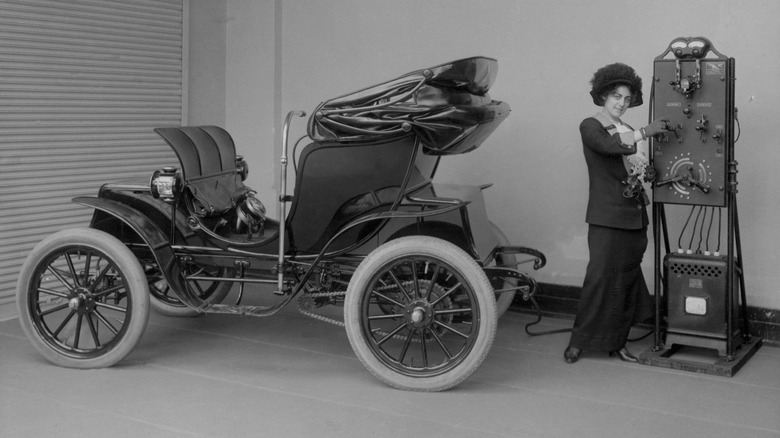
One such station, visible in the image above, was the creation of General Electric. Formally called the mercury arc rectifier, it took alternating current and sent it through vaporized mercury in a glass tube. This converted it into direct current, which powered up the EV’s battery. The woman in the image, who’s charging a Columbia Mark 68 Victrola, is standing at the control panel, which allowed a user to adjust power levels. 

These chargers could be installed everywhere, including homes, businesses, and public parking garages, supporting the electric vehicle boom of the early 20th century. While 21st-century EV chargers have come a long way from where they were, the basic building blocks are all still there, and it’s fascinating to see.

How EV chargers have evolved since the early 20th century

EV charging has changed a lot in some ways — but not in others. At the core of it all is the aforementioned conversion from AC to DC, which still happens when you charge modern EVs at standard charging stations. The difference is that your vehicle’s on-board charger performs the conversion, not the charger. Old EV chargers took between several hours and a day to charge, and current-day units can similarly take a few hours to well over a day from empty, depending on the charger’s speed. Fast chargers, which provide DC directly, can cut this down to around an hour or less.

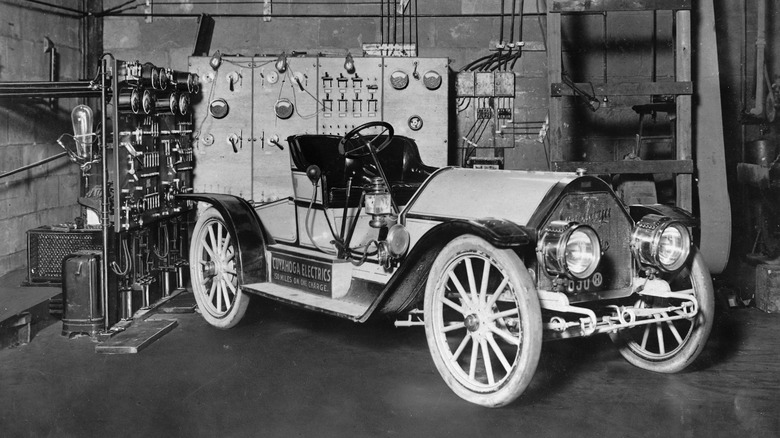
Old-school and modern EV chargers also differ in how they provide power to the vehicle. Mercury arc rectifiers connected directly to the negative terminal of the lead-acid battery that needed charging. Nowadays, EVs use dedicated charging ports. Battery swapping was also commonplace in the early 1900s, and companies like General Electric tried to cash in by offering to replace drivers’ old, run-down batteries with new ones for a fee. That’s not yet possible with most mainstream EVs, although companies like Stellantis have tried to introduce EV battery swapping with moderate success.

Even if they were unrefined compared to today’s models, early EVs seemed to be on to something. Why, then, did electric cars fail, and how did gasoline end up becoming the predominant power source for vehicles?

What led to the downfall of the original wave of electric cars

EVs were no mere fad in the 1900s and 1910s. According to the 1900 United States census, 1,575 of the 4,192 vehicles sold that year were electric, with the value of these early EVs — $2,873,464 — accounting for more than half of the total market value of $4,899,443. It wasn’t just EVs, either; other sources of propulsion, like steam, were also vying for a foothold in the automobile market. By the 1920s and 1930s, though, these had all been superseded by the internal combustion engine.

One of the major drawbacks of early EVs was the fact that electricity was not yet widely available. Electrical hookups were a rarity outside of major cities, limiting the use of these vehicles. The lead-acid batteries they used also had their fair share of issues. They needed to be inspected, cleaned, and repaired every few days, making them more of an inconvenience than anything. Worse yet, they had poor mileage, and, with chargers possibly out of reach, many likely didn’t want to risk being stranded while out for a drive.

Eventually, price reductions for gas cars and improvements such as electric starters and better reliability prompted buyers and automakers alike to move away from electric rides. Thus, while the best-selling EVs of 2026 show that it’s a good time for EVs, this electric boom plainly isn’t the first of its kind. Early EVs eventually fizzled out, but they still set the stage for our current fascination with electric vehicles.


Source link