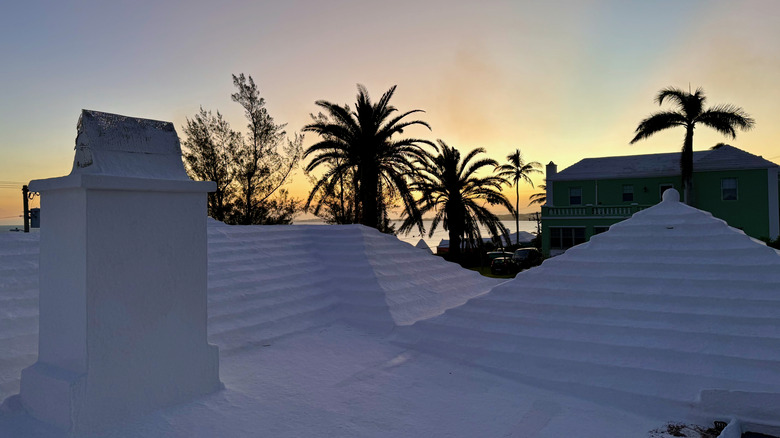

There’s a strange quirk about Bermuda that would make no sense to an outsider at first. It’s an island sitting roughly 700 miles off the Virginia coast with no lakes, rivers, or streams. Any groundwater is brackish, too. So how are roughly 65,000 people living there, with another half-million or so tourists visiting every year, getting by without leaning on things like desalination plants? The answer is sitting on top of every single house, those bright white roofs shaped sort of like a wedding cake. They’re so unique, they’re even called Bermuda roofs.
In 1609, when British sailors first washed up on the island from the Sea Venture (the flagship of the Virginia Company) after it wrecked, they realized they were stranded in paradise, a place teeming with natural resources. The only resource missing was fresh water.
Bermuda receives an average annual rainfall of about 57 inches, which is distributed fairly evenly throughout the year. So, early settlers decided to catch it. While they started out with frail palmetto-frond shelters, they quickly graduated to local limestone once they realized it was abundant and perfectly suited for the weather conditions. They laid limestone slabs with a unique stepped design over the roofs of their houses, with lower edges sculpted into stone gutters that doubled as drainage channels.
This approach is what climate experts have started eyeing for the rest of the world. You’d need decent rainfall and the right climate, but, for the right regions, it’s cheap, low-tech, and has four centuries of field testing already done.
Why it could help solve today’s water crises
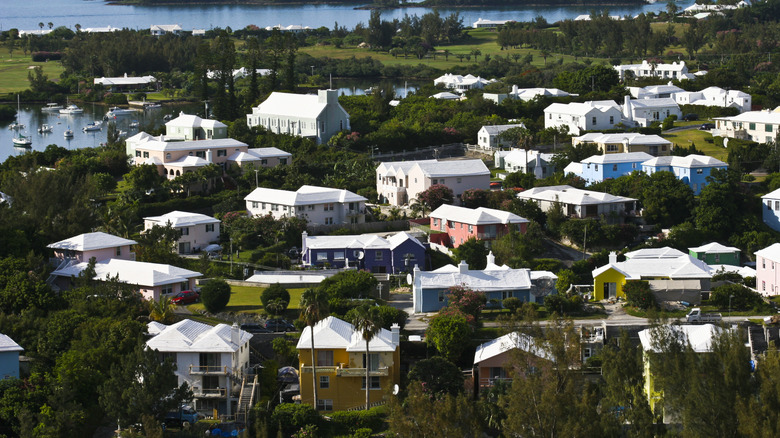
You might be surprised to hear that the whole setup is mandatory under local law, and it’s also why every house in Bermuda has the same white roof. Every single one of is legally required to direct 80% of the catchment into the tank below, which itself must hold 8 gallons for every square foot of roof above it. These roofs might not be suitable for solar panels, though.
When rain hits, often heavy, the little steps act like speed bumps and slow the water down so it doesn’t blow past the edges. From the gutters, the water gets funneled through pipes built into the walls and dropped into a tank sitting underneath the house. With droughts hitting cities from California to Cape Town year after year, a network of thousands of small household reservoirs starts to look more resilient than one big centralized pipe. The model won’t work everywhere, of course.
More than just a rain catcher
That said, they do a lot more for the water than just collect it. For one, the white you see on every roof actually helps purify it. That color isn’t natural limestone showing through, it’s the result of islanders painting their roofs. Earlier, they used something called limewash.
Not only is it alkaline, which gives it antibacterial properties, but it also reflects UV from sunlight since it’s white. This adds a second layer of purification as the water runs across. Today, modern acrylic paints have replaced limewash, but the bright white still gives the water a little UV treatment on its way down.
There’s more going on, too. The white help keep things cool, which lets a lot of Bermudian homes get by without any air conditioning. But perhaps the biggest perk they offer, besides water collection, is durability. Again, Bermuda gets battered by Atlantic storms every summer, and the heavy limestone slabs don’t fly away. The stepped profile also breaks up wind shear.
Ultimately, these roofs keep the rain in, the storms out, and the house cool, all at once. It’s a case of geometry and gravity working together neatly, making the thinking behind it not far off from what you’d find in some Archimedes inventions that can still be seen in modern engineering.

Stephan is the sports journalist for the Maple Grove Report.