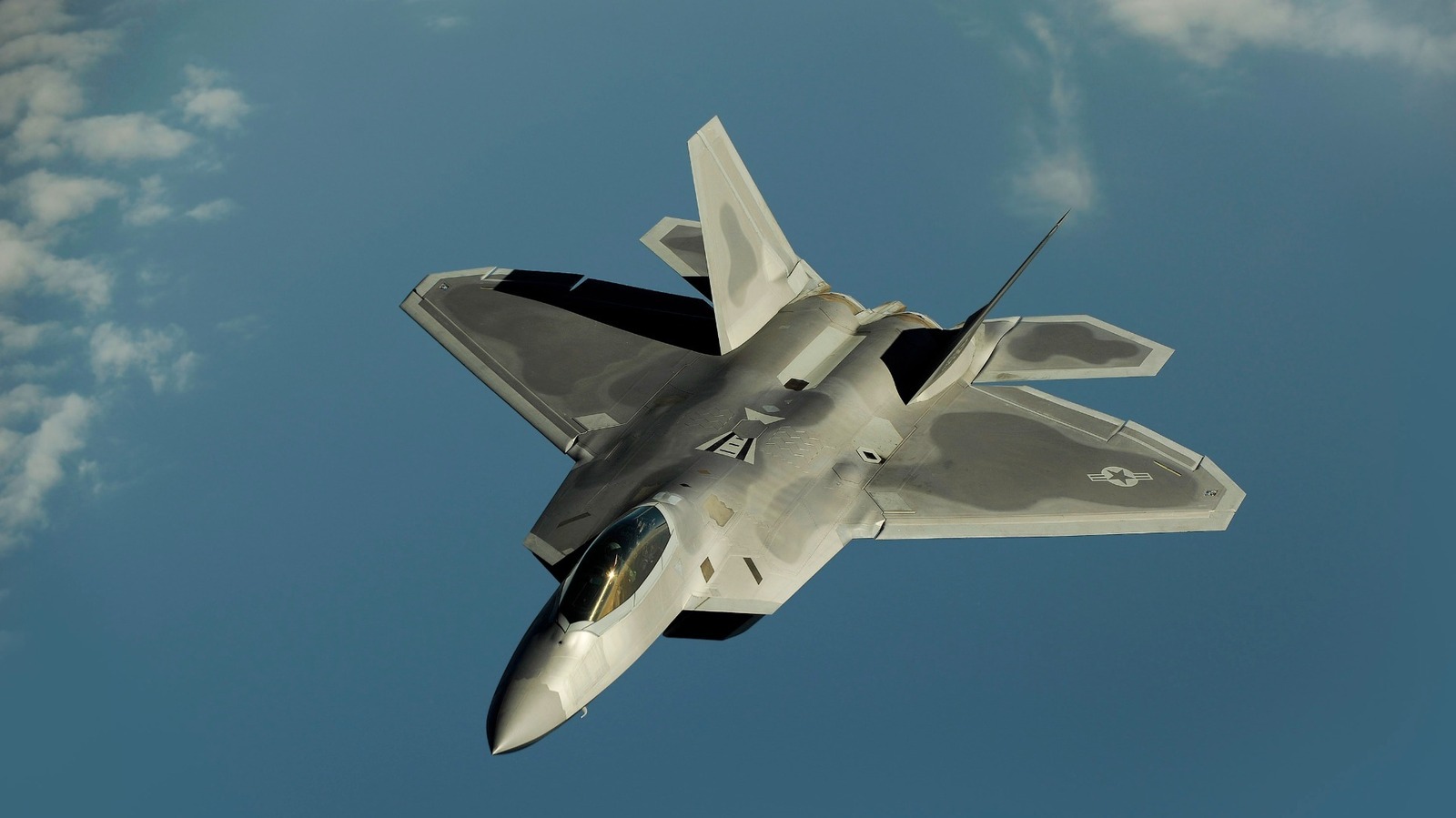

It’s difficult to imagine the grueling hours of training that fighter pilots endure. During these crucial simulations, pilots get a taste of how certain weapons act and perform, helping them develop potentially life-saving maneuvers when they are faced with real-life threats. It can be particularly informative to pit allied aircraft against each other in these kinds of simulations, which can provide some shocking results. That was the case with one famous “battle” in 2009 between an F-22 Raptor and a naval jet known as the EA-18G Growler.
The two aircraft were embroiled in a training test at Nellis Air Force Base on the outskirts of Las Vegas, Nevada. Of course, the United States military doesn’t want its multi-million dollar jets to actually destroy each other. Instead, the military conducts simulations. In one of these drills, “the [Growler] crew managed to obtain a missile lock that counted as a simulated kill against the stealth fighter,” as reported by Indian Defence Review.
The Navy’s Growler is not a conventional fighter jet and it is not designed to take on an aircraft as specialized as the F-22 Raptor in a real-world scenario. Nonetheless, it triumphed using its own advanced suite of electronic warfare tools. After all, the Growler has its own unique set of capabilities.
The defeat of a formidable foe
The F-22 Raptor is such an advanced figher jet that the U.S. banned it from being exported. Paired with stealth systems that make it very difficult to track using radar technology, “the sophisticated F-22 aerodesign, advanced flight controls, thrust vectoring, and high thrust-to-weight ratio provide the capability to outmaneuver all current and projected aircraft,” according to the U.S. Air Force.
Still, it is not without its own set of weaknesses, and other aircraft have been designed with countermeasures to combat it. The EA-18G Growler is one great example. Specifically designed to debilitate or disable enemy detection equipment and other systems, it’s equipped with ALQ-99 low and high band jamming pods as well as more conventional weapons like AIM-9X Sidewinder missiles and AIM-120s. The latter two provide it with air-to-air power, but with the jammers, this aircraft can interrupt signals from across the electro-magnetic spectrum.
Fighter jets that may be opposing this aircraft are heavily reliant on their radar and communications systems, particularly in the sorts of hazardous situations they may be facing in air-to-air combat. As a result, strikes to these systems will leave an aircraft vulnerable, compromising their weapon systems, and thereby giving both the Growler and its allies huge potential advantages. Of course, in this case, the aircraft was “facing” an ally. Nonetheless, its unique talents proved decisive in the encounter, seemingly reducing its capacity to target the Growler while exploiting angles at which it could get a lock itself.
Other instances of victories over the formidable F-22
The F-22 is well-regarded for its combat prowess. This defeat at the hands of a U.S. Navy Growler, simulated as it was, remains a major upset. It would not be the only one, either. In June 2012, U.S. pilots flying the F-22 engaged in protracted training exercises against German forces’ Eurofighter Typhoons. The Typhoon is not a stealth model, nor a dedicated air superiority fighter like the F-22, so it might be expected that it would struggle to hold its own.
However, the Typhoon was also able to target some of the iconic U.S. fighter’s weaknesses. Major Marc Gruene of the German air force explained to Wired that the Typhoon was specifically able to take down the F-22 by closing the gap between the two planes. The moment pilots reached the “merge,” or the point at which two fighters are essentially passing by each other at close range, “the Typhoon doesn’t necessarily have to fear the F-22,” he said. The F-22 has a maximum takeoff weight of 83,500 lbs, compared to 51,809 lbs for the Typhoon. That means the weight differential may offer a maneuverability advantage to the latter at close quarters.
In an earlier case in November 2009, a training exercise at Al Dhafra Air Base, near Abu Dhabi, yielded similarly interesting results. The F-22, while dominant overall, was reportedly “defeated” in other simulations by a French Dassault Rafale and a Mirage 2000. In the years since, the F-22 Raptor’s production has been discontinued. Despite these simulated kills, it remains one of the most formidable fighters in history.

Stephan is the sports journalist for the Maple Grove Report.